1878/6 G25C BG-883 (Regular Strike)
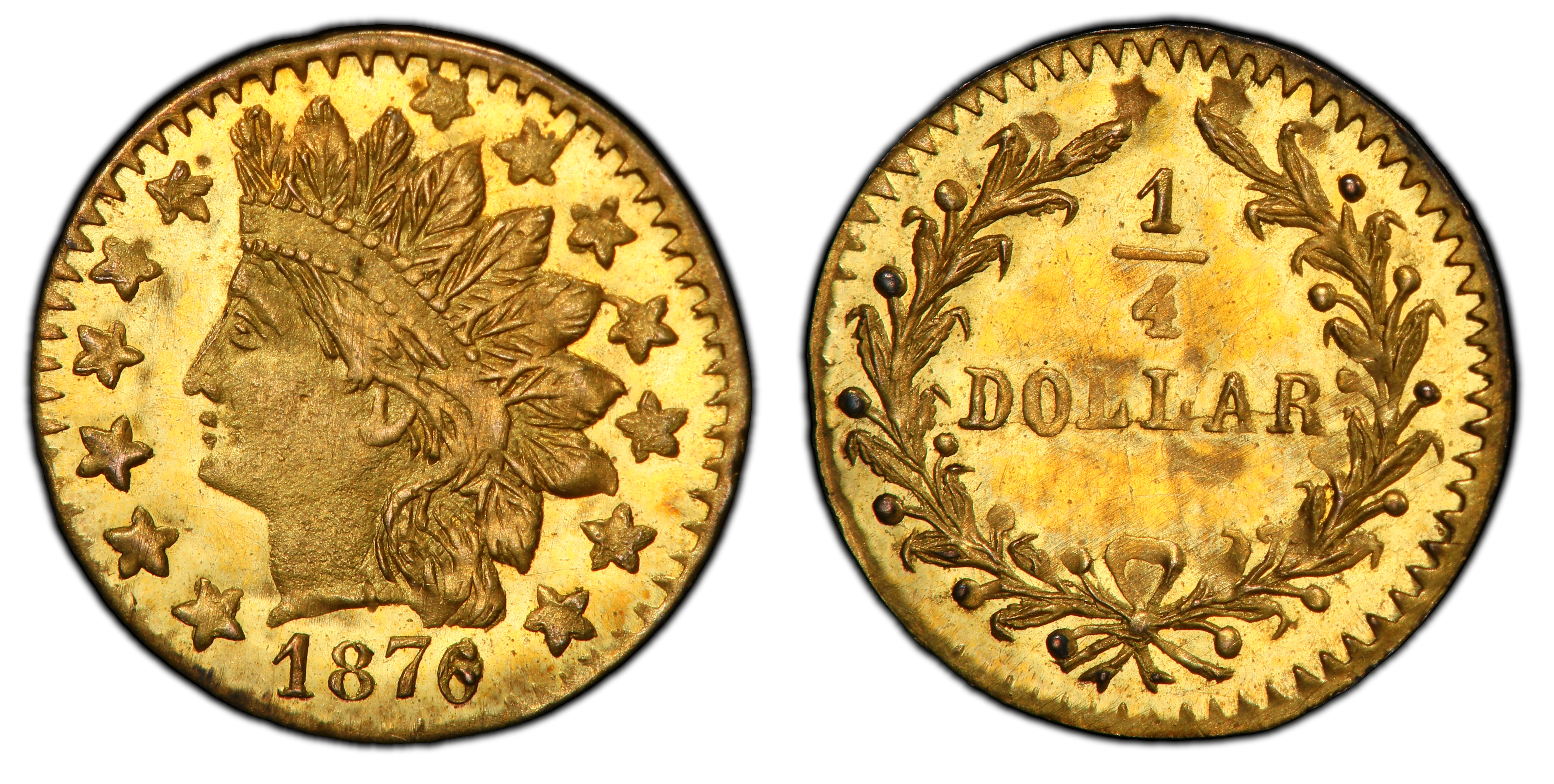
Obverse & Reverse
The 1878/6 25 Cents, cataloged as Breen-Gillio 883, is a quintessential example of a 'Period Two' California Fractional Gold piece. By the late 1870s, the original impetus for this private coinage—a severe shortage of circulating small change during the Gold Rush—had long since vanished. The San Francisco Mint, operating since 1854, was producing ample federal coinage for commerce. However, the romance of the Gold Rush had created a robust tourist and souvenir market. San Francisco jewelers capitalized on this by manufacturing these miniature, denominated gold tokens that evoked the region's pioneer heritage. The Coinage Act of 1864 had explicitly outlawed private coinage, but enforcement by the Secret Service was notoriously lax until a crackdown in 1883. This legal gray area allowed for a prolific output of such 'jeweler's issues' throughout the 1870s. These pieces were not intended to, and did not, serve as money. Their intrinsic value was significantly less than their face value, a common trait for Period Two issues which were lighter and often of a lower fineness than their Period One predecessors. Instead, they were sold as keepsakes, charms for bracelets, or curiosities for collectors back East. The 1878/6 overdate is a fascinating production detail, indicating the re-use of an older 1876 die, likely for economy. This specific variety shares its reverse die with BG-882, an 1876-dated issue, and the Breen-Gillio reference notes this die as being 'shattered within wreath,' providing a key diagnostic feature. The existence of these pieces speaks to a mature post-Gold Rush economy in San Francisco, where local artisans could profitably manufacture and market nostalgic symbols of the city's recent, tumultuous, and golden past.
Associated EventPost-Gold Rush California Tourism & Commerce
Reason For MintingTo serve a thriving souvenir and collector market by providing nostalgic mementos of the California Gold Rush.
Minter HistoryThe specific minter of BG-883 is unknown, a common circumstance for many 'Period Two' California Fractional Gold pieces. Production is attributed to the skilled community of manufacturing jewelers active in San Francisco in the 1870s. Firms like Robert B. Gray & Co. and the Levison Brothers (operating as the California Jewelry Co.) are known to have produced similar items. These artisans possessed the die-sinking and striking capabilities necessary to create such intricate miniature coins. They operated in a competitive market, producing a wide variety of designs, often mimicking federal coinage like the Indian Head motif to enhance their appeal. These pieces were marketed directly to tourists and locals as jewelry items and souvenirs, representing a distinct and final phase of private gold minting in the United States before federal enforcement ended the practice.
Historical SignificanceThe BG-883 represents the final evolution of private California gold coinage, shifting from a necessary medium of exchange in the 1850s to a commercial souvenir product by the 1870s. It stands as a tangible artifact of California's burgeoning tourism industry and the romantic mythology that had already grown around the Gold Rush. Numismatically, it is an important example of a 'jeweler's issue,' struck in a legally ambiguous period, and the 1878/6 overdate offers a glimpse into the pragmatic die-recutting practices of its anonymous manufacturer.
Not Applicable, Breen-Gillio BG-883
Denomination25 Cents
Minting Period1878
Assayer/MinterUnknown San Francisco Jeweler
Geographic OriginSan Francisco, California
Obverse DescriptionA well-defined portrait of a Native American princess facing left, wearing a feathered headdress. The portrait is encircled by 13 stars. The date, showing a clear 8 punched over a 6, is positioned below the bust.
Obverse Inscription1878/6
Reverse DescriptionThe denomination '1/4 DOLLAR' is displayed in two lines within a delicate, intricate wreath composed of leaves and berries. The wreath is open at the top.
Reverse Inscription1/4 DOLLAR
CompositionGold
Stated Fineness Actual FinenessVariable, typical for Period Two issues, generally between 14k and 21k.
Weight0.38 grams
Diameter10.40 mm
EdgePlain
Unknown
Survival Estimate75-125
Rarity ScaleR-4+
BG-883 is highly sought after for its clear and attractive 1878/6 overdate, its connection to the popular Indian Head motif, and its status as a quintessential 'jeweler's issue' from the romantic post-Gold Rush era. Its defined rarity makes it a challenging but achievable goal for specialists.
Key VarietiesThe primary variety is the 1878/6 overdate business strike. Prooflike (PL) examples are designated by grading services and command a significant premium. The key die marriage diagnostic is the reverse, which is shared with BG-882 (dated 1876). This reverse die is known for being 'shattered,' exhibiting numerous fine die cracks within the wreath, a feature that helps authenticate genuine examples. No later-date restrikes or special collector issues are known.
Authentication TipsGenuine examples must have a denominated reverse ('1/4 DOLLAR'); pieces with bears or non-denominated markings are modern replicas. The overdate should be clearly visible, with the top loop of the underlying 6 evident within the upper loop of the 8. Look for faint, spidery die cracks on the reverse within the wreath, characteristic of this known 'shattered' die. The strike on genuine pieces can be uneven, especially at the periphery, while modern fakes are often unnaturally sharp and uniform. The fabric should appear thin and lightweight, consistent with genuine fractional gold.
Shopping ConsiderationsA premium quality example for its grade will exhibit a sharp strike on the central devices, particularly on the details of the headdress feathers and the lettering of 'DOLLAR'. Look for original, undisturbed luster, which is often satiny or Prooflike. The 1878/6 overdate should be bold and unambiguous. Toning can range from a light yellow-gold to a deeper reddish-orange hue; attractive, original color is highly desirable. Avoid examples that have been harshly cleaned, which strips the original skin and imparts a dull or hairlined appearance. Also, inspect carefully for evidence of having been mounted in jewelry, such as rim damage, solder marks, or smoothing.
A coin's grade is its condition, rated on a 1-70 scale. For rare coins, this is the most critical factor in determining value, as a tiny difference in preservation can mean a huge difference in price.
Relevant Grade TypesAll original examples of BG-883 are business strikes, produced for sale as souvenirs rather than circulation. They are found in both Circulated (1-58) and, more commonly, Mint State (MS, 60-70) grades due to their nature as collectibles. No true Proofs were struck during the original period of issue. The term 'Prooflike' (PL) is a special designation applied by grading services to business strikes that exhibit highly reflective, mirror-like fields, a desirable characteristic for this issue.
Mint State CharacteristicsUncirculated examples are defined by their luster. A typical BG-883 has a soft, satiny luster, though many exhibit Prooflike fields due to being struck from polished dies. Strike quality varies; the central Indian portrait is usually sharp, but weakness can be present on the peripheral stars. Contact marks are common due to the softness of the gold and their handling as souvenirs, with the cheek and fields being the most susceptible areas.
Circulated Wear PatternsThough not intended for heavy circulation, wear on circulated examples first appears on the highest points of the design. Look for flattening on the cheek of the Indian princess, the eyebrow, and the topmost feathers of the headdress. On the reverse, the highest points of the wreath's leaves and the letters of 'DOLLAR' will show initial friction and loss of detail. In lower grades, the date and stars will become faint.
Key Factors For ValueFor the BG-883, value is driven by several key factors. Firstly, the grade is paramount. Secondly, the quality of the surfaces is critical; an example with minimal marks and original, uncleaned 'skin' will always be prized over a cleaned or abraded piece. Thirdly, the strength and clarity of the 1878/6 overdate adds a significant premium. Finally, eye appeal, which encompasses luster (with a premium for Prooflike examples), attractive original toning, and a sharp strike, is a major value determinant. A CAC sticker, indicating premium quality for the grade, adds a further substantial premium for this desirable variety.
PCGS Price Guide
| Grade | Price | Population |
|---|---|---|
| 61 | $350.00 | 1 |
| 62 | $400.00 | 3 |
| 62+ | $450.00 | N/A |
| 63 | $525.00 | 21 |
| 63+ | $600.00 | N/A |
| 64 | $775.00 | 31 |
| 64+ | $875.00 | N/A |
| 65 | $1,250.00 | 3 |
| 66 | N/A | N/A |