1870 G50C BG-922 (Regular Strike)
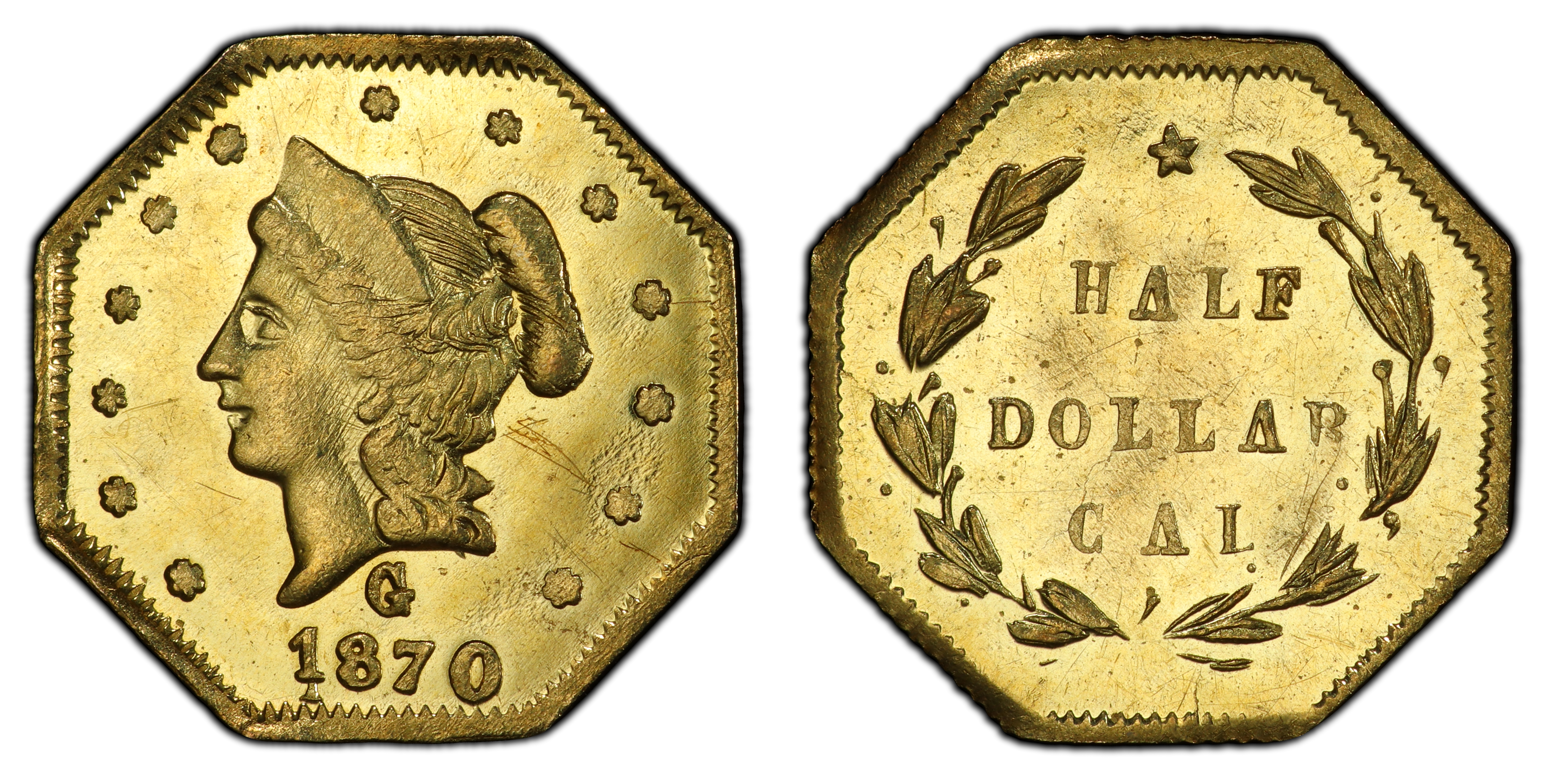
Obverse & Reverse
The 1870 Octagonal 50 Cent piece, cataloged as Breen-Gillio 922, belongs to the second great era of California Fractional Gold, known as 'Period Two' or the 'Jewelers' Issues' (1858-1882). Unlike their 'Period One' predecessors which were struck to alleviate a critical shortage of small change during the initial Gold Rush frenzy, these later issues served a different purpose. By 1870, the San Francisco Mint was in full operation, producing ample quantities of official United States coinage and rendering private issues for circulation unnecessary. Instead, these diminutive gold pieces were created to satisfy a burgeoning tourist and souvenir market. They were tangible mementos of the romanticized Gold Rush, easily mailed back East or carried as pocket pieces and watch fobs. The legal environment for these pieces was ambiguous. The Private Coinage Act of 1864 had explicitly outlawed the striking of private coins, yet enforcement was lax for over a decade. The makers of these souvenir tokens operated in a grey area, continuing production by ensuring the pieces were denominated (e.g., '50 CENTS' or '1/2 DOLLAR'), thus mimicking coinage without being intended for widespread commerce. Production of fractional gold actually increased in the 1870s, a testament to its popularity as a novelty. The makers were typically anonymous jewelers and engravers in San Francisco, who hand-cut dies and struck the pieces with varying levels of quality. This cottage industry finally came to a halt in 1883 when the U.S. Secret Service, under Chief James J. Brooks, determined they posed a risk of fraud and began actively suppressing their manufacture, ending a unique 30-year chapter in American numismatics.
Associated EventCalifornia Gold Rush Aftermath & Souvenir Market
Reason For MintingPrimarily struck as souvenirs and novelty items for the tourist trade, capitalizing on the romanticism of the Gold Rush.
Minter HistoryThe minters of most Period Two California Fractional Gold pieces, including BG-922, are unknown. They are believed to be various jewelers and artisans working in San Francisco who saw a commercial opportunity in creating gold souvenirs. Unlike the prominent assayers of the initial Gold Rush, these makers did not typically sign their work, and records of their operations are non-existent. Their legacy is the wide variety of charming and sometimes crude dies they produced.
Historical SignificanceThe BG-922 represents the transition of California Fractional Gold from a necessary medium of exchange to a popular collectible and souvenir. It is a physical artifact of the post-Gold Rush California economy and the national fascination with the West. The continued production in defiance of the 1864 Act highlights a period of limited federal oversight and the persistence of local economic customs.
BG-922
Denomination50 Cents
Minting Period1870
Assayer/MinterUnknown San Francisco Jeweler
Geographic OriginSan Francisco, California
Obverse DescriptionA Liberty Head facing left, similar in style to contemporary U.S. gold coinage but often of cruder execution. The portrait is surrounded by thirteen six-pointed stars arranged in a circle near the octagonal border.
Obverse InscriptionLIBERTY (on coronet)
Reverse DescriptionThe denomination '1/2' is centered, with 'DOLLAR' below it, all enclosed within a continuous, closed wreath of leaves and berries. The date '1870' is positioned below the wreath's bow.
Reverse Inscription1/2 DOLLAR 1870
CompositionGold
Stated FinenessNot stated on the coin.
Actual FinenessVaries, but typically debased and lower than official U.S. coinage, often in the .500 to .750 range.
Weight0.25 grams
Diameter11.00 mm
EdgePlain
Unknown, as with most Period Two issues.
Survival Estimate201-500
Rarity ScaleR-3
BG-922 is one of the most relatively 'common' and accessible varieties of California Fractional Gold, making it an ideal entry point and a classic type coin for collectors. Its appeal lies in its direct connection to the Gold Rush era, octagonal shape, and affordability compared to rarer issues. High-grade examples are plentiful, allowing collectors to acquire a beautiful, mint-state piece of this fascinating series.
Key VarietiesThere are no major recognized varieties, patterns, or special collector restrikes for the BG-922 issue from the original minting period. All known examples are considered regular business strikes, albeit intended for the souvenir market.
Authentication TipsAuthentic Period Two fractionals are very thin and lightweight. Most counterfeits and modern replicas are thicker, heavier, and often have a soapy or cast-like appearance. Genuine pieces must be denominated (e.g., 'DOLLAR' or 'CENTS'); modern fakes often say 'CAL GOLD' and feature a bear on the reverse, a design never used on genuine circulating or souvenir issues from 1852-1882. Look for sharp, albeit sometimes crude, die work. Weak or missing details are common, but the overall strike should appear crisp, not soft.
Shopping ConsiderationsA premium quality BG-922 will exhibit a sharp strike with full details on Liberty's coronet and the wreath leaves. Look for examples with bright, original mint luster, often described as 'proof-like' (PL) or 'deep proof-like' (DPL) by grading services. These flashy surfaces are highly desirable and command a significant premium. Common problems include improper cleaning, which dulls the luster and leaves hairlines, and previous use in jewelry, resulting in solder marks, rim damage, or holes. Given their high survival rate in uncirculated condition, collectors should be patient and seek out a problem-free, lustrous specimen.
A coin's grade is its condition, rated on a 1-70 scale. For rare coins, this is the most critical factor in determining value, as a tiny difference in preservation can mean a huge difference in price.
Relevant Grade TypesOriginal issues were business strikes intended for the souvenir market, not circulation. They are found in Circulated grades (AU-50 to AU-58 are most common for those that were handled) and, more frequently, in Mint State (MS, 60-70). No true Proofs were struck during the original period. The terms 'Proof-like' (PL) and 'Deep Proof-like' (DPL) are surface designations applied to high-grade business strikes that exhibit mirrored fields, a common and desirable characteristic for this specific issue.
Mint State CharacteristicsUncirculated BG-922 specimens are characterized by their luster, which ranges from satiny to intensely proof-like. Strike quality varies; some are sharply detailed while others show minor weakness in the centers. Due to the manual striking process, planchet quality can be inconsistent, sometimes showing minor striations or adjustment marks made prior to the strike. Bag marks are less common than on larger coins, but small, detracting contact marks can still affect the grade.
Circulated Wear PatternsFor the few examples that show wear, it first appears on the highest points: Liberty's cheek, the hair above the eye, and the coronet. On the reverse, the highest points of the wreath's bow and leaves will show the first signs of friction, becoming flattened and losing detail. In lower circulated grades, the stars and legends would begin to merge with the fields.
Key Factors For ValueFor the BG-922, the primary value driver is the quality and intensity of the surface luster. A coin with deep, flashy, mirrored fields (designated DPL) is worth significantly more than a standard Mint State coin. Sharpness of strike, problem-free surfaces free of cleaning or damage, and original, attractive 'green-gold' or reddish toning contribute heavily to eye appeal and value. A CAC sticker, indicating premium quality for the grade, adds a strong premium, especially for MS-64 and higher grades.
PCGS Price Guide
| Grade | Price | Population |
|---|---|---|
| 40 | $230.00 | 1 |
| 45 | $240.00 | 2 |
| 45+ | $260.00 | N/A |
| 50 | $275.00 | 7 |
| 50+ | $300.00 | N/A |
| 53 | $325.00 | 2 |
| 53+ | $340.00 | N/A |
| 55 | $365.00 | 15 |
| 55+ | $380.00 | N/A |
| 58 | $400.00 | 27 |
| 58+ | $425.00 | N/A |
| 60 | $450.00 | 4 |
| 61 | $475.00 | 7 |
| 62 | $500.00 | 38 |
| 62+ | $550.00 | N/A |
| 63 | $600.00 | 19 |
| 63+ | $650.00 | 1 |
| 64 | $750.00 | 11 |
| 64+ | $1,000.00 | N/A |
| 65 | $1,500.00 | 1 |