1880/76 G25C BG-885, PL (Regular Strike)
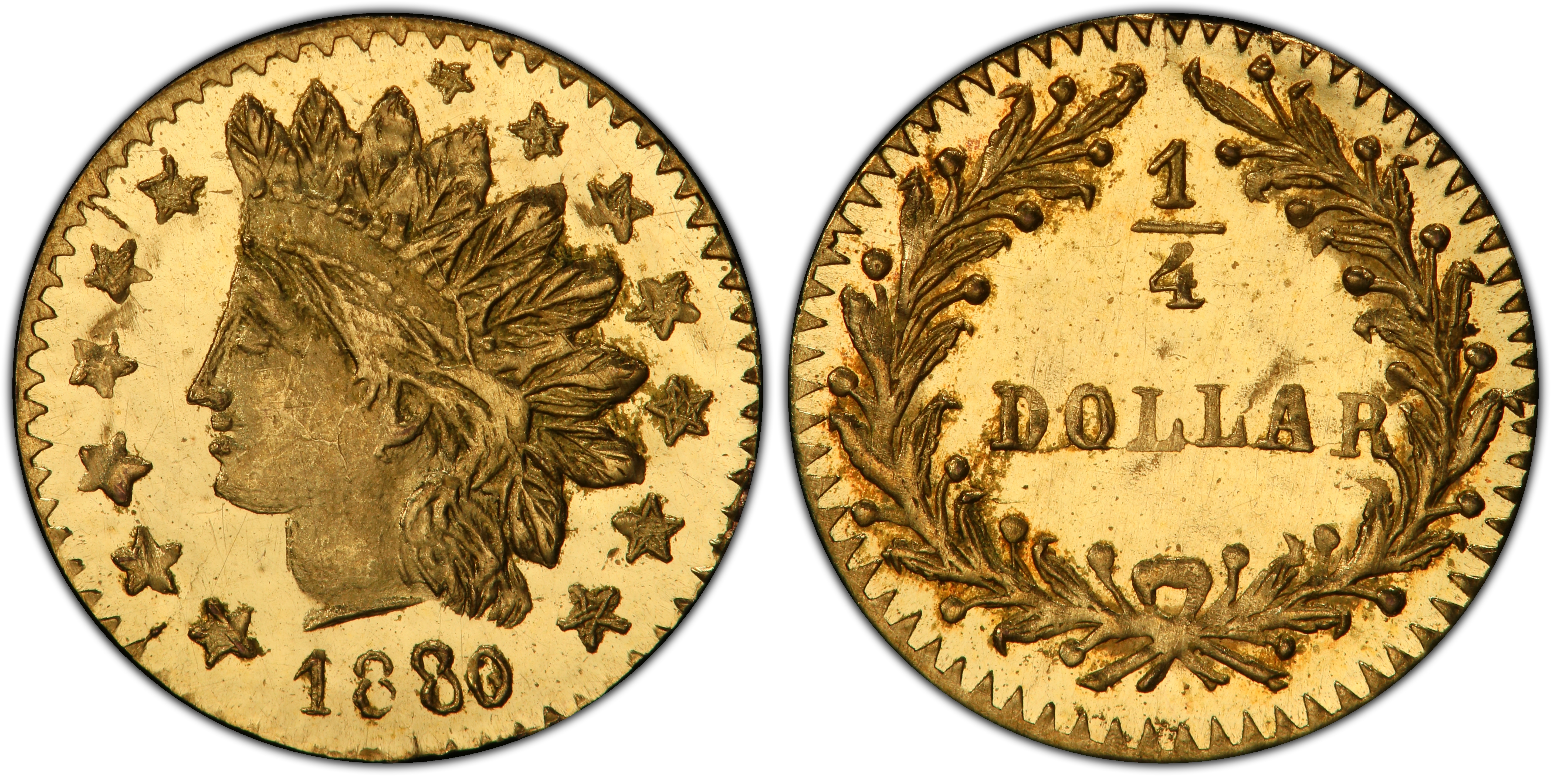
Obverse & Reverse
The 1880/76 25 Cents, cataloged as Breen-Gillio 885 (BG-885), represents the final chapter in the fascinating story of California Fractional Gold. These small-denomination gold pieces arose from a chronic shortage of circulating coinage in California following the 1848 Gold Rush. While the initial period (1852-1857) saw a genuine commercial need for such coins, by the 1870s and 1880s, their production had shifted almost entirely to serve the numismatic and jewelry markets. The Coinage Act of 1864 had explicitly forbidden the private issuance of gold coins, pushing later production into a legal gray area. Assayers and jewelers like Robert B. Gray continued to strike these pieces, often backdating them to pre-1864 years to circumvent the law. The BG-885 is a prime example of this practice, employing a die created in 1876 that was subsequently altered for use in 1880, resulting in a clear '80' punched over a '76'. These later 'Period Two' pieces were not intended for rugged daily commerce but were sold as souvenirs and keepsakes to a public fascinated by the romance of the Gold Rush era. They were meticulously crafted, often with better strike quality and more intricate designs than their utilitarian predecessors. Their existence speaks to a burgeoning collector base in the late 19th century and the clever marketing of private minters who capitalized on California's golden identity long after the initial fever had subsided. The use of an overdated die is particularly compelling, as it provides tangible evidence of the die-sinking and production economies employed by these small-scale, semi-clandestine operations.
Associated EventPost-Gold Rush Numismatic & Souvenir Trade
Reason For MintingPrimarily created as numismatic curiosities and souvenir items for collectors and tourists, capitalizing on the legacy of the California Gold Rush.
Minter HistoryRobert B. Gray & Co. was a prominent San Francisco jewelry and die-sinking firm active in the latter half of the 19th century. Unlike the pioneer assayers of the 1850s who fulfilled a critical monetary need, Gray's operation catered more to the production of medals, tokens, and, notably, California Fractional Gold pieces for the collector and souvenir market. They were known for the high quality of their die work and striking, producing many of the pieces now classified as 'Period Two' (1872-1882) fractionals. Their use of backdating and overdating dies is a characteristic feature of their business, reflecting the legal ambiguities of private coinage after 1864.
Historical SignificanceThis coin is significant as an artifact of the late-period souvenir phase of California Fractional Gold production. It demonstrates the transition of these pieces from quasi-money to pure numismatic items and provides a clear, physical example of the manufacturing shortcuts (die reuse and overdating) common among private minters of the era operating under legal constraints.
N/A
Denomination25 Cents (Quarter Dollar)
Minting Period1880
Assayer/MinterRobert B. Gray & Co.
Geographic OriginSan Francisco, California
Obverse DescriptionA depiction of a Native American princess, commonly referred to as an 'Indian Head', facing left. She wears a feathered headdress, with the letters of LIBERTY incised on the band. The portrait is surrounded by 13 six-pointed stars.
Obverse InscriptionLIBERTY
Reverse DescriptionThe denomination '1/4 DOLLAR' is centered within a continuous wreath of leaves and berries tied with a bow at the bottom. The date, with the clear 1880 over 1876 overdate, is positioned below the bow. The 'C' mintmark for California is typically found below the denomination within the wreath.
Reverse Inscription1/4 DOLLAR CAL. 1880
CompositionGold
Stated Fineness Actual FinenessTypically varied, often between .500 and .750 fine (12k-18k gold).
Weight0.24 grams
Diameter9.80 mm
EdgePlain
Unknown
Survival Estimate50-75
Rarity ScaleR-5
The BG-885 is highly sought after due to its dramatic and clearly visible 1880/76 overdate, a visually appealing feature that tells a story of die reuse. Its connection to the final years of fractional gold production and the attractive Indian Head design add to its desirability among specialists.
Key VarietiesThe primary variety is the 1880/76 overdate itself. Within the BG-885 catalog, specimens are noted for their strike quality and surface characteristics. While no major intentional varieties from 1880 exist, collectors differentiate based on die states (early, crisp strikes vs. later, more worn strikes). The 'PL' (Prooflike) designator refers to regular business strikes made with freshly polished dies, resulting in mirrored fields and frosted devices, and is not a true Proof striking. No known period Proofs or later restrikes exist for this specific variety.
Authentication TipsAuthentic examples exhibit sharp, well-defined details, particularly in the headdress feathers and wreath leaves, consistent with the work of Robert Gray. The overdate should be clear, with the underlying '76' visible beneath the '80'. The weight and diameter should conform to known standards for the type. Beware of modern replicas, which often have a mushy or soapy appearance, incorrect weight, or tool marks around the letters and date from modern engraving techniques. Many fakes are cast rather than struck, leaving behind pitting or a granular surface texture.
Shopping ConsiderationsA premium quality example for its grade will display a bold strike, especially on the word LIBERTY on the headdress and the fine details of the wreath. For PL-designated coins, look for deep, clean mirrors in the fields with a distinct cameo contrast on the devices. Avoid examples that have been harshly cleaned, which will show parallel hairlines and impaired luster. Check for evidence of jewelry mounting, such as rim damage or solder marks, which was a common fate for these attractive pieces. Original, unadulterated surfaces command a significant premium.
A coin's grade is its condition, rated on a 1-70 scale. For rare coins, this is the most critical factor in determining value, as a tiny difference in preservation can mean a huge difference in price.
Relevant Grade TypesAll original BG-885 coins are business strikes intended for the collector/souvenir market, and are found in Circulated (1-58) and Mint State (MS, 60-70) grades. The 'PL' or Prooflike designation is a surface characteristic of a business strike and not a separate method of manufacture. True Proof (PR/PF) strikings were not produced for this issue during the original period of minting.
Mint State CharacteristicsUncirculated examples of BG-885 are characterized by their typically sharp strikes, a hallmark of Robert Gray's later work. The luster is often vibrant and frosty. Prooflike (PL) specimens from polished dies will have reflective, mirror-like fields. Due to the small size, even minor contact marks can be distracting, so 'clean' surfaces with minimal chatter are highly desirable. The highest points, such as the cheek of the Indian princess and the tips of the wreath leaves, are the most susceptible to friction and contact.
Circulated Wear PatternsOn circulated examples, wear first appears on the high points of the design. Look for flattening on the cheek, the feathers in the headdress, and the brow of the Indian princess on the obverse. On the reverse, the highest points of the wreath leaves and the bow will show initial wear and loss of detail. In lower grades (VF and below), the word LIBERTY on the headdress band becomes faint and eventually illegible.
Key Factors For ValueThe primary value drivers for an BG-885 are grade and surface quality. A high-grade Mint State coin (e.g., MS-64 or MS-65) is worth multiples of a circulated example. The strength and clarity of the overdate are critical; a bold, easily discernible 80/76 commands a premium. For PL coins, the depth of the mirrored fields and the degree of cameo contrast are paramount. Original, uncleaned surfaces with attractive golden toning are highly prized. A CAC sticker, verifying the quality for the assigned grade, adds a significant premium, as it confirms superior eye appeal and originality.
PCGS Price Guide
| Grade | Price | Population |
|---|---|---|
| 63 | $600.00 | 2 |
| 63+ | $700.00 | N/A |
| 64 | $850.00 | N/A |
| 64+ | $975.00 | N/A |
| 65 | $1,150.00 | 1 |
| 65+ | $1,450.00 | N/A |
| 66 | $2,000.00 | 1 |