1859 G50C BG-1004 (Regular Strike)
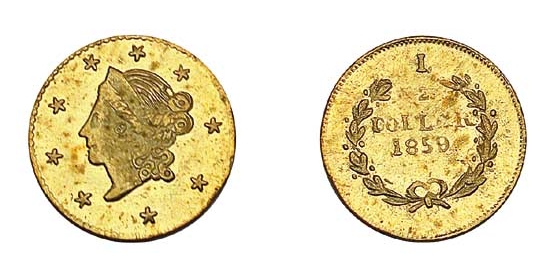
Obverse & Reverse
The 1859 BG-1004 50 Cent piece emerges from the second period of California Fractional Gold production (1858-1882), a fascinating era that saw these miniature gold coins transition from necessities of commerce to popular souvenirs. By 1859, a decade after the initial Gold Rush, the acute shortage of small denomination coinage that prompted the first issues (Period One, 1852-1857) had been largely alleviated by the output of the United States Mint in San Francisco, which opened in 1854. However, the allure of California gold remained potent, and enterprising local jewelers recognized a new market: producing small, denominated gold tokens for tourists, merchants, and citizens who desired a tangible memento of the Golden State's primary export. These 'jeweler's issues' were not intended to fill a monetary void in the same way as their predecessors. Instead, they served as keepsakes, often used in jewelry or carried as pocket pieces. The BG-1004 variety, like its contemporaries, was struck anonymously. The identity of its creator is lost to history, a common characteristic of Period Two issues, where makers rarely applied identifiable hallmarks. These pieces were typically produced using the 'hammer method,' a crude but effective process where dies were struck by hand with a sledgehammer, leading to considerable variation in strike quality and planchet regularity. Despite their unofficial status and often having an intrinsic gold value below their face value, they were technically legal until the Private Coinage Act of April 22, 1864, though enforcement against these small pieces was lax until the early 1880s. The BG-1004 is a quintessential example of this period's output—a small, attractive, and now very rare artifact that captures the entrepreneurial spirit of post-Gold Rush San Francisco and the enduring mystique of its gold.
Associated EventCalifornia Gold Rush Aftermath
Reason For MintingPrimarily created as souvenirs and private tokens for commerce and jewelry, capitalizing on the continued fascination with California gold after the initial rush.
Minter HistoryThe minter of BG-1004 is unknown, a common trait for the 'suppressed jewelers' issues' of Period Two (1858-1882). Unlike some earlier minters who hallmarked their work, the producers of this era were typically anonymous San Francisco jewelers who created these small gold pieces as commercial novelties rather than a circulating medium of exchange. Their operations were small-scale, utilizing hand-operated presses or simple hammer-striking techniques to meet local demand for gold souvenirs.
Historical SignificanceThe BG-1004 represents the transition of California Fractional Gold from a necessary form of local currency to a popular souvenir item. It is a tangible link to the burgeoning tourism and commercial trade of late 1850s San Francisco, reflecting a period when the romanticism of the Gold Rush was commodified for a wider audience. Its high rarity today underscores the ephemeral nature of these pieces, most of which were lost or melted over time.
Not Applicable
Denomination50 Cents
Minting Period1859
Assayer/MinterAnonymous Jeweler
Geographic OriginSan Francisco, California
Obverse DescriptionA fairly crude rendering of a Liberty Head, facing left. The portrait is surrounded by thirteen stars, typically unevenly spaced and weak in areas. The date, 1859, appears below the bust truncation. The overall design mimics contemporary U.S. federal gold coinage but on a miniature scale.
Obverse Inscription1859
Reverse DescriptionThe reverse features the denomination '50 CENTS' within a wreath. The wreath is composed of two branches tied with a bow at the bottom. The details of the leaves and berries are often soft due to the striking process.
Reverse Inscription50 CENTS
CompositionGold
Stated Fineness Actual FinenessFineness varies widely among Period Two issues, typically ranging from .500 to .800 fine gold, and often contains silver or copper alloys.
Weight0.25 grams
Diameter10.00 mm
EdgePlain
Unknown, but certainly very small.
Survival Estimate13-30 coins known (Low R-6)
Rarity ScaleLow R-6
The BG-1004 is highly sought after due to its extreme rarity (Low R-6) and its status as an anonymous Period Two issue. Collectors of California Fractional Gold appreciate its historical context as a 'jeweler's issue' and the challenge of acquiring such a scarce variety. Its crude, miniature charm is a key part of its appeal.
Key VarietiesThe BG-1004 is itself a single, distinct die variety. No major sub-varieties from the original minting period are known or cataloged. No special collector issues, patterns, or restrikes are known to exist for this specific variety. The primary variations among surviving examples relate to strike quality and planchet characteristics inherent in the hand-striking process.
Authentication TipsGenuine BG-1004 examples are struck in gold, not brass or gilt base metal. Look for the specific die characteristics of this variety, including the positioning of the stars relative to the Liberty head and the particular style of the numerals in the date and reverse inscription. Counterfeits and modern replicas often have a mushy, cast-like appearance or incorrect letter/numeral punches. Genuine pieces may have planchet striations or adjustment marks, and often exhibit a slightly irregular shape due to the crude hammer-striking method. Consulting high-resolution images of certified examples is crucial for die comparison.
Shopping ConsiderationsA premium quality example for this issue is defined by a sharp strike, particularly on Liberty's portrait and the reverse legend. Look for coins that retain some original mint luster, often described as 'prooflike' or 'flashy' for this variety. Given the rarity, even lightly circulated examples in AU grades are highly desirable. Avoid specimens that have been harshly cleaned, which will appear unnaturally bright with hairline scratches, or those that show evidence of being used as jewelry (solder marks, excessive rim damage). A strong, centered strike on a relatively round planchet commands a significant premium. A CAC sticker on a certified example would confirm its superior quality for the assigned grade.
A coin's grade is its condition, rated on a 1-70 scale. For rare coins, this is the most critical factor in determining value, as a tiny difference in preservation can mean a huge difference in price.
Relevant Grade TypesOriginal issues of BG-1004 were all business strikes created for private commercial use and as souvenirs. They are found in Circulated grades (AG-3 to AU-58) and, very rarely, in Mint State (MS, 60-70). No proofs were struck during the original period of issue, and no later-date proof restrikes are known to exist for this variety.
Mint State CharacteristicsUncirculated examples of BG-1004 are exceedingly rare. A typical Mint State specimen would exhibit frosty to semi-prooflike luster in the fields. The strike is often uneven, with some weakness expected on the stars or parts of the wreath. Due to the softness of the low-fineness gold and crude manufacturing, even uncirculated pieces will likely display some light planchet marks or handling chatter that occurred at the time of minting. A sharp strike on the central devices (Liberty's hair, '50 CENTS') is a key indicator of quality.
Circulated Wear PatternsWear first appears on the highest points of the design. On the obverse, check for flatness on Liberty's cheek, the hair just above the ear, and the tips of the coronet. On the reverse, the highest points of the wreath's leaves and the bow of the ribbon will show wear first. In lower grades (VG and below), the date and stars will begin to merge with the fields, and the reverse lettering will become faint.
Key Factors For ValueThe primary drivers of value for this variety are rarity and grade. Surface quality is paramount; an example with original, undisturbed skin and luster is far more valuable than one that has been cleaned or polished. Strike sharpness is the next key factor, as a well-centered, bold strike is rare and highly prized. Eye appeal, which is a combination of attractive toning (often a reddish-gold hue), lack of distracting marks, and overall pleasing appearance, significantly influences value. For a rare and esoteric issue like this, certification by PCGS or NGC is standard, and a CAC sticker indicating premium quality for the grade adds a substantial premium.
PCGS Price Guide
| Grade | Price | Population |
|---|---|---|
| 55 | N/A | N/A |
| 58 | $450.00 | 2 |
| 58+ | $480.00 | N/A |
| 60 | $575.00 | N/A |
| 61 | $625.00 | 1 |
| 62 | $700.00 | 4 |
| 62+ | $850.00 | N/A |
| 63 | $1,025.00 | 3 |
| 63+ | $1,350.00 | N/A |
| 64 | $2,250.00 | 4 |