1876 G50C BG-950, PL (Regular Strike)
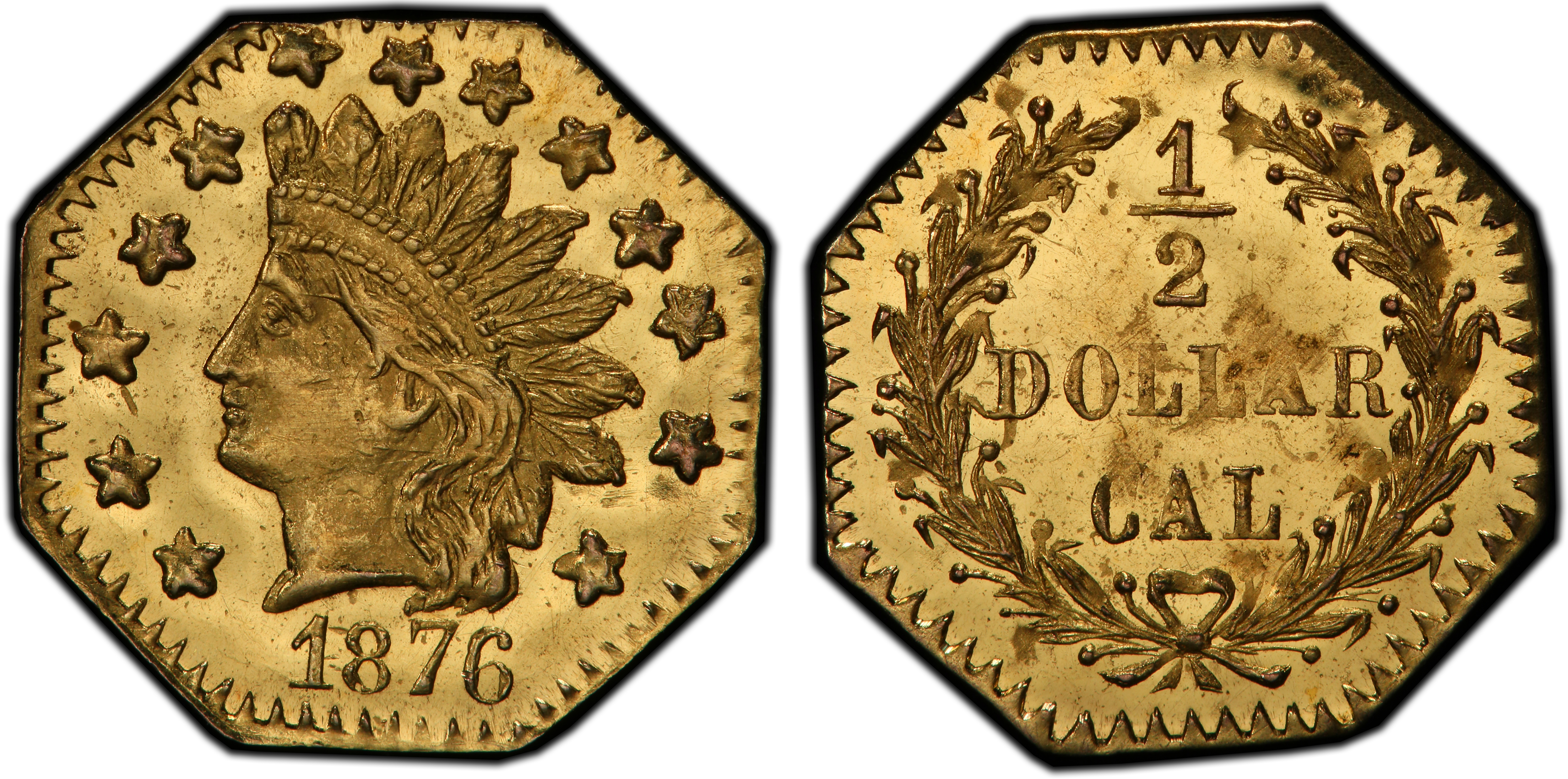
Obverse & Reverse
The 1876 BG-950 50 Cents is a quintessential example of a 'Period Two' California Fractional Gold piece. These small-denomination coins were born out of the chaos and opportunity of the California Gold Rush. The initial influx of over 300,000 people to California created booming economies but also a severe shortage of circulating small change. Gold dust, the primary medium of exchange, was imprecise and inconvenient for everyday transactions. To fill this numismatic void, private jewelers and metallurgists began striking their own coins in 25 cent, 50 cent, and one dollar denominations starting in 1852. These 'Period One' (1852-1857) issues were utilitarian and intended for circulation, supplementing the scant supply of federal coinage. However, by the time the BG-950 was struck in 1876, the landscape had changed dramatically. The San Francisco Mint, opened in 1854, was producing ample federal coinage, eliminating the commercial necessity for private issues. Consequently, 'Period Two' (1858-1882) pieces like this one transitioned from circulating currency to souvenir items. Struck by jewelers primarily in San Francisco, they were marketed to tourists, nostalgic '49ers, and residents as mementos of the Gold Rush excitement. The Coinage Act of 1864 had made private coinage illegal, but the law was not strictly enforced against these small souvenir pieces until a Secret Service crackdown in 1883. Minters of Period Two issues often backdated their coins to pre-1864 dates to circumvent the law, though this 1876-dated piece was struck openly during the Centennial year of the United States, adding to its appeal as a commemorative souvenir. These pieces were intentionally struck with less gold content than their face value, functioning as tokens rather than true coinage, a fact understood and accepted by the purchasing public who valued them for their novelty and connection to the romanticism of the West.
Associated EventCalifornia Gold Rush
Reason For MintingPrimarily struck as a souvenir or keepsake of the California Gold Rush era for tourists and collectors, rather than for circulation.
Minter HistoryThe specific minter of the BG-950 variety is unknown, as is common for many Period Two California Fractional Gold pieces. Production was dominated by a community of San Francisco jewelers, many of French origin, who skillfully engraved dies and struck these miniature gold pieces. Firms like Deriberpe & Nouizillet (DN) and Frontier & Deviercy (FD) are known from their initials on other pieces, but the maker of BG-950 left no identifying mark. These craftsmen operated small-scale minting operations, using hand-operated presses or even the simple 'hammer method' to strike coins, which accounts for the variability in strike quality seen across the series.
Historical SignificanceThe BG-950, as a Period Two issue, represents the commercial evolution and enduring romanticism of the Gold Rush. It signifies the shift from privately-issued coinage as a response to economic necessity to its production as a nostalgic commodity. These pieces are tangible links to the post-Gold Rush economy of San Francisco, where the legacy of the '49ers was already a powerful marketing tool. Numismatically, they are part of a uniquely American series of private coinage that is studied for its vast number of die varieties and the history it reveals about commerce and culture on the American frontier.
N/A
Denomination50 Cents
Minting Period1876
Assayer/MinterUnknown Private Minter
Geographic OriginSan Francisco, California
Obverse DescriptionFeatures a stylized bust of a Native American princess facing left, wearing a feathered headdress. The portrait is encircled by 13 stars, representing the original colonies. The date, 1876, appears below the bust.
Obverse Inscription1876
Reverse DescriptionThe reverse features the denomination '1/2' in the center, surrounded by an ornate wreath of leaves and berries. The words 'CALIFORNIA GOLD' are inscribed within the wreath, above the fraction.
Reverse InscriptionCALIFORNIA GOLD 1/2
CompositionGold
Stated Fineness Actual FinenessPeriod Two issues are known to vary widely, typically ranging from 14 to 22 karats (.583 to .917 fine), and were intentionally underweight for their face value.
EdgePlain
Unknown, but extremely low.
Survival EstimateFewer than 15 known specimens. The combined NGC and PCGS population reports show a total of approximately 9-11 unique coins graded.
Rarity ScaleR-7 (4 to 12 known)
The BG-950 is highly sought after due to its extreme rarity (R-7), its connection to the U.S. Centennial year of 1876, and its octagonal shape, which is emblematic of the Territorial gold series. Its status as a Prooflike (PL) issue adds significant appeal, as the mirrored fields and frosted devices are visually stunning on such a small coin.
Key VarietiesThe BG-950 is itself a distinct die pair variety within the larger series. No major sub-varieties from the original minting period are known. As a 'Period Two' souvenir issue, there were no official restrikes or patterns in the traditional sense. Collectors should be aware of a vast universe of modern replicas and fantasy pieces, which are not considered part of the Breen-Gillio catalog of authentic issues. These modern copies often have different designs (e.g., a bear on the reverse) or lack a denomination.
Authentication TipsAuthentication requires comparison to known genuine examples. Referencing the Breen-Gillio reference work, 'California Pioneer Fractional Gold,' is essential. Key diagnostics include the exact positioning of the date, stars, and lettering. Genuine pieces often exhibit a somewhat crude, hand-finished quality, and may have weak areas in the strike due to the hammer-striking process. Counterfeits are often sharply and uniformly struck, may feel greasy, and can be of incorrect weight or composition. The surfaces of genuine prooflike examples should show reflectivity in the fields, not a modern, polished appearance. Any piece not listed in the Breen-Gillio guide should be treated with extreme caution.
Shopping ConsiderationsA premium quality example of BG-950 is defined by a sharp strike, particularly on the high points of the Indian's headdress and the details of the reverse wreath. Given its prooflike designation, look for deep, clear, and reflective fields with minimal distracting marks. Originality of the surfaces is paramount; avoid examples that have been cleaned, polished, or show evidence of being mounted in jewelry (a common fate for these pieces). A smooth, problem-free surface commands a significant premium. Given the extreme rarity, any certified example is a major acquisition, but one with a CAC sticker would be a pinnacle piece, confirming its quality for the assigned grade.
A coin's grade is its condition, rated on a 1-70 scale. For rare coins, this is the most critical factor in determining value, as a tiny difference in preservation can mean a huge difference in price.
Relevant Grade TypesAll original BG-950 examples are considered business strikes, though many were produced with specially prepared dies to create a mirrored, Prooflike (PL) finish for souvenir sales. They are found in Circulated (1-58) and, more commonly for this souvenir issue, Mint State (MS, 60-70) grades. No true Proofs were struck during the original period. Any coin advertised as a 'Proof' is likely misattributed or a later fantasy piece.
Mint State CharacteristicsUncirculated examples of BG-950 are judged on the quality of their prooflike surfaces. A top-tier specimen will have deeply mirrored fields with strong cameo contrast on the devices. The strike can be inconsistent due to the primitive manufacturing process; a well-centered strike with full detail on the headdress feathers and wreath is highly desirable. Small planchet flaws or striations from the die polishing process are common and should be distinguished from post-strike damage. Bag marks are less common than on larger coins, but tiny, distracting contact marks in the primary fields can significantly impact the grade and eye appeal.
Circulated Wear PatternsAlthough intended as souvenirs, some pieces saw light handling. Wear first appears on the highest points: the cheek and feathers of the Indian princess on the obverse, and the leaves and bow of the wreath on the reverse. In lower grades (e.g., AU), the prooflike fields will be noticeably dulled, and the fine details will begin to merge. On a piece this small, even slight wear can dramatically soften the design.
Key Factors For ValueFor the BG-950, value is driven by three main factors: 1) Rarity: As an R-7 variety, any example is valuable. 2) Grade: The numeric grade is critical, with each point in Mint State adding significant value. 3) Surface Quality and Eye Appeal: A sharply struck coin with deep, clean prooflike fields and attractive original gold color will command a massive premium over a dull, scratched, or cleaned counterpart of the same grade. A CAC sticker for this issue would be a major value-added feature, confirming the coin's quality.
PCGS Price Guide
| Grade | Price | Population |
|---|---|---|
| 63 | $1,750.00 | 1 |
| 63+ | $2,250.00 | N/A |
| 64 | $3,000.00 | 1 |
| 64+ | $4,500.00 | N/A |
| 65 | $7,500.00 | N/A |