1856 G25C BG-228, PL (Regular Strike)
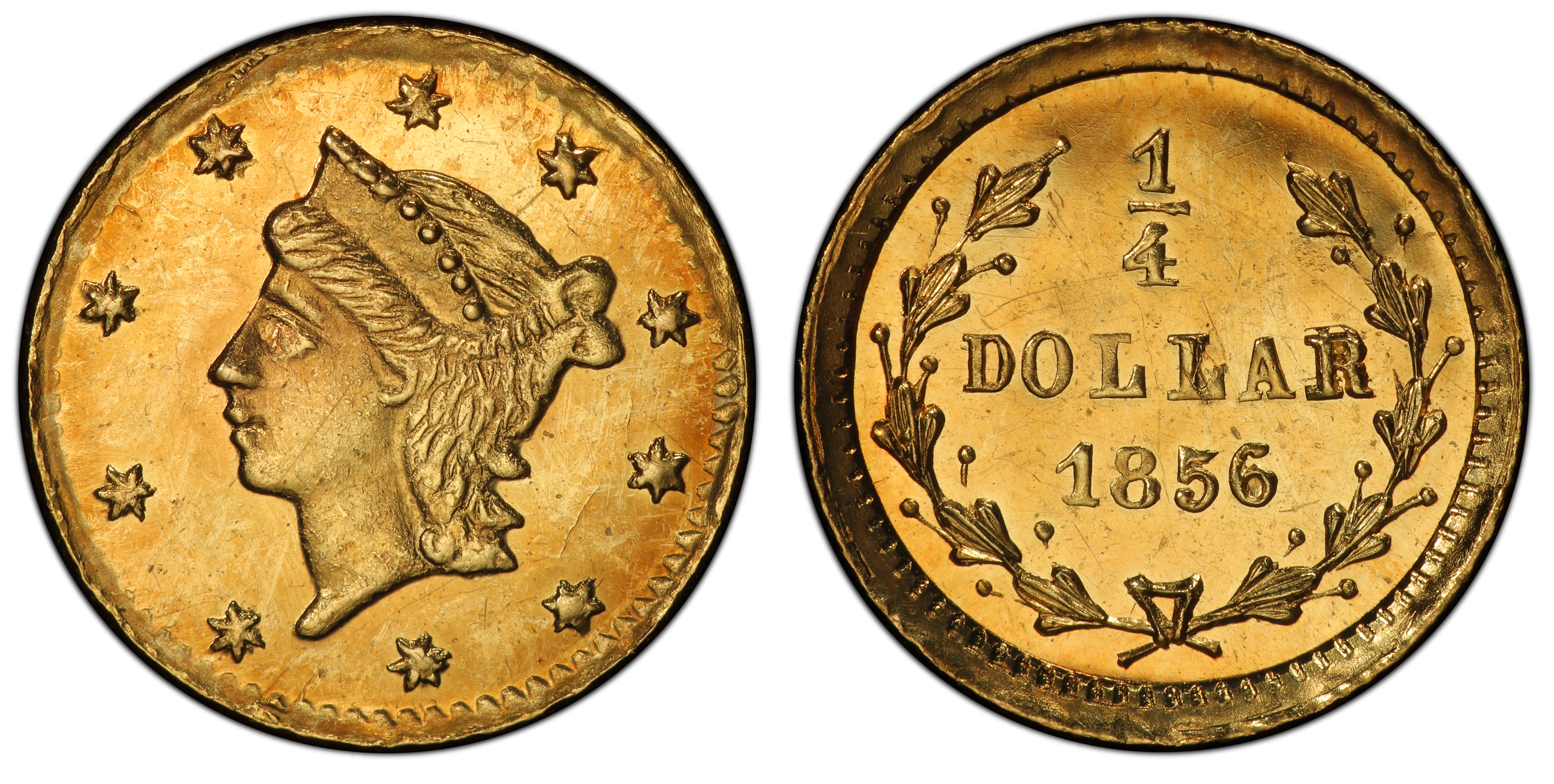
Obverse & Reverse
The 1856 BG-228 Quarter Dollar is a tangible relic from the chaotic and economically volatile zenith of the California Gold Rush. By 1856, San Francisco was a bustling metropolis, yet the lingering effects of the 1-to-1 silver-to-gold price disparity and the immense influx of raw gold dust created a persistent, severe shortage of small-denomination coinage for daily transactions. A 'pinch' of gold dust, notoriously inconsistent, was no longer a viable way to buy a drink or a loaf of bread. Federal efforts to supply the region with sufficient coinage were lagging; the San Francisco Mint, which had opened in 1854, was primarily focused on turning miners' bullion into large-denomination coins, leaving a vacuum in low-value currency. Into this void stepped a number of private minters, many of whom were enterprising French-immigrant jewelers and craftsmen. These artisans, whose identities are now mostly lost to history, began striking their own fractional-denomination gold coins. These 'Period One' (1852-1856) issues were initially created as genuine currency substitutes, intended to facilitate commerce. They were struck by hand, using a hammer and anvil method, which resulted in coins of varying strike quality and often inconsistent weight and fineness. The BG-228, struck in the final year of this initial period, represents a refinement of the earlier, cruder attempts. Its design, particularly the stylized eagle on the reverse, showcases a higher level of artistic skill than many of its predecessors. Despite their utility, these lightweight private coins were met with mixed reception. While merchants and citizens used them out of necessity, their intrinsic value was often less than their face value, leading to eventual distrust. The increasing output from the federal mint in San Francisco soon rendered them obsolete for circulatory purposes. By the time the BG-228 was minted, the transition from transactional necessity to souvenir had likely begun, with many pieces being purchased as curiosities and mementos of the Gold Rush dream. The Coinage Act of 1864 would later make all private coinage illegal, cementing the fate of these fascinating and ephemeral pieces of frontier currency.
Associated EventCalifornia Gold Rush
Reason For MintingTo alleviate a chronic shortage of small-denomination coinage for everyday commercial transactions in Gold Rush-era San Francisco.
Minter HistoryThe specific minter of BG-228 is unknown, a common fate for many 'Period One' California Fractional Gold producers. Research by Breen and Gillio suggests that many of these coins were the work of French immigrant jewelers operating in San Francisco. These craftsmen possessed the requisite skills in die-sinking and metallurgy. Unlike the more organized private assay firms striking larger gold coins, these individuals or small partnerships operated without leaving extensive records, often viewing their minting operations as a temporary and anonymous solution to a local economic problem rather than a formal, lasting enterprise. Their legacy is preserved only in the varied and artistic designs of the coins themselves.
Historical SignificanceThe BG-228 is a prime example of 'Period One' California Fractional Gold, which served a vital, albeit brief, role in the economy of the American West. It represents a grassroots, private-sector response to a failure in the official monetary system and embodies the ingenuity and entrepreneurial spirit of the Gold Rush. As one of the great rarities in the series, it is a key numismatic artifact illustrating the transition of these pieces from essential currency to treasured souvenirs.
BG-228
Denomination$0.25
Minting Period1856
Assayer/MinterUnknown San Francisco Jeweler
Geographic OriginSan Francisco, California
Obverse DescriptionA fairly well-executed head of Liberty, facing left. Her hair is tied in a bun at the back, secured by beads. A coronet inscribed with 'LIBERTY' is worn on her head. The portrait is encircled by thirteen six-pointed stars, with the date '1856' positioned below the truncation of the neck.
Obverse InscriptionLIBERTY / 1856
Reverse DescriptionA distinctive and highly stylized eagle, often referred to as a 'Peacock' due to its fan-like tail and proud posture. The eagle stands with its head turned to the right and wings partially spread. A patriotic shield is on its breast. The denomination '25 CENTS' is inscribed in a circle around the eagle.
Reverse Inscription25 CENTS
CompositionGold
Stated Fineness Actual FinenessVariable, but typically around .800 to .900 fine.
Weight0.25 grams
Diameter9.50 mm
EdgePlain
Extremely low, but unknown.
Survival Estimate4-12 pieces known.
Rarity ScaleR-7 (Breen-Gillio)
This coin is highly sought after as a major rarity within the popular California Fractional Gold series. Its appeal lies in its R-7 rating, the attractive and distinctive 'Peacock' reverse design, and its status as a 'Period One' issue genuinely intended for commerce. It represents a pinnacle of challenge and prestige for the advanced specialist.
Key VarietiesThere are no major varieties of the BG-228 from its original minting period. No known patterns, trial pieces, or official restrikes exist. Collectors should be aware of contemporary counterfeits and modern replicas, which are common for the series but typically crude and easily identifiable by specialists.
Authentication TipsAuthenticity is paramount for this issue. Genuine examples exhibit a specific die state, including minute planchet striations and a particular sharpness (or lack thereof) on specific details like the stars and letters. The surfaces should show the characteristic texture of a hammer-struck gold piece, not the uniform fields of a modern strike. The lettering style, especially the shape of the 'S' in CENTS, is a key diagnostic. Weight can be a helpful but not definitive indicator, as it varied even among genuine pieces. Comparison with high-resolution images of certified examples is essential. Counterfeits often have incorrect lettering, a 'soapy' or cast appearance, and are typically made of brass or gilded base metal.
Shopping ConsiderationsA premium quality example for its grade will exhibit a bold strike, especially on Liberty's hair and the eagle's feathers. Original, uncleaned surfaces with some residual mint luster command a significant premium. Given the extreme rarity, any example, even those in circulated grades, is a major acquisition. Buyers should prioritize coins with clear details and problem-free surfaces. Avoid examples that have been harshly cleaned, tooled, or mounted in jewelry, as this severely impacts value. Due to the high value and prevalence of counterfeits, third-party certification from PCGS or NGC is virtually mandatory for any transaction involving a BG-228.
A coin's grade is its condition, rated on a 1-70 scale. For rare coins, this is the most critical factor in determining value, as a tiny difference in preservation can mean a huge difference in price.
Relevant Grade TypesOriginal period issues were business strikes intended for circulation, found in Circulated (1-58) and Mint State (MS, 60-70) grades. Given their purpose, most known examples are circulated. No Proof (PR/PF) examples of this variety were struck during the original period of issue, and no later-date official restrikes are known to exist.
Mint State CharacteristicsAn uncirculated BG-228 is exceptionally rare. Quality is defined by the strength of the strike; many fractionals are weakly struck in the centers. A top-tier MS example would show sharp details on Liberty's coronet and the eagle's shield. The luster is typically satiny rather than deeply frosty. As these were hand-struck on small, thin planchets, some minor planchet flaws or adjustment marks may be present and are often acceptable. The tiny size makes them susceptible to contact marks, so an MS coin with exceptionally clean fields is a great prize.
Circulated Wear PatternsWear first appears on the highest points: the hair above Liberty's eye and on her cheek. On the reverse, the eagle's head and the upper part of the shield will show the first signs of friction. In lower grades (VF and below), the letters in 'LIBERTY' and the stars will begin to merge with the fields, and the denomination on the reverse will become soft.
Key Factors For ValueFor the BG-228, rarity is the primary value driver. Beyond that, a sharp strike is the most important factor, as many are found softly impressed. Surface preservation is critical; an example with original, lustrous 'skin' is far more valuable than a cleaned or polished piece of the same grade. Eye appeal, which includes attractive original toning and a well-centered strike, adds a significant premium. Given the stakes, a CAC sticker indicating premium quality for the grade would add substantially to the coin's market value.
PCGS Price Guide
| Grade | Price | Population |
|---|---|---|
| 63 | $16,000.00 | 1 |