1852 G25C BG-891 (Regular Strike)
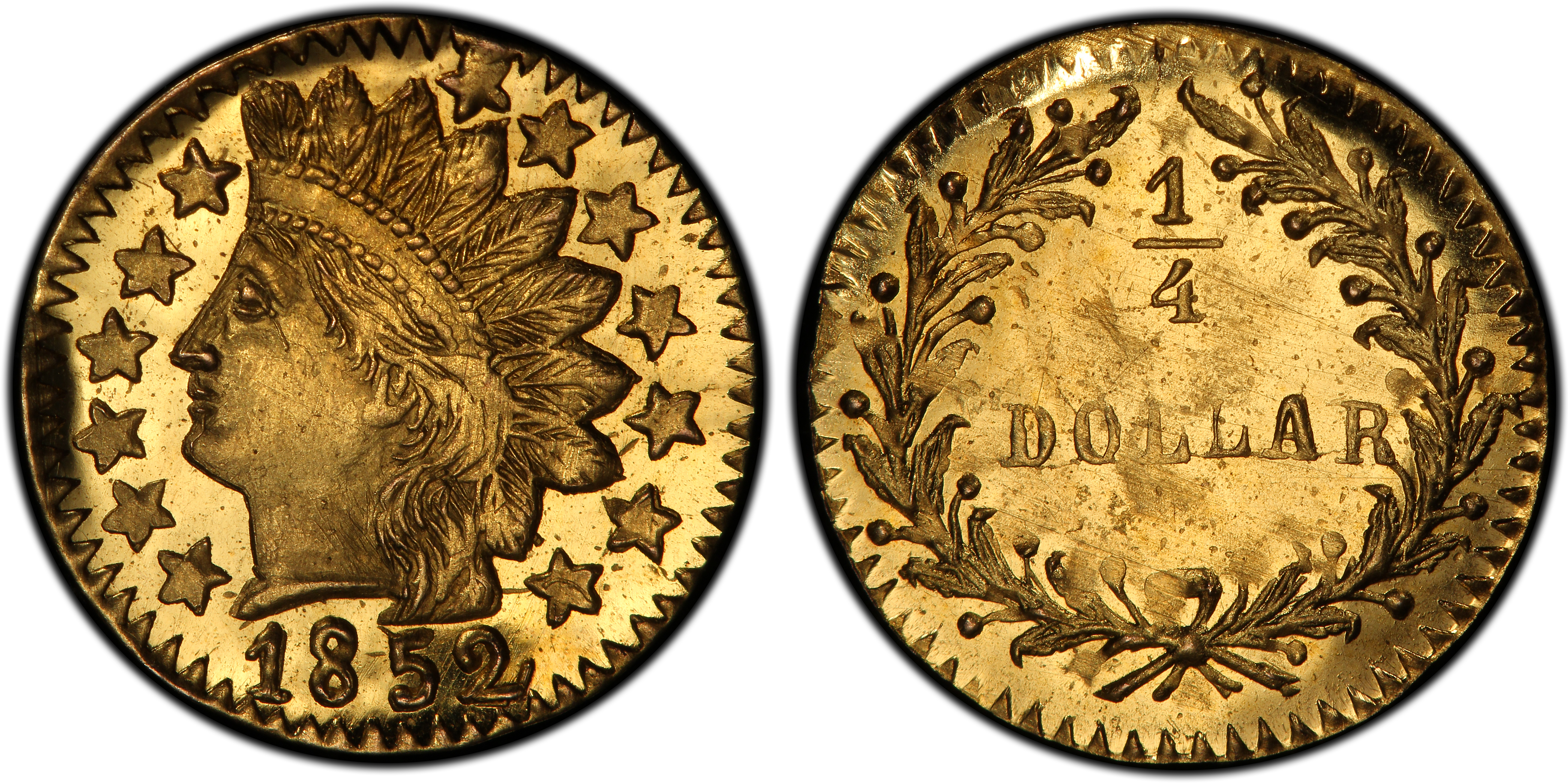
Obverse & Reverse
The 1852 G25C BG-891, despite its date, is a quintessential example of a 'Period Two' California Fractional Gold piece, a series born from the unique economic conditions of the California Gold Rush. The initial discovery of gold at Sutter's Mill in 1848 triggered a massive influx of over 300,000 people to California, creating vibrant but chaotic boomtowns. A severe shortage of small denomination coinage plagued this new economy; gold dust and foreign silver coins were impractical and unreliable for everyday transactions like buying a meal or a drink. To fill this void, private minters, predominantly jewelers in San Francisco with experience in metalwork, began striking their own small gold coins in quarter, half, and one-dollar denominations starting in 1852. These initial 'Period One' (1852-1857) issues are believed to have genuinely circulated to alleviate the small change crisis. However, the establishment of the U.S. Branch Mint in San Francisco in 1854 and its subsequent production of official federal coinage gradually reduced the need for these private issues. The BG-891 variety, though dated 1852, was actually struck between 1858 and 1882. During this 'Period Two,' the purpose of fractional gold shifted from utilitarian currency to souvenirs and novelty items for the burgeoning tourist trade and for use as jewelry. These pieces, often called 'jeweler's issues,' were intentionally made underweight relative to their face value, functioning more as tokens than true coinage. The production of denominated private issues continued until a U.S. Secret Service crackdown in 1883, which enforced the Private Coinage Act of 1864 and effectively ended the era of California Fractional Gold. Today, these tiny gold pieces are cherished numismatic artifacts that symbolize the entrepreneurial spirit and unique challenges of the Gold Rush era.
Associated EventCalifornia Gold Rush
Reason For MintingThough dated 1852, this 'Period Two' issue was primarily created as a souvenir or jewelry item for tourists, rather than to alleviate the earlier, critical shortage of small change.
Minter HistoryThe specific minter for BG-891 is unknown, which is common for many fractional gold varieties. Most were produced anonymously by various manufacturing jewelers located in San Francisco who had the skills and equipment to work with gold. These craftsmen used crude but effective methods, such as the 'hammer method,' where dies were struck by hand with a sledgehammer, leading to frequent variations in strike quality. While some later issues bear initials identifying their makers (like Deriberpe, Nouizillet, and Routhier), many, including BG-891, remain unattributed.
Historical SignificanceThe BG-891 represents the transition of fractional gold from a necessary circulating medium to a commercial souvenir. It is a tangible link to the romantic allure of the Gold Rush that persisted long after the initial frenzy, showcasing how the 'Wild West' was being packaged and sold to a wider audience. Its existence highlights a fascinating and legally gray chapter in American monetary history.
N/A
Denomination25 Cents
Minting Period1858-1882
Assayer/MinterUnknown, likely various San Francisco jewelers
Geographic OriginSan Francisco, California
Obverse DescriptionAn Indian Head motif, facing left, surrounded by thirteen six-pointed stars arranged in a circle. The portrait is typically stylized and varies in sharpness due to the crude minting process.
Obverse Inscription1852
Reverse DescriptionThe denomination '25 CENTS' is enclosed within a wreath of leaves and berries. A notable diagnostic for this variety is the reverse die, which is often rotated significantly, sometimes more than 90 degrees counter-clockwise from the standard coin alignment.
Reverse Inscription25 CENTS
CompositionGold
Stated Fineness Actual FinenessVaries, but typically ranges from 14 to 22 carats. Period Two issues like this were not intended to contain their full face value in gold.
Diameter9.50 mm
EdgePlain
Unknown
Survival Estimate31-75 known examples
Rarity ScaleR-5+ / R-6
This variety is popular due to its classic Indian Head design, its status as a tangible piece of Gold Rush history, and its relative affordability compared to rarer Period One issues. The frequent and dramatic die rotation on the reverse adds a unique and collectible characteristic.
Key VarietiesThe primary variety is the regular business strike. While no original proof strikings are known, some surviving examples exhibit prooflike (PL) surfaces, characterized by mirror-like fields, which command a premium. Die state is a key consideration, as the reverse is known to be rotated to various degrees. No special collector restrikes from the period are known to exist.
Authentication TipsGenuine pieces are denominated with 'CENTS'. Replicas often have a soapy, cast-like appearance and incorrect weight or dimensions. Authentic pieces were struck and should show evidence of this process. They are typically very thin. A key diagnostic for genuine fractional gold is to 'beware of the bear'; no authentic 19th-century issues feature a bear on the reverse. Buyers should rely on the Breen-Gillio (BG) reference guide and consider purchasing examples certified by major grading services like PCGS or NGC to ensure authenticity.
Shopping ConsiderationsA premium quality example for this variety will exhibit a sharp strike, particularly on the Indian's headdress and the details of the wreath. Look for clean, original surfaces with minimal distracting marks. Luster is a significant factor; coins with bright, prooflike fields are highly desirable and sell for more. Given the crude hammer-striking method, perfectly struck examples are rare; therefore, some weakness is expected. Avoid coins that have been harshly cleaned, polished, or mounted in jewelry, as this significantly impairs their value. Pay close attention to any mention of significant die rotation in the seller's description, as this is a hallmark of the variety.
A coin's grade is its condition, rated on a 1-70 scale. For rare coins, this is the most critical factor in determining value, as a tiny difference in preservation can mean a huge difference in price.
Relevant Grade TypesOriginal issues were business strikes intended for the souvenir market, not general circulation, and are found in Circulated (1-58) and, more commonly, Mint State (MS, 60-70) grades. No proofs were struck during the original production period. Some Mint State coins were struck on highly polished planchets, resulting in a Prooflike (PL) designation, which are distinct from true Proof coins but are highly valued.
Mint State CharacteristicsIn uncirculated grades, BG-891 often displays a bright, satiny to semi-prooflike luster. Strike quality is a major variable; many are softly struck in the centers, particularly on the high points of the Indian's portrait and the wreath. A well-struck example with full details is rare and desirable. Small planchet flaws or adjustment marks are not uncommon due to the private manufacturing process. The surfaces are often clean, as many were preserved as keepsakes rather than being spent.
Circulated Wear PatternsFor the few examples that saw any handling or circulation, wear will first appear on the high points: the cheek and feathers of the Indian Head on the obverse, and the highest leaves and bow of the wreath on the reverse. As wear progresses, the stars and lettering will become softer and eventually merge with the fields.
Key Factors For ValueThe primary drivers of value for an 1852 BG-891 are its certified grade and surface quality. A high-grade Mint State example (e.g., MS-63 or higher) carries a significant premium. The presence of prooflike (PL) surfaces can substantially increase value. Eye appeal is crucial; coins with original, vibrant luster and no evidence of cleaning or damage are most sought after. The degree of die rotation on the reverse can also be a point of interest for specialists, though its impact on value is less defined than grade and surface quality.
PCGS Price Guide
| Grade | Price | Population |
|---|---|---|
| 60 | $325.00 | N/A |
| 61 | $375.00 | 1 |
| 62 | $400.00 | 3 |
| 62+ | $425.00 | N/A |
| 63 | $500.00 | 9 |
| 63+ | $575.00 | 1 |
| 64 | $675.00 | 10 |
| 64+ | $750.00 | N/A |
| 65 | $1,000.00 | 12 |
| 65+ | $1,250.00 | N/A |
| 66 | $2,000.00 | 1 |