1876 G50C BG-1039 (Regular Strike)
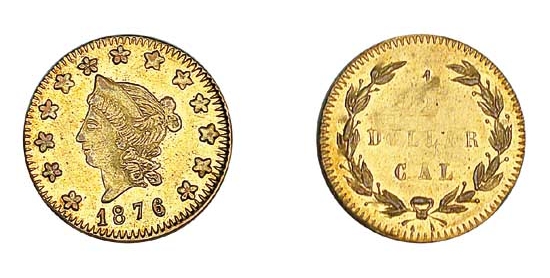
Obverse & Reverse
The 1876 G50C BG-1039 is a numismatic artifact from the second period of California Fractional Gold production (1859-1882), a fascinating era that saw these miniature gold pieces transition from utilitarian currency to souvenir items. By the mid-1870s, the initial impetus for fractional gold—a severe shortage of small change during the Gold Rush—had long vanished. The United States Mint in San Francisco, operating since 1854, was producing ample federal coinage for commerce. However, the allure of California and the Gold Rush remained a powerful draw for tourism and national identity, creating a robust market for keepsakes. Local jewelers, many of French origin, stepped into this market, producing vast quantities of gold quarters, halves, and dollars. These 'jeweler's issues' were not intended to meet a monetary need but to be sold as charms, souvenirs, and objects of curiosity. Crucially, this activity took place in a legally gray area. The Private Coinage Act of April 22, 1864, had made it illegal for private entities to mint coins intended as currency. While enforcement was initially lax, the U.S. Secret Service, under the zealous direction of Chief James J. Brooks, began to crack down on these operations in the late 1870s and early 1880s. Agents argued that because these pieces carried a denomination and resembled coinage, they violated federal law, despite jewelers' claims that they were mere tokens. This pressure forced producers to become clandestine, often omitting identifying marks. The BG-1039, dated 1876, was struck during this period of increasing scrutiny but before the final cessation of denominated issues around 1882. Its anonymous nature is typical of the era, a stark contrast to some earlier issues that bore makers' initials. The extreme rarity of the BG-1039 variety suggests it may have been a trial piece or part of an exceptionally small production run, perhaps curtailed by legal fears or the failure of the dies. Its existence as a unique or near-unique specimen elevates it from a simple souvenir to a significant numismatic rarity, representing the final chapter of privately issued, denominated gold in the United States.
Associated EventPost-Gold Rush California Tourism
Reason For MintingPrimarily produced as a souvenir or keepsake for the tourist trade, not to alleviate a coin shortage.
Minter HistoryThe specific minter for BG-1039 is unknown, which is characteristic of many Period Two (1859-1882) issues. These pieces are often referred to as 'jeweler's issues' and were typically produced anonymously by various San Francisco-based jewelers and artisans to avoid legal complications stemming from the Private Coinage Act of 1864.
Historical SignificanceThis coin represents the twilight of private, denominated gold coinage in the United States. Struck as a souvenir rather than for circulation, it highlights the transition of fractional gold from a necessary form of currency to a collectible curiosity, all while operating under the increasing threat of government suppression.
BG-1039
Denomination50 Cents
Minting Period1876
Assayer/MinterUnknown San Francisco Jeweler
Geographic OriginSan Francisco, California
Obverse DescriptionA Liberty Head motif, facing left, styled after contemporary U.S. federal gold coinage. The portrait is encircled by thirteen stars representing the original colonies.
Obverse InscriptionLIBERTY (on coronet)
Reverse DescriptionThe denomination '50 CENTS' is enclosed within a wreath of leaves and berries. The date '1876' is positioned below the wreath.
Reverse Inscription50 CENTS 1876
CompositionGold
Stated Fineness Actual FinenessVaries, typically between .500 and .800 for Period Two issues, and often underweight for the stated value.
Weight0.25 grams
Diameter10.00 mm
EdgePlain
Extremely Low; Possibly a trial or pattern striking.
Survival Estimate1-3 known
Rarity ScaleR-9 (Per Breen-Gillio scale, indicating Unique or Nearly Unique)
The BG-1039 is a paramount rarity in the California Fractional Gold series. Its appeal is driven by its nearly unique status (R-9), its direct link to the historic 'jeweler's issue' period, and the challenge of acquiring a legendary variety. It is considered an ultimate prize for the advanced specialist.
Key VarietiesThe primary variety is the regular strike BG-1039 itself, which is of the highest rarity. A closely related variety, BG-1039A, exists and is more frequently encountered, though still rare (rated High R-6). BG-1039A differs in die characteristics, most notably in the placement and details of the stars and date. No special collector issues, restrikes, or patterns are known for BG-1039.
Authentication TipsAuthentication requires expert examination due to its extreme rarity. Genuine examples should exhibit the known die characteristics of the authenticated specimen(s). The strike will likely be sharp in areas but may show some crudeness or weakness typical of hammered jeweler's pieces. The planchet should be thin, a key feature of genuine fractionals, unlike modern, thicker replicas. The surfaces should not have a casting-related texture. Comparison to the known authentic specimen, such as the one graded by NGC, is essential.
Shopping ConsiderationsAcquiring a BG-1039 is a once-in-a-generation opportunity. Any potential buyer must insist on third-party certification from a top-tier service like PCGS or NGC. Given its R-9 status, provenance is critical. The primary consideration will be simply locating an example for sale. Eye appeal, while important, is secondary to the coin's mere existence and authenticity. Examine for common problems that can affect even rare coins, such as evidence of having been mounted in jewelry, harsh cleanings, or tooling, which would be noted on the holder but could still impact its value relative to a problem-free example.
A coin's grade is its condition, rated on a 1-70 scale. For rare coins, this is the most critical factor in determining value, as a tiny difference in preservation can mean a huge difference in price.
Relevant Grade TypesAll original examples of BG-1039 were struck as business strikes, intended for sale as souvenirs. They are found in Circulated (1-58) and, more commonly for this period, Mint State (MS, 60-70) grades, as many were preserved as keepsakes. No proofs were struck during the original period of issue, and no later-date collector restrikes are known to exist.
Mint State CharacteristicsA Mint State example of BG-1039 would be defined by its luster and strike. Luster is typically satiny to slightly prooflike, a common characteristic of Period Two jeweler's issues. The strike can be uneven; some elements, like the central portrait and wreath, might be sharp, while peripheral elements like the stars or date could show weakness due to the primitive hammered striking process. As these were not intended for circulation, contact marks should be minimal but are not unusual given their small size and handling over time.
Circulated Wear PatternsOn this design, wear would first appear on the highest points: the coronet and hair strands above Liberty's eye, and the cheekbone. On the reverse, the leaves and berries of the wreath and the numerals of the denomination would show the first signs of friction. In lower grades (VF and below), the thirteen stars on the obverse would begin to merge with the fields.
Key Factors For ValueFor a coin of this magnitude, authenticity and certification are the paramount factors. Its R-9 rarity places it in a category where any confirmed example is immensely valuable. Beyond that, a problem-free surface is the most important quality. An example with original, uncleaned surfaces and attractive, reddish-gold toning would command a significant premium. Sharpness of strike on the Liberty portrait is a key determinant of eye appeal. The presence of a CAC sticker would provide further confirmation of premium quality for the assigned grade and would be highly sought after.
PCGS Price Guide
| Grade | Price | Population |
|---|---|---|
| 60 | $4,500.00 | N/A |
| 61 | $5,250.00 | 1 |
| 62 | $6,500.00 | 1 |