1852 G50C BG-962A (Regular Strike)
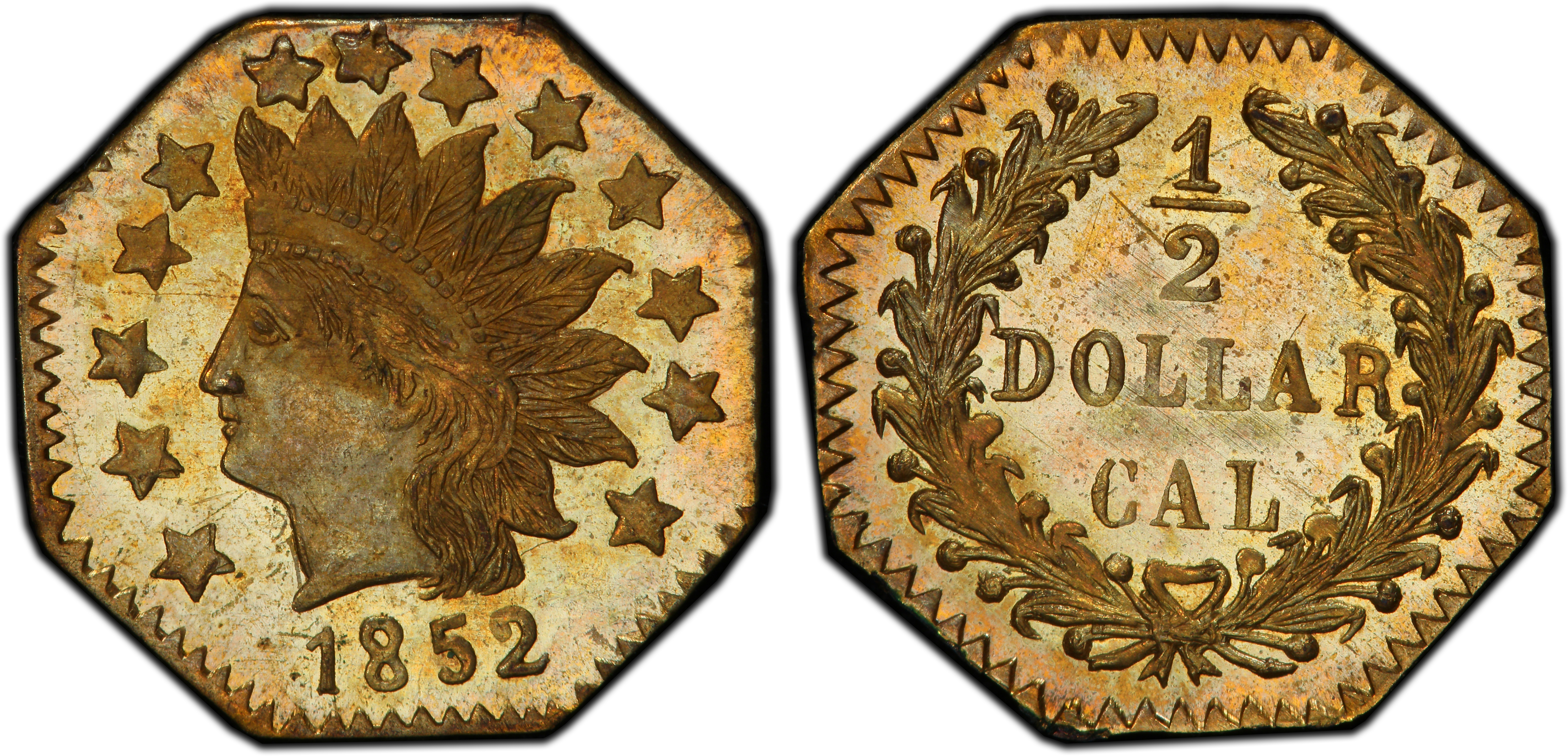
Obverse & Reverse
The 1852 Gold 50 Cents, cataloged as Breen-Gillio 962A, is a quintessential artifact from the chaotic, formative years of the California Gold Rush. Following the discovery of gold at Sutter's Mill in 1848, a massive influx of prospectors and merchants descended upon California, creating a vibrant but fundamentally flawed economy. While massive quantities of gold dust and large-denomination private ingots circulated, there was a severe, crippling shortage of small-denomination coinage for daily transactions. A pinch of gold dust for a drink or a meal was an imprecise and often contentious method of payment. This monetary vacuum spurred private jewelers and metallurgists in San Francisco to action. Among the most prominent of these was Antoine Louis Nouizillet, a French jeweler whose name is associated with many of the finest and most competently produced 'Period One' (1852-1857) issues. These early pieces, unlike the later, often debased 'Period Two' souvenir issues, were struck with the genuine intent of serving as a circulating medium. They were hammered by hand, a crude but effective method where dies were struck with a sledgehammer, resulting in significant variation in strike quality. The BG-962A was part of this first wave of fractional gold. Though its intrinsic value was less than its face value, it was readily accepted in commerce out of sheer necessity. The coins were notoriously small and easily lost, a fact that contributed to their high attrition rate and subsequent rarity. The passage of the private coinage act in 1864 officially ended their legal status, but by then, the establishment of the San Francisco Mint in 1854 and the increasing supply of federal silver coinage had already rendered them largely obsolete. Today, the BG-962A is a tangible link to a time when California's economy was being forged, not by a government, but by the ingenuity and enterprise of private individuals responding to the urgent needs of their community.
Associated EventCalifornia Gold Rush
Reason For MintingTo alleviate a severe shortage of small-denomination coinage for everyday commercial transactions in Gold Rush-era California.
Minter HistoryAntoine Louis Nouizillet was a French jeweler and watchmaker who operated in San Francisco during the 1850s. He was one of the most prolific and skilled private minters of Period One California Fractional Gold. His pieces are noted for their relatively high quality of design and execution compared to some of his contemporaries. His maker's mark, 'N' or 'DN' (for a partnership with M. Deriberpe), appears on some varieties. Nouizillet's operations were crucial in providing a functional, if unofficial, medium of exchange for the burgeoning population. Around 1859, he sold his business, including his dies and equipment, to another jeweler, Robert B. Gray, who would go on to produce Period Two fractional gold.
Historical SignificanceThis coin represents a critical solution to a major economic problem during the California Gold Rush, demonstrating the role of private enterprise in creating currency in the absence of sufficient federal coinage. It is a key artifact of the 'Period One' issues, which were intended for actual circulation.
N/A
Denomination50 Cents
Minting Period1852
Assayer/MinterAttributed to Antoine Louis Nouizillet
Geographic OriginSan Francisco, California
Obverse DescriptionLiberty Head, facing left, with 'LIBERTY' inscribed on the coronet. The portrait is executed in a crude but recognizable style, reminiscent of the official U.S. gold dollar. Thirteen stars, representing the original colonies, encircle the portrait.
Obverse InscriptionLIBERTY
Reverse DescriptionThe denomination '50 CENTS' is enclosed within a beaded circle, which is itself surrounded by the inscription 'CALIFORNIA GOLD'. The lettering is often unevenly spaced and struck due to the nature of manual production.
Reverse InscriptionCALIFORNIA GOLD 50 CENTS
CompositionGold
Stated Fineness Actual FinenessTypically .800 to .880 fine, with significant variation due to the use of unrefined native California gold which contained silver.
Weight0.80 grams
Diameter11.50 mm
EdgePlain
Unknown
Survival EstimateFewer than 20
Rarity ScaleR-7 (4-12 known)
The BG-962A is highly prized as a very rare 'Period One' type, struck with the intent to circulate. Its connection to the California Gold Rush, attribution to the important minter Nouizillet, and extreme rarity make it a trophy piece for advanced collectors of territorial gold.
Key VarietiesThe primary variety is the regular business strike. No known proof strikings from the original period of issue exist. Restrikes of Period One designs were made by other jewelers in later years, but none are specifically cataloged as BG-962A restrikes. Collectors should be aware of the broader category of modern replicas, which are gold-plated and have no numismatic value.
Authentication TipsGenuine examples exhibit a characteristic crude, manual strike. Look for softness in some areas and better definition in others. The planchets are often slightly irregular. The 'feel' of the gold should be correct; counterfeits are often brassy or have a soapy, cast-like surface. Lettering on genuine pieces, while crude, is stylistically consistent with other Nouizillet products. Weight can be a key diagnostic; most fakes are incorrect. Any piece with a bear on the reverse is a modern souvenir.
Shopping ConsiderationsFor this issue, a premium quality example is defined less by absolute grade and more by the strength and evenness of the strike. Look for a specimen with a bold date and clear legends, as these were often the first elements to be weakly struck. Original, uncleaned surfaces with some remaining luster are exceptionally rare and command significant premiums. Avoid examples that have been holed or mounted for jewelry, a common fate for these small coins. Even high-grade pieces will show planchet irregularities and striking flaws; these are part of the coin's character and are not necessarily defects unless they are unusually severe.
A coin's grade is its condition, rated on a 1-70 scale. For rare coins, this is the most critical factor in determining value, as a tiny difference in preservation can mean a huge difference in price.
Relevant Grade TypesOriginal period issues were business strikes intended for circulation and are found in Circulated (1-58) and, very rarely, in Mint State (MS, 60-70) grades. No Proof (PR/PF) examples were struck during the original minting period. Any piece described as a 'Proof' is either a later fabrication or a misattribution of a very high-quality, prooflike business strike.
Mint State CharacteristicsAn uncirculated BG-962A would be defined by full mint luster, typically satiny in texture. However, the strike is almost never full. Expect to see some weakness in the center of the obverse (Liberty's hair) and corresponding areas of the reverse. The fields will likely show minor planchet adjustment marks or other striations inherent to the crude manufacturing process. Contact marks, even on MS coins, are common due to the softness of the gold and their use in circulation alongside other coins.
Circulated Wear PatternsWear first appears on the highest points: Liberty's cheek, the hair above the ear, and the coronet. On the reverse, the numerals '50' and the letters in 'CENTS' will show the first signs of flattening. In lower grades (VG and below), the stars on the obverse will begin to merge with the rim, and the legends will become faint.
Key Factors For ValueFor the BG-962A, rarity is paramount, but within the small surviving population, value is driven by three key factors. First is the sharpness of the strike; a coin with a bold date and legends is far more desirable than a weakly struck example of the same grade. Second is surface quality; coins with original, crusty, uncleaned surfaces are prized. Third is overall eye appeal; specimens that are free of distracting marks, jewelry mounting, or damage command the highest prices. A CAC sticker on this issue would indicate superior quality for the grade and would add a significant premium.
PCGS Price Guide
| Grade | Price | Population |
|---|---|---|
| 60 | $4,000.00 | N/A |
| 61 | $4,250.00 | N/A |
| 62 | $4,500.00 | 1 |
| 62+ | $4,750.00 | N/A |
| 63 | $5,000.00 | N/A |
| 63+ | $5,250.00 | N/A |
| 64 | $5,750.00 | N/A |
| 64+ | $6,250.00 | N/A |
| 65 | $7,500.00 | 2 |