1874 G50C BG-929 (Regular Strike)
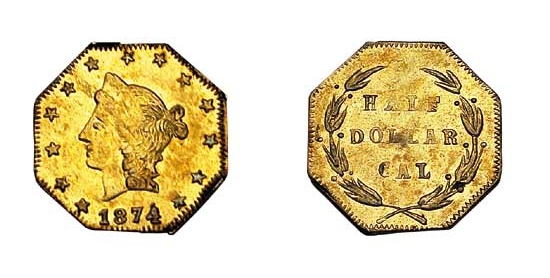
Obverse & Reverse
The 1874 Gold 50 Cents, cataloged as Breen-Gillio 929 (BG-929), is a product of the fascinating and complex period of California's post-Gold Rush economy. While the initial frenzy of the late 1840s and early 1850s had subsided, California remained a major gold producer, and its economy was uniquely specie-based. The rest of the nation grappled with paper money and the economic turmoil following the Civil War, but Californians distrusted anything but 'hard money.' This created a persistent local demand for coinage, especially for small denominations. The United States Mint in San Francisco produced standard federal coinage, but there was a commercial and cultural niche for smaller, privately issued gold pieces. These 'fractional gold' pieces, in denominations of 25 cents, 50 cents, and one dollar, were not legal tender but served as popular items for commerce, gifts, and souvenirs, filling a void left by the scarcity of small federal silver coins which were often hoarded. Minted by various jewelers and private assayers in San Francisco, these tiny coins mimicked federal designs to inspire confidence, often featuring a Liberty head and a wreath. The period from the 1870s to the early 1880s saw the final chapter of this unique coinage. The pieces were struck with a lower intrinsic gold value compared to their face value, making them profitable tokens. However, their existence drew the ire of the U.S. Treasury Department. The Secret Service viewed them as illegal private coinage that violated federal law, leading to crackdowns and the eventual cessation of their manufacture around 1882. The BG-929 variety from 1874 is a quintessential example of this later period, characterized by more standardized, mass-produced designs compared to the cruder issues of the 1850s. Its survival today provides a tangible link to California's vibrant and independent economic spirit and the twilight of America's private coinage era.
Associated EventPost-California Gold Rush Economic Period
Reason For MintingTo satisfy local demand for small denomination coinage for commerce and souvenirs in a specie-based economy.
Minter HistoryThe specific minter for BG-929 is unconfirmed, a common trait for many California fractional gold issues. Research by Breen and Gillio suggests a strong likelihood that many of the Period Three (1872-1882) issues, including this one, were produced by the California Jewelry Company of San Francisco. This firm, along with others, operated as jewelers and manufacturers who saw a business opportunity in creating these popular gold tokens. They were not official government assayers but skilled metalworkers who produced the coins in large quantities for commercial distribution.
Historical SignificanceThe BG-929, like other later-date California Fractional Gold pieces, represents the final phase of private minting in the United States. It highlights the persistent regional economic conditions in California and the tension between local commercial needs and federal monetary laws. Its eventual suppression marks the consolidation of coinage authority by the U.S. government.
N/A
Denomination50 Cents
Minting Period1874
Assayer/MinterUnknown, possibly California Jewelry Co.
Geographic OriginSan Francisco, California
Obverse DescriptionA beaded border encloses a small bust of a female figure representing Liberty, facing left. She wears a coronet or tiara inscribed with the word 'LIBERTY' (often indistinct). Thirteen stars encircle the bust.
Obverse Inscription[Stars surrounding bust, with 'LIBERTY' on tiara]
Reverse DescriptionA beaded border encloses a wreath of two olive branches, tied with a bow at the bottom. Within the wreath is the denomination '1/2'. The date '1874' is positioned below the bow.
Reverse Inscription1/2
CompositionGold
Stated Fineness Actual FinenessVaries, typically low fineness (around .500 fine or less), often alloyed with copper.
Weight0.25 grams
Diameter10.00 mm
EdgePlain
5,000-10,000
Survival Estimate500-750
Rarity ScaleR-4
This coin is highly popular as a representative example of the later 'souvenir' phase of California Fractional Gold. Its affordability relative to earlier issues, clear date, and classic design make it a favorite entry point for collectors into this fascinating series. It provides a tangible connection to the Old West long after the initial Gold Rush.
Key VarietiesThe 'Regular Strike' is the standard issue. There are no major varieties of BG-929 from the original minting period. No contemporary proof restrikes or patterns are known to exist for this specific variety. Collectors should be aware that the term 'Restrike' in the context of California Fractionals often refers to modern, 20th-century copies, which are not considered original numismatic items and have no significant value.
Authentication TipsAuthentic BG-929 examples have a specific 'die look.' Look for sharp, evenly spaced denticles (beading). The stars on the obverse should be small and relatively well-defined. The numerals in the date are of a specific style; counterfeits often have incorrect date punches. A key diagnostic is the weakness of the 'LIBERTY' inscription on the tiara, which is almost always indistinct even on high-grade specimens. The weight should be very close to 0.25 grams. Modern fakes are often overweight, underweight, or have a soapy, cast-like appearance. Genuine pieces have a struck, sharp quality, even if the design elements are weak.
Shopping ConsiderationsA premium quality example for its grade will possess a sharp strike for the issue, with as much detail as possible in the wreath and Liberty's hair. Look for clean, lustrous surfaces free of distracting marks, cleaning, or scratches. Original, uncleaned 'skin' with a slightly reddish-gold hue is highly desirable and commands a significant premium. Avoid examples that have been used as jewelry, evidenced by solder marks, heavy polishing, or rim damage. Given their small size, even minor imperfections are magnified, so eye appeal is paramount. A coin that is well-centered and fully struck on a round planchet is preferable to one that is off-center or on a clipped planchet.
A coin's grade is its condition, rated on a 1-70 scale. For rare coins, this is the most critical factor in determining value, as a tiny difference in preservation can mean a huge difference in price.
Relevant Grade TypesOriginal period issues were business strikes intended for circulation and souvenir sales, and they are found in Circulated (1-58) and Mint State (MS, 60-70) grades. No Proofs (PR/PF) were struck during the original period of issue for BG-929. Any coin described as a 'Proof' of this variety is likely a modern copy or has been misrepresented. The vast majority of surviving examples are in Mint State, as they were primarily saved as keepsakes rather than heavily used in commerce.
Mint State CharacteristicsUncirculated examples of BG-929 typically exhibit a soft, satiny luster. The strike is a key differentiator; many are weakly struck, particularly on the word 'LIBERTY' on the tiara and in the centers of the stars. High-end MS examples will show better definition in these areas. Due to the softness of the gold alloy and mass production, even uncirculated pieces often show tiny planchet flaws or minor die polishing lines. Small, light contact marks ('chatter') are common and acceptable, but large, distracting marks will lower the grade and value.
Circulated Wear PatternsFor the rare circulated examples, wear first appears on the high points of Liberty's cheek, hair, and the coronet. On the reverse, the highest points of the wreath's leaves and the bow will show initial flatness and smoothing. In lower grades (VF and below), the stars will begin to merge with the field, and the numerals of the date will become soft.
Key Factors For ValueThe primary driver of value for an 1874 BG-929 is the numerical grade combined with eye appeal. A sharp, well-struck example will always be worth more than a weakly struck coin of the same grade. Surface quality is critical; coins with original, vibrant luster and minimal contact marks are prized. A specimen with a pleasing, original reddish or orange-peel toning will command a significant premium over a harshly cleaned or dipped coin. Finally, certification by a top-tier grading service (PCGS or NGC) is essential for market acceptance, and a CAC sticker for this issue indicates superior quality for the grade, adding a further premium.
PCGS Price Guide
| Grade | Price | Population |
|---|---|---|
| 60 | $1,350.00 | N/A |
| 61 | $1,500.00 | 1 |
| 62 | $1,750.00 | 3 |
| 62+ | $2,000.00 | N/A |
| 63 | $2,400.00 | 3 |