1865 G50C BG-1005 (Regular Strike)
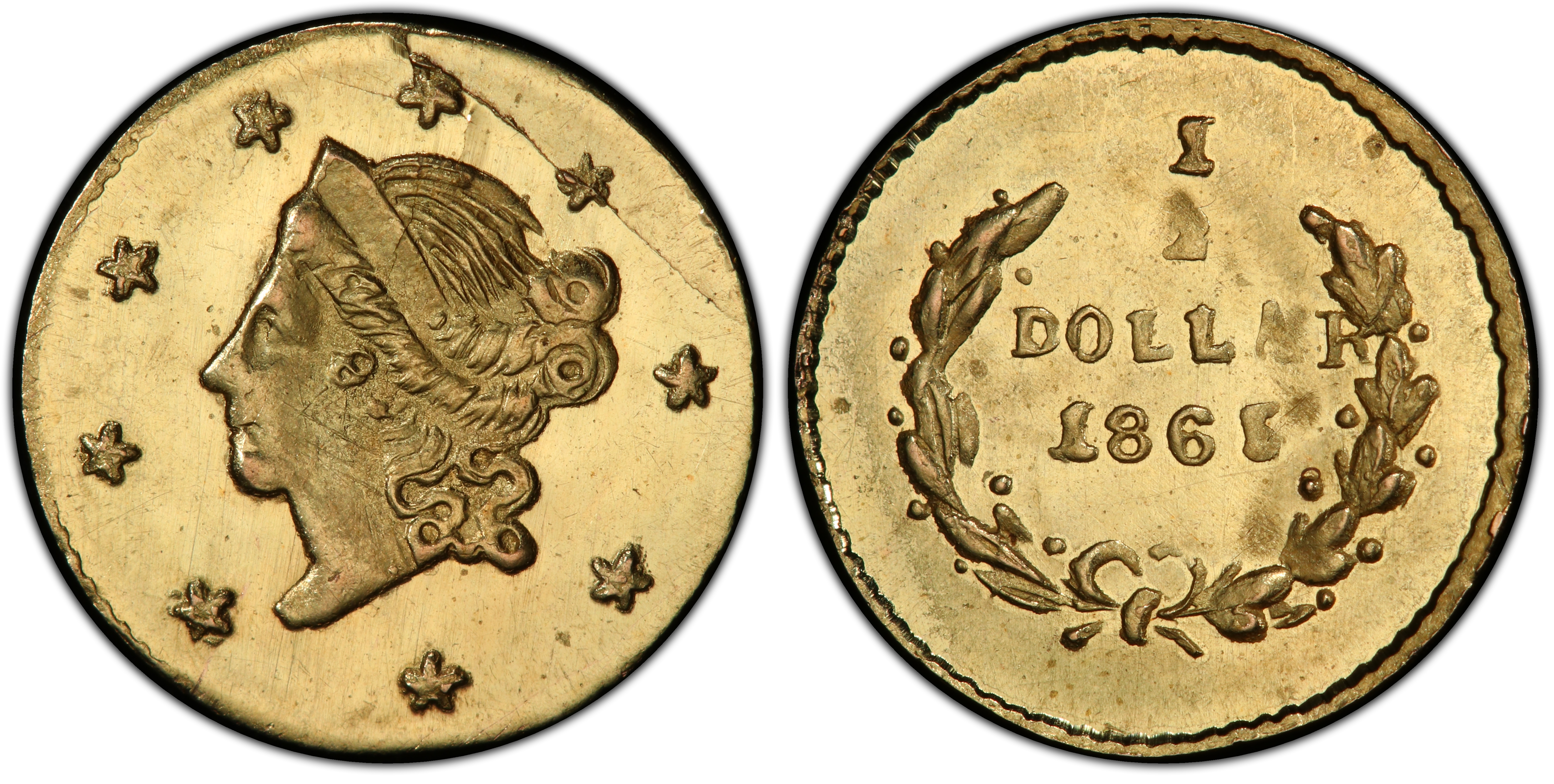
Obverse & Reverse
The 1865 G50C BG-1005 is a product of California's vibrant post-Gold Rush economy. By the mid-1860s, while the major gold discoveries had subsided, the state's economy was still heavily reliant on gold and silver. A chronic shortage of small-denomination federal coinage plagued the West Coast, a situation exacerbated by the economic disruptions of the Civil War (1861-1865), which saw federal coinage hoarded or shipped east. Into this void stepped a variety of private minters who produced small, fractional gold coins in 25-cent, 50-cent, and one-dollar denominations. These pieces, often called 'tokens' or 'charms' by detractors but used widely as currency, facilitated everyday transactions, allowing merchants to make change for purchases that were far smaller than the commonly circulating $2.50 quarter eagles. The minters were jewelers and assayers, such as Robert B. Gray & Co., who possessed the skills to create dies and strike coins from refined gold. These coins were not officially sanctioned by the U.S. government and were of varying weights and fineness, often containing less than their face value in gold. Their production became a subject of federal scrutiny, leading to the Act of June 8, 1864, which prohibited the private issuance of coins. However, enforcement was inconsistent, and production continued illicitly for several years. The BG-1005 variety is characteristic of the 'Period Two' (1859-1882) issues, which are generally more refined in their design and execution than the earlier, cruder pieces. Today, these fractional gold coins are cherished as tangible links to the unique economic conditions of Civil War-era California, representing a fascinating chapter in American monetary history where private enterprise directly addressed a failure in the official currency supply.
Associated EventPost-California Gold Rush / American Civil War Coinage Shortage
Reason For MintingTo alleviate a severe shortage of small change for daily commerce on the West Coast during and after the Civil War.
Minter HistoryThe precise minter of the BG-1005 is not definitively known, a common trait for many fractional gold issues. However, stylistic elements and punches often link them to established jewelers and assayers of the time. Many Period Two issues are attributed to the circle of craftsmen associated with Robert B. Gray & Co. of San Francisco. These individuals were skilled in die sinking and metallurgy and operated in a competitive environment, often producing coins that mimicked federal designs to enhance public acceptance.
Historical SignificanceCalifornia Fractional Gold pieces are historically significant as a primary example of privately issued coinage filling a crucial gap in a region's money supply. They demonstrate the persistent need for specie in daily trade on the frontier, the ingenuity of local craftsmen, and the limits of federal monetary control in the remote West during the 19th century. The BG-1005 is a representative artifact of this unique monetary experiment.
N/A
Denomination50 Cents
Minting Period1865
Assayer/MinterUnknown, possibly Robert B. Gray & Co.
Geographic OriginSan Francisco, California
Obverse DescriptionA well-executed, classic Liberty Head design facing left. The portrait features beaded hair tied with a band. Thirteen stars encircle the portrait along the denticled rim.
Obverse Inscription[No text inscription, only the 13 stars]
Reverse DescriptionThe denomination '50 CENTS' is centrally located within an open wreath composed of two olive branches tied together at the bottom with a ribbon. The date '1865' is positioned below the wreath, just above the denticled rim.
Reverse Inscription50 CENTS 1865
CompositionGold
Stated Fineness Actual FinenessVaries, but typically in the .500 to .800 range.
Weight0.97 grams
Diameter12.70 mm
EdgePlain
Unknown
Survival Estimate50-75
Rarity ScaleR-5
The BG-1005 is popular among collectors for its classic, federally-inspired design, relatively large size for the denomination, and its status as a genuine circulating artifact of Civil War-era California. Its R-5 rarity makes it challenging but achievable to acquire, appealing to both series specialists and type collectors.
Key VarietiesThe primary designation is BG-1005 (Breen-Gillio). While no major varieties are attributed to the original minting period, collectors should be aware of the vast number of modern replicas and fantasy pieces that infest the fractional gold market. There are no known original period Proofs or official restrikes for this issue. All genuine BG-1005 examples are business strikes.
Authentication TipsAuthentic BG-1005 coins have a characteristic fabric and strike quality. The details, especially the fine hair strands and the wreath leaves, should be sharp but not unnaturally so, as seen on modern copies. The numerals in the date and the letters in 'CENTS' have a specific, known punch style. Look for a natural, slightly soft luster rather than the hard, mirror-like fields of many fakes. Weight and diameter are critical; genuine pieces are typically overweight for their gold content but adhere to a known range. Many counterfeits are cast, showing porosity under magnification, or are die-struck with incorrect details and lettering fonts.
Shopping ConsiderationsA premium quality example for its grade will possess a sharp, well-centered strike. Look for strong definition on Liberty's hair details and the bow on the reverse wreath. Original, uncleaned surfaces are paramount; many surviving examples have been harshly cleaned or used as jewelry. A coin with original reddish-gold or mellow greenish-gold toning and minimal distracting marks commands a significant premium. Avoid pieces with evidence of tooling, rim damage from jewelry mounting, or significant planchet flaws. Pay close attention to surface quality, as the soft gold is easily scratched and abraded.
A coin's grade is its condition, rated on a 1-70 scale. For rare coins, this is the most critical factor in determining value, as a tiny difference in preservation can mean a huge difference in price.
Relevant Grade TypesOriginal period issues of BG-1005 were exclusively business strikes intended for circulation and are found in Circulated (1-58) and Mint State (MS, 60-70) grades. No Proofs (PR/PF) were struck during the original period of issuance. Any piece described as a 'Proof' is either a modern replica or a misattribution. The vast majority of surviving examples are circulated.
Mint State CharacteristicsAn uncirculated BG-1005 will exhibit full, unbroken mint luster, which is typically soft and satiny rather than deeply reflective. The strike can be variable; a premium MS example will show sharp detail on Liberty's hair cords and the wreath leaves. Due to the softness of the gold and the nature of their production and handling, even high-grade Mint State examples will typically show some minor contact marks or hairlines. A 'gem' quality piece would be exceptionally well-struck from fresh dies with virtually mark-free surfaces and vibrant luster.
Circulated Wear PatternsWear first appears on the highest points of the design. On the obverse, this is Liberty's cheek, the hair just above the ear, and the upper curls of hair. On the reverse, the high points of the wreath's leaves and the knot of the bow will show initial flatness and smoothing. In lower grades (VG and below), the stars will become faint, and the letters and numerals will start to merge with the fields.
Key Factors For ValueFor the BG-1005, value is driven by three main factors: grade, surface preservation, and eye appeal. A high-grade (e.g., AU-58 vs. XF-40) example carries a much higher value. However, a coin with original, uncleaned surfaces and a sharp strike will often be more valuable than a higher-graded but cleaned or weakly struck specimen. Eye appeal is crucial; coins with attractive, original toning and minimal distracting marks are highly sought after. Certification by a top-tier grading service (PCGS or NGC) is standard, and a CAC sticker, indicating premium quality for the grade, adds a significant premium.
PCGS Price Guide
| Grade | Price | Population |
|---|---|---|
| 40 | $250.00 | 2 |
| 45 | $265.00 | N/A |
| 45+ | $275.00 | N/A |
| 50 | $300.00 | 3 |
| 50+ | $305.00 | N/A |
| 53 | $310.00 | 3 |
| 53+ | $320.00 | N/A |
| 55 | $350.00 | 6 |
| 55+ | $360.00 | N/A |
| 58 | $375.00 | 7 |
| 58+ | $395.00 | N/A |
| 60 | $425.00 | 4 |
| 61 | $450.00 | 3 |
| 62 | $485.00 | 12 |
| 62+ | $550.00 | N/A |
| 63 | $650.00 | 8 |
| 63+ | $750.00 | N/A |
| 64 | $1,100.00 | 2 |
| 64+ | $1,250.00 | N/A |
| 65 | $1,600.00 | 3 |