1875 G25C BG-877 (Regular Strike)
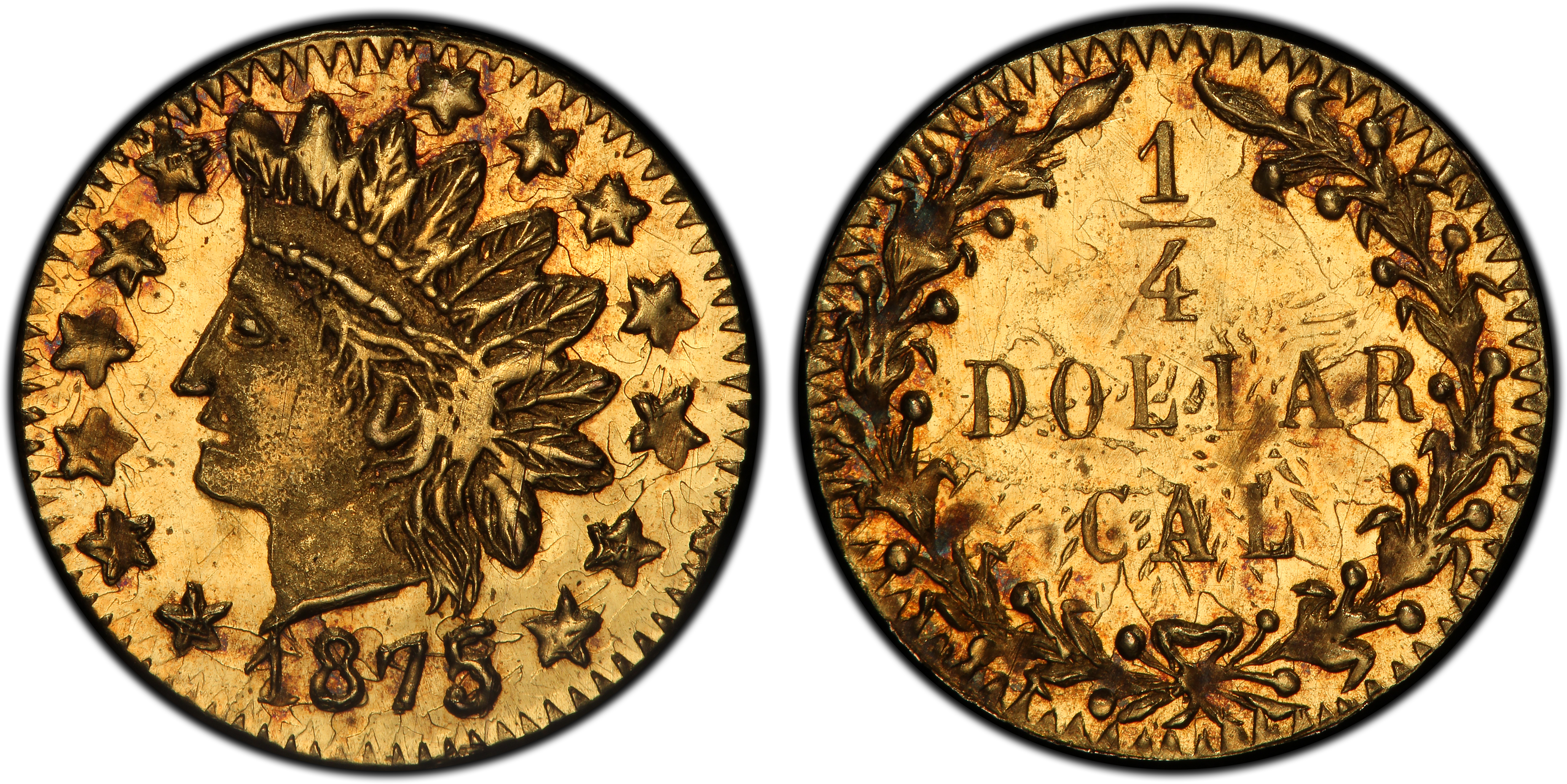
Obverse & Reverse
The 1875 25 Cents, cataloged as Breen-Gillio 877, is a product of the second great wave of California small denomination gold production. Unlike the 'Period One' issues (1852-1857), which were struck out of genuine necessity to alleviate a shortage of small change during the initial Gold Rush, the 'Period Two' pieces (1858-1882) served a different purpose. By 1875, the California economy was more mature, and an adequate supply of federal coinage had largely eliminated the desperate need for private issues in daily commerce. Instead, these later pieces were primarily produced by jewelers and novelty makers to be sold as souvenirs, keepsakes, and curiosities for tourists and locals alike. They capitalized on the romantic image of the Gold Rush, offering a tiny, affordable piece of 'pioneer gold' that was much cheaper than the earlier, heavier issues or federal gold coins. The Coinage Act of April 22, 1864, had officially made private coinage illegal, but the law was not strictly enforced against these small, low-value tokens until the Secret Service cracked down on their manufacturers in the early 1880s. The makers of BG-877, like most Period Two minters, remain anonymous, their identities lost to history. They operated in a legal gray area, producing what were essentially tokens that mimicked the appearance of the earlier, functional fractional gold. These pieces rarely circulated as money in the traditional sense but were immensely popular as personal adornments or mementos of a trip to the Golden State. Their numismatic significance today lies in their direct connection to this later, more commercialized phase of the California Gold Rush legacy and the diverse artistry of the many small, private firms that produced them.
Associated EventPost-Gold Rush California Commerce
Reason For MintingPrimarily struck for sale to tourists and collectors as souvenirs and jewelry items, not to alleviate a circulating coin shortage.
Minter HistoryThe specific minter or jewelery firm responsible for the BG-877 variety is unknown. During this period, numerous anonymous jewelers in San Francisco produced a wide array of fractional gold tokens. Unlike the earlier Period One minters who sometimes initialed their work, most Period Two makers did not sign their dies, leaving their identities unrecorded.
Historical SignificanceBG-877 is representative of 'Period Two' California Fractional Gold, which illustrates the commercialization of the Gold Rush legacy. These pieces were not essential for commerce but instead served the burgeoning tourist trade, acting as popular and affordable souvenirs of California's golden era. Their existence highlights a unique chapter in American numismatics that operated outside of federal authority for decades.
N/A
Denomination25 Cents
Minting Period1875
Assayer/MinterUnknown Private Minter
Geographic OriginSan Francisco, California
Obverse DescriptionA head of a female figure, often described as 'Indian Head' or 'Liberty Head,' facing left, wearing a feathered headdress. The portrait is surrounded by thirteen stars, representing the original colonies.
Obverse InscriptionNo lettering on the obverse; the design consists of the portrait and thirteen stars.
Reverse DescriptionThe denomination '1/4' is at the center, enclosed within a wreath of leaves. The inscription 'CALIFORNIA GOLD' appears above the wreath, arching along the upper rim. The date '1875' is below the wreath, though some varieties from this era place the date on the obverse.
Reverse InscriptionCALIFORNIA GOLD 1/4 1875
CompositionGold
Stated Fineness Actual FinenessVariable, often between .500 and .750 fine. Period Two pieces are known for having a lower gold content than Period One issues.
Diameter9.80 mm
EdgePlain
Unknown, but very small.
Survival Estimate31-75 coins known.
Rarity ScaleHigh R-5
This variety appeals to specialists in the extensive California Fractional Gold series. Its allure lies in its defined rarity (High R-5), the classic Indian Head design, and its status as a representative of the fascinating 'Period Two' souvenir era of private gold coinage.
Key VarietiesThe primary variety is the regular business strike, BG-877. Research does not indicate the existence of any known patterns, trial pieces, or official later-date restrikes for this specific Breen-Gillio number. The series is complex, however, with many similar but distinct die pairings from the same year, such as the BG-878, which uses a different reverse die.
Authentication TipsAuthenticity is a major concern with all California Fractional Gold. Genuine BG-877 pieces will exhibit sharp, well-defined details from a high-pressure strike, unlike modern replicas which are often cast and have a mushy or porous appearance. Look for characteristic die markers, such as tiny imperfections or file marks on the die, which are cataloged in specialized references. The luster should be frosty or satiny, not the glassy, proof-like surface of many 20th-century copies. Third-party certification from PCGS or NGC is highly recommended for any potential purchase.
Shopping ConsiderationsA premium quality example of BG-877 is defined by a strong strike, particularly on the feathers of the headdress and the details of the wreath. Look for clean, unabraded surfaces with minimal contact marks; the small size of these coins makes them prone to damage. Original, uncleaned surfaces with a touch of reddish-gold or mellow orange toning are highly desirable and command significant premiums. Avoid examples that have been harshly cleaned, polished, or used as jewelry, as this severely impairs their value. Pay close attention to the sharpness of the date and legends, which can be weak even on high-grade specimens.
A coin's grade is its condition, rated on a 1-70 scale. For rare coins, this is the most critical factor in determining value, as a tiny difference in preservation can mean a huge difference in price.
Relevant Grade TypesOriginal period issues of BG-877 were all business strikes, although they were sold as novelties and did not circulate widely. They are found in both Circulated (AU-58 and below) and Mint State (MS, 60-70) grades, with Mint State examples being the most common for this variety. No true Proofs were struck during the original period of issue. Any piece described as 'Proof' is likely a later-made replica or a business strike with proof-like surfaces.
Mint State CharacteristicsIn uncirculated grades, BG-877 typically displays a soft, satiny luster. The strike can be inconsistent; well-struck examples will show clear definition in the feathers and the wreath, while others may be slightly soft in these areas. Due to the softness of the gold alloy and the minting process, small planchet flaws or die polishing lines may be present and should not be confused with post-strike damage. Contact marks, even small ones, are common and will affect the grade.
Circulated Wear PatternsFor circulated examples, wear first appears on the highest points: the cheek and feathers of the Indian Head, and the bow and high points of the leaves in the wreath. On lower-grade pieces, the stars on the obverse will begin to merge with the fields, and the fine lines of the wreath will become indistinct. The date is a protected area and often remains legible even on well-worn examples.
Key Factors For ValueThe primary value drivers for BG-877 are grade and surface quality. A high-grade Mint State coin (e.g., MS-64 or MS-65) is worth multiples of a circulated or low-end uncirculated (e.g., MS-61) example. Originality of the surfaces is paramount; a coin with its original 'skin' and luster is far more valuable than one that has been cleaned or polished. Eye appeal, driven by a sharp strike and attractive, stable toning, also contributes significantly to the coin's market value. A CAC sticker for this issue would denote premium quality for the grade and add a considerable premium.
PCGS Price Guide
| Grade | Price | Population |
|---|---|---|
| 55 | $255.00 | 1 |
| 55+ | $260.00 | N/A |
| 58 | $270.00 | 1 |
| 58+ | $280.00 | N/A |
| 60 | $290.00 | N/A |
| 61 | $310.00 | 2 |
| 62 | $365.00 | 4 |
| 62+ | $385.00 | N/A |
| 63 | $500.00 | 12 |
| 63+ | $600.00 | N/A |
| 64 | $950.00 | 12 |
| 64+ | $1,150.00 | N/A |
| 65 | $1,650.00 | 3 |