1882 G25C BG-892, PL (Regular Strike)
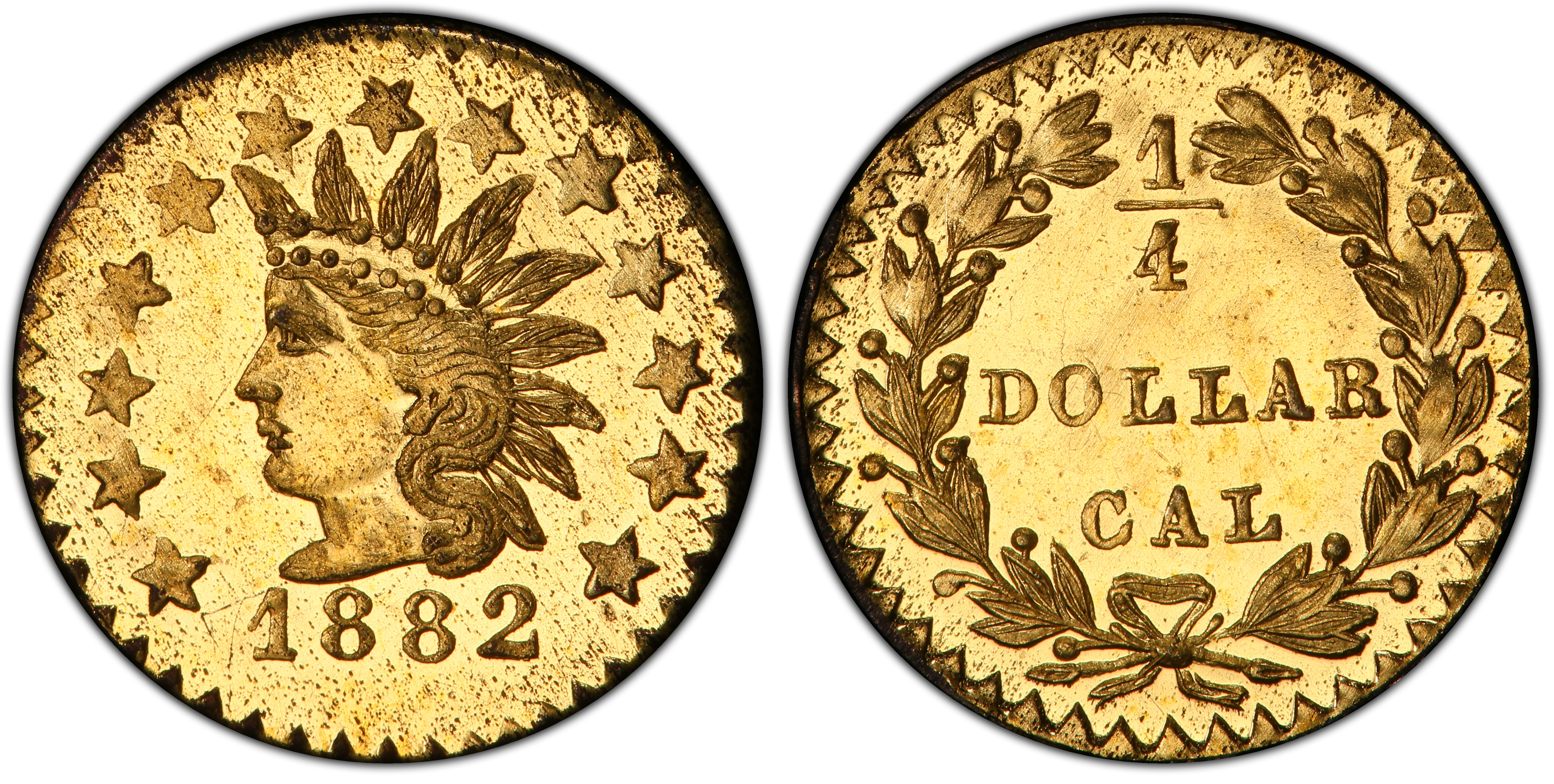
Obverse & Reverse
The 1882 25 Cents, cataloged as Breen-Gillio 892 (BG-892), represents the final chapter in the fascinating and often complex history of California Fractional Gold. Produced long after the initial Gold Rush fervor, these small-denomination tokens served a distinct purpose in the evolving economy of the American West. By the 1880s, the United States Mint was producing ample quantities of silver subsidiary coinage, theoretically eliminating the need for private issues. However, in localized contexts, particularly in the far West, a cultural preference for gold and a persistent shortage of small change for daily transactions kept a niche market alive for these privately minted pieces. They were not legal tender, but rather jewelry and souvenir items that mimicked the appearance of currency and often passed as money in small-scale, local commerce. The U.S. government took a dim view of these private issues, viewing them as a usurpation of federal authority. The Act of 1864 had prohibited private coinage, but manufacturers of these later-date 'charms' or 'tokens' often circumvented the law by omitting the word 'DOLLAR' or 'CENTS,' although this piece explicitly includes 'CENTS.' The persistence of their manufacture into the early 1880s speaks to their popularity as keepsakes and mementos of the romanticized Gold Rush era. The firm of Robert B. Gray & Co., a prominent San Francisco jewelry and watchmaking establishment, was a primary producer of these late-period pieces. Their production was not a rustic, frontier operation but a sophisticated manufacturing process using modern coining presses, resulting in well-made, consistent products. The BG-892, struck in the final year of this extended period, is a testament to the enduring legacy of gold in California's identity, transitioning from a raw medium of exchange to a symbol of regional heritage.
Associated EventPost-Gold Rush Economic Period
Reason For MintingPrimarily created for use as souvenirs, jewelry, and gift items, while also sometimes filling a localized, informal need for small change.
Minter HistoryRobert B. Gray was a watchmaker and jeweler who operated in San Francisco from the 1850s into the 1880s. His firm, Robert B. Gray & Co., was a significant manufacturer of California Fractional Gold pieces, particularly during the later period (1871-1882). Unlike the pioneer assayers of the 1850s who met a critical currency need, Gray's operation was more commercial, producing these small gold pieces as popular souvenirs and novelties for tourists and locals. The quality of his firm's products was generally high, using standardized designs and modern minting techniques. They produced a wide variety of designs, often featuring an Indian Head or Liberty Head motif, and are responsible for many of the more common and accessible pieces available to collectors today.
Historical SignificanceThe BG-892 is significant as it marks the end of the original California Fractional Gold era (1852-1882). Its existence demonstrates the transition of private gold coinage from a necessary medium of exchange in the 1850s to a commercial, souvenir-driven industry by the 1880s, reflecting California's economic maturation and the romanticism associated with its Gold Rush past.
N/A
Denomination25 Cents
Minting Period1882
Assayer/MinterRobert B. Gray & Co.
Geographic OriginSan Francisco, California
Obverse DescriptionA beaded border encircles a right-facing portrait of an Indian princess with a prominent feathered headdress. Thirteen stars surround the portrait, seven to the left and six to the right.
Obverse Inscription[None, only stars and portrait]
Reverse DescriptionA beaded border surrounds a wreath of two olive branches tied with a ribbon at the bottom. The denomination '25' and 'CENTS' are in the center, with the date '1882' below the denomination but still within the wreath.
Reverse Inscription25 CENTS 1882
CompositionGold
Stated Fineness Actual FinenessApproximately .500 fine (12 karat), though this can vary.
Weight0.25 grams
Diameter9.80 mm
EdgePlain
Unknown
Survival Estimate500-750
Rarity ScaleR-4
This variety appeals to collectors as the final year of issue for the historic California Fractional Gold series. Its affordability relative to earlier issues makes it a popular entry point. The 'PL' (Prooflike) designation, indicating sharply reflective fields, adds significant appeal for specialists seeking coins with exceptional surface quality.
Key VarietiesThe primary variety is the Regular Strike, as specified. Within this category, specimens can be found with varying degrees of reflectivity. Those designated 'PL' (Prooflike) by grading services are not a separate striking but are business strikes from the earliest use of polished dies, resulting in mirror-like fields. There are no known original Proof strikings or later restrikes for this specific variety.
Authentication TipsAuthentic BG-892 pieces exhibit a sharp, well-defined strike, particularly in the feathers of the headdress and the details of the wreath. The numerals and letters are crisp. Counterfeits are common but often have a mushy or soapy appearance, incorrect weight, or a brassy, unnatural color. The font style, particularly of the '2' in the date, is a key diagnostic. Be wary of pieces with tool marks around the design elements or unnaturally smooth fields, which may indicate alteration or forgery.
Shopping ConsiderationsA premium quality example for its grade will possess a strong, complete strike, with full definition in the highest points of the Indian's cheek and the details of the wreath. For PL-designated coins, look for deep, clean mirrors with significant contrast against the frosted devices (a 'cameo' effect, though rare, is highly desirable). Avoid examples with distracting carbon spots, significant abrasions in the fields that impair the reflectivity, or any evidence of harsh cleaning, which deadens the surfaces and destroys the PL character. Original, reddish-gold toning is a plus.
A coin's grade is its condition, rated on a 1-70 scale. For rare coins, this is the most critical factor in determining value, as a tiny difference in preservation can mean a huge difference in price.
Relevant Grade TypesAll original 1882 BG-892 pieces are business strikes, intended for commercial or souvenir purposes, and are found in Circulated (1-58) and Mint State (MS, 60-70) grades. There were no Proof (PR/PF) coins struck during the original period of issue. The 'PL' or Prooflike designation is applied to business strikes that were made with freshly polished dies, creating mirrored surfaces. These are not a separate issue but rather an early die-state of the normal business strike production.
Mint State CharacteristicsAn uncirculated (MS) BG-892 will exhibit full, frosty mint luster. Strike quality can vary, but high-end examples will show sharp detail on the feathers and the central wreath. Due to the small size and handling, even MS examples may show minor contact marks, particularly on the cheek and in the open fields. A Prooflike (PL) specimen will have reflective, mirror-like fields, often with a 'flash' that is visible as the coin is tilted. The quality of the PL designation depends on the clarity and depth of this reflection.
Circulated Wear PatternsWear first appears on the highest points of the design. On the obverse, this is the cheekbone of the Indian and the upper feathers of the headdress. On the reverse, the high points of the wreath's leaves and the ribbon bow will show initial flatness. In lower grades (VF and below), the finer details of the feathers will merge and the legends will become soft.
Key Factors For ValueFor this issue, the primary value driver is grade, followed by surface quality. A Mint State coin is worth a significant premium over a circulated one. The presence of a 'PL' designation from a major grading service (PCGS or NGC) can double or triple the value over a non-PL coin of the same numerical grade. Eye appeal is critical; coins with clean, reflective fields, minimal marks, and original golden or reddish toning are highly sought. A CAC sticker, verifying premium quality for the grade, adds a further, often substantial, premium.
PCGS Price Guide
| Grade | Price | Population |
|---|---|---|
| 66 | N/A | 1 |