1872 G25C BG-791, PL (Regular Strike)
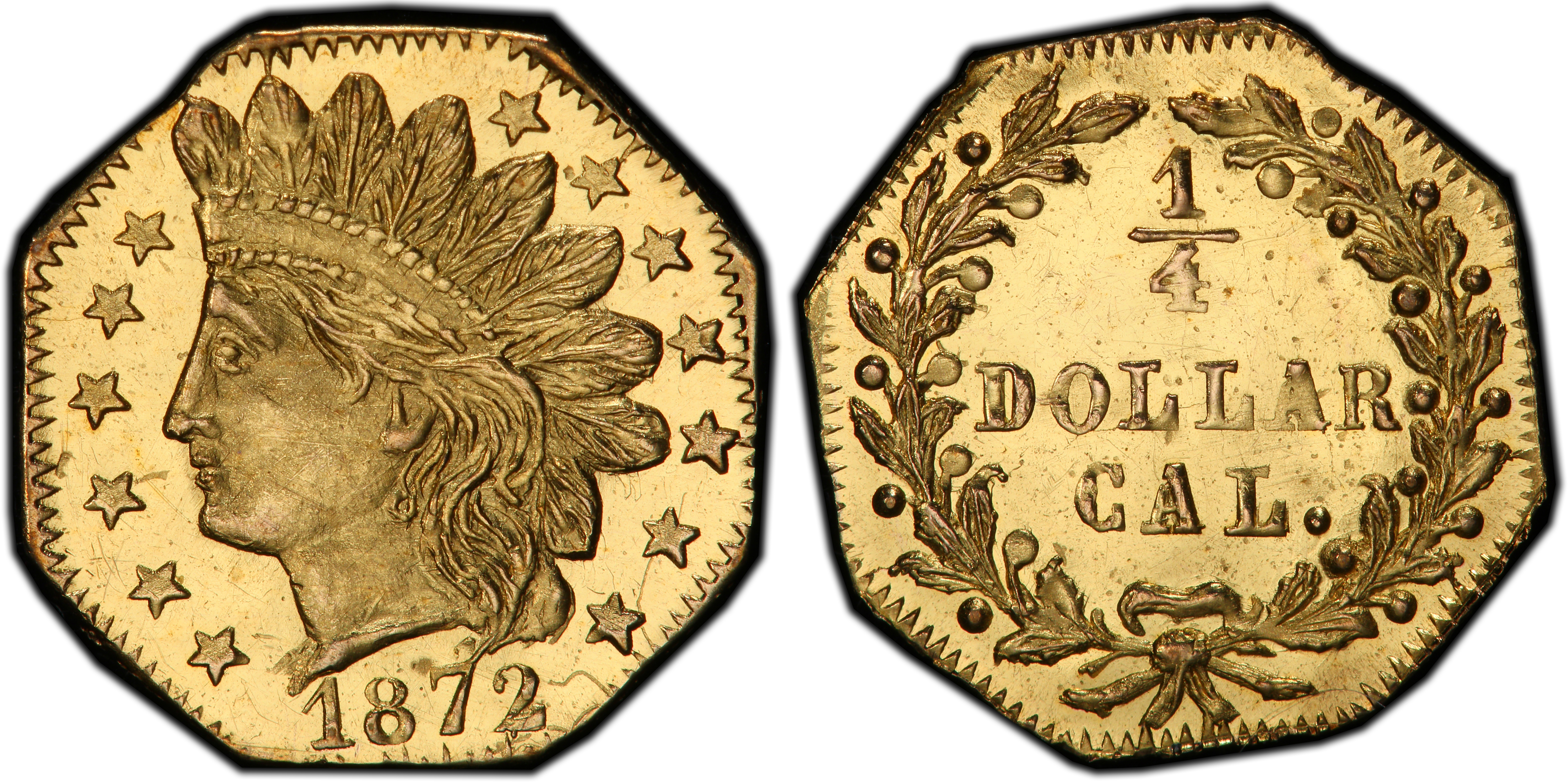
Obverse & Reverse
The 1872 G25C BG-791 octagonal 25-cent piece emerges from the second major phase of California's private gold coinage, a period defined more by commercial artistry and the burgeoning souvenir trade than the urgent monetary necessity that characterized the initial Gold Rush years. By the 1870s, the acute shortage of small change that had plagued California in the early 1850s had been largely resolved by the output of the official San Francisco Mint, which began operations in 1854. However, the allure of gold and the romance of the '49er era persisted, creating a robust market for gold novelties. Private minters, many of whom were skilled jewelers and engravers, transitioned from producing quasi-circulating currency to creating beautifully crafted, low-denomination gold pieces for tourists, merchants, and those wishing to send a piece of California's golden dream back East. These 'Period Two' issues (1859-1882) were typically underweight for their face value, functioning as tokens or keepsakes rather than true coinage. Their production existed in a legal gray area following the Coinage Act of 1864, which banned private coinage. However, the law was not strictly enforced against these small-denomination pieces until the Secret Service launched a major crackdown in 1883. The BG-791, attributed to jeweler Christopher Ferdinand Mohrig, is a prime example of this era's output. Struck with precision and an artistic flair uncommon in the earlier, cruder issues, these pieces were designed for aesthetic appeal. Their octagonal shape was a deliberate nod to the massive, iconic $50 'slugs' issued by the U.S. Assay Office in the early 1850s, linking them directly to the most famous symbols of Gold Rush wealth. Though they never meaningfully circulated as money, they tell a crucial story about California's evolving economy and its burgeoning identity as a destination, where the memory of the Gold Rush was itself a valuable commodity.
Associated EventPost-Gold Rush California Economic Development
Reason For MintingPrimarily created to serve the growing demand for souvenirs and jewelry items related to the California Gold Rush, rather than to alleviate a currency shortage.
Minter HistoryChristopher Ferdinand Mohrig was a prominent and prolific San Francisco jeweler and engraver. Active from the 1860s into the 1880s, he was responsible for a wide variety of California fractional gold designs. His work is noted for its high artistic quality and sharp striking characteristics, distinguishing it from the cruder products of some of his contemporaries. Mohrig's business capitalized on the demand for gold tokens and novelties, and his distinctive Indian Head and Liberty Head designs are among the most recognizable and collected in the entire series. He operated in the legal ambiguity of the time, producing denominated pieces until the government crackdown in the early 1880s.
Historical SignificanceThe BG-791 represents the maturation of the California fractional gold series from utilitarian coinage of necessity to commercial keepsakes. It is a tangible artifact of the post-Gold Rush souvenir trade and the romanticization of the era, showcasing the high level of skill achieved by private San Francisco minters. Its existence highlights a period of lax federal enforcement on private coinage, which allowed a vibrant and collectible numismatic category to flourish for three decades.
N/A
Denomination25 Cents
Minting Period1872
Assayer/MinterChristopher Ferdinand Mohrig
Geographic OriginSan Francisco, California
Obverse DescriptionA large, well-defined bust of a Native American princess facing left, often described as an 'Indian Head'. The portrait is adorned with a feathered headdress. Thirteen stars encircle the bust along the octagonal border.
Obverse Inscription[None, only the portrait and stars]
Reverse DescriptionThe reverse features the denomination '1/4' and the word 'DOLLAR' within a wreath of leaves and berries. The date '1872' is positioned below the wreath.
Reverse Inscription1/4 DOLLAR 1872
CompositionGold
Stated Fineness Actual FinenessVaries, but typically between 14 and 22 carats. These Period Two issues were known to be underweight for their face value.
Diameter10.00 mm
EdgePlain
Unknown
Survival Estimate200-300
Rarity ScaleR-4
This variety is highly popular due to its crisp, attractive Indian Head design by a known maker, C.F. Mohrig. Its octagonal shape, reminiscent of the famous $50 slugs, adds to its historical appeal. The frequent availability of examples with prooflike (PL) surfaces makes it a favorite for collectors seeking exceptional eye appeal.
Key VarietiesThe primary variety is the BG-791 as described. No major varieties from the original minting period are widely recognized. However, the 'PL' (Prooflike) designation is a key distinction sought by collectors, indicating coins struck from highly polished dies, resulting in mirror-like fields. There are no known official restrikes or pattern pieces for this specific variety.
Authentication TipsGenuine BG-791 pieces exhibit a sharp, high-relief strike, especially on the feathers and facial features. The lettering and date on the reverse should be clear and well-formed. Look for a diagnostic die crack that often appears on the obverse. Counterfeits are common and often have a mushy or soapy appearance, incorrect weight, or a brassy color. Modern replicas are also plentiful but usually lack the fine details of genuine strikes and may be gold-plated rather than solid gold.
Shopping ConsiderationsA premium quality example for its grade will possess deeply reflective, prooflike surfaces that contrast with frosted devices (cameo effect). Look for sharp details on the highest points of the Indian's headdress and the leaves in the wreath. While contact marks are common on these small, soft gold pieces, seek out examples with marks that are minimal and located in inconspicuous areas. Avoid coins that have been harshly cleaned, which will show hairline scratches and impaired luster. Specimens with original, undisturbed surfaces and a reddish-gold toning command significant premiums.
A coin's grade is its condition, rated on a 1-70 scale. For rare coins, this is the most critical factor in determining value, as a tiny difference in preservation can mean a huge difference in price.
Relevant Grade TypesOriginal 1872 BG-791 issues were business strikes, though many were produced with special care for the souvenir market. They are found in Circulated grades (1-58) and, more commonly, in Mint State (MS, 60-70). The 'PL' (Prooflike) and 'DMPL' (Deep Mirror Prooflike) designations are particularly relevant and desirable for this issue, indicating highly reflective fields. No true Proofs were struck during the original period of issue, and there are no known later-date Proof restrikes.
Mint State CharacteristicsUncirculated examples of BG-791 are known for their sharp strikes, a hallmark of Mohrig's work. Luster on standard Mint State coins is typically bright and satiny. On Prooflike (PL) specimens, the fields are highly reflective, resembling a mirror. Due to the manufacturing process and handling, even high-grade examples can show minor planchet flaws or small, scattered contact marks. A key diagnostic is often a die crack on the obverse, which is a feature of manufacturing and not a flaw.
Circulated Wear PatternsWear first appears on the high points of the design: the cheek and the feathers of the headdress on the obverse. On the reverse, the highest parts of the wreath and the numerals of the fraction '1/4' will show initial friction. In lower circulated grades (VF and below), the finer details of the feathers will merge and the stars will begin to weaken.
Key Factors For ValueThe single most important factor for this variety is the quality of the surfaces. A coin with a PL or DMPL designation will be worth significantly more than a standard MS example of the same numerical grade. Strong cameo contrast between the devices and fields also adds a substantial premium. As with all gold, originality is key; specimens with original 'skin' and no evidence of cleaning or polishing are heavily favored. The presence of a CAC sticker, verifying quality for the grade, adds a notable premium for this popular and visually striking issue.
PCGS Price Guide
| Grade | Price | Population |
|---|---|---|
| 63 | N/A | 1 |
| 64 | $575.00 | N/A |
| 64+ | $775.00 | N/A |
| 65 | $1,100.00 | 2 |
| 65+ | $1,250.00 | N/A |
| 66 | $1,450.00 | N/A |
| 66+ | $1,750.00 | N/A |
| 67 | $2,750.00 | N/A |