1876 G50C BG-953, PL (Regular Strike)
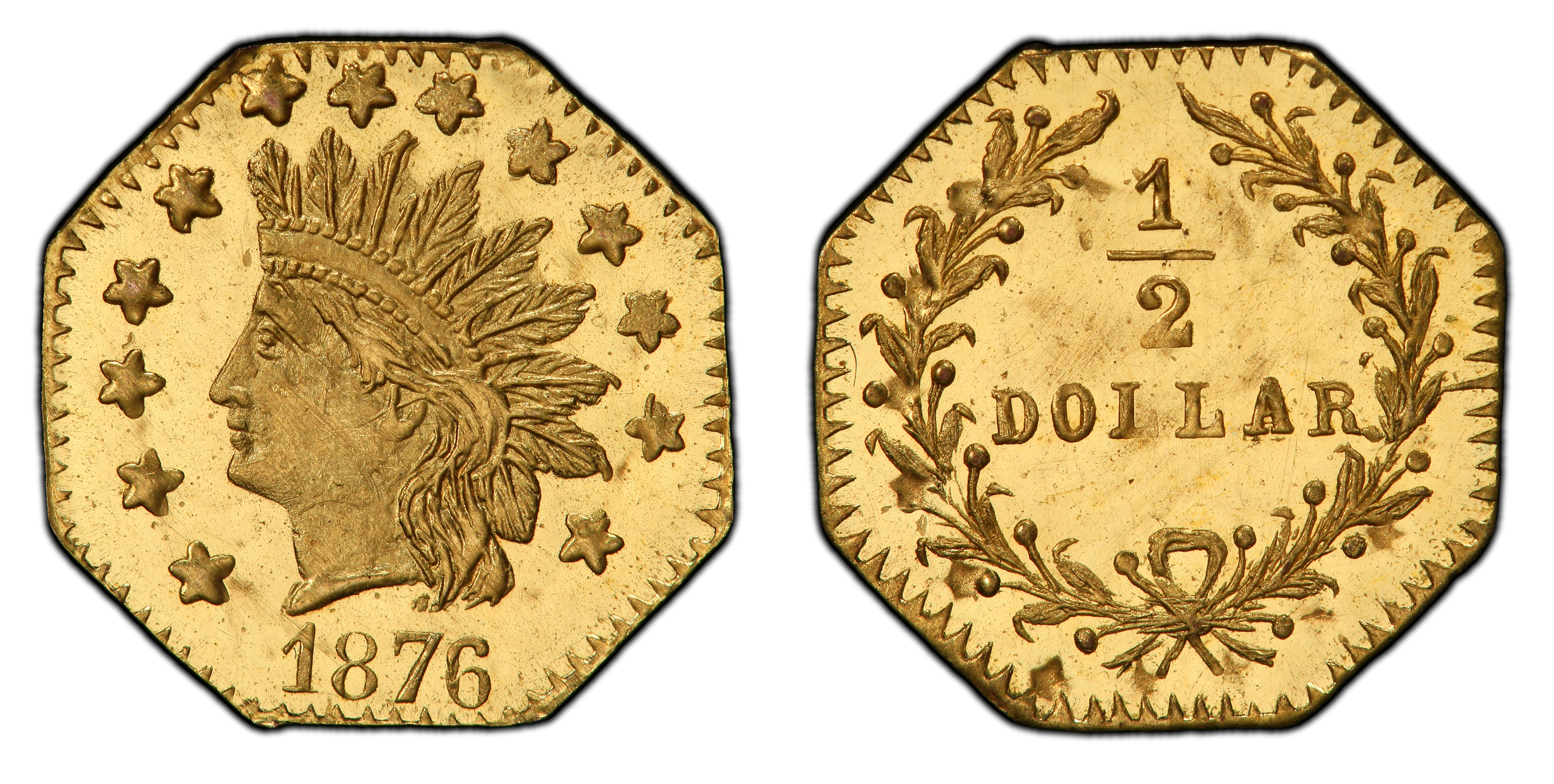
Obverse & Reverse
The 1876 BG-953 50 Cent piece emerges from the second period (1859-1882) of California Fractional Gold production, a fascinating and complex chapter in American numismatics. The initial impetus for these tiny gold coins in the early 1850s was a severe shortage of small change in the economically isolated boomtowns of the California Gold Rush. While larger private and federal gold coins handled significant transactions, the lack of dimes, quarters, and half dollars made daily commerce cumbersome. Local jewelers and metallurgists stepped in, privately striking quarter, half, and one-dollar denominations to facilitate trade. These 'Period One' (1852-1857) issues are believed to have genuinely circulated. By the time the BG-953 was struck, the landscape had changed dramatically. The San Francisco Mint, opened in 1854, had largely resolved the small-denomination coinage shortage. The motivation for producing fractional gold shifted from commerce to souvenir and novelty sales. These 'Period Two' pieces, often called 'jeweler's issues,' were created primarily for tourists and as keepsakes of the Gold Rush era. This context is crucial for understanding the BG-953; it was not intended to be a workhorse of the economy but a memento. The year 1876 was particularly significant as it marked the Centennial of the United States, an event celebrated with great patriotic fervor nationwide, including in California. Many fractional gold pieces from this year, with their Indian Head and Liberty motifs, tapped into this national sentiment. The production of these denominated tokens existed in a legal gray area. The Coinage Act of 1864 explicitly outlawed private coinage, but the law was not vigorously enforced against these small, low-value tokens until the Secret Service cracked down in the early 1880s. Evidence of this enforcement includes the 1876 arrest of minter Christopher Ferdinand Mohrig, whose dies and stock were confiscated and destroyed, explaining the rarity of many 1876-dated varieties. The BG-953, likely struck by the firm of Robert B. Gray & Co., represents the twilight of this unique industry, a final flourish of private minting before federal law closed the chapter for good.
Associated EventPost-Gold Rush California / U.S. Centennial
Reason For MintingPrimarily created as souvenirs for tourists and as keepsakes of the Gold Rush era, rather than to fill a circulating coinage need.
Minter HistoryWhile attribution is not definitive for every die marriage, the BG-953 is widely believed to have been produced by Robert B. Gray & Co. of San Francisco. Gray was a prominent jeweler and a prolific manufacturer of California Fractional Gold during 'Period Two.' His firm, along with others run by French jewelers like Deriberpe, Nouizillet, and Deviercy, dominated the souvenir fractional gold market. These minters were skilled craftsmen who adapted their designs to appeal to the public, often mimicking federal coinage motifs like the Indian Head, which was popular at the time on the U.S. cent. Their operations were typically small-scale, using hand-operated presses to strike the tiny gold planchets.
Historical SignificanceThe BG-953 is a tangible artifact of the post-Gold Rush California economy and the burgeoning tourism industry. It represents a numismatic echo of the great rush, embodying the transition of fractional gold from a commercial necessity to a nostalgic souvenir. Its existence highlights a period of limited federal oversight and the persistent entrepreneurial spirit of private minters who continued to operate for nearly two decades after private coinage was officially outlawed.
N/A
DenominationG50C
Minting Period1876
Assayer/MinterProbably Robert B. Gray & Co.
Geographic OriginSan Francisco, California
Obverse DescriptionAn Indian Head motif, facing left, wearing a feathered headdress. The portrait is surrounded by thirteen stars, representing the original colonies.
Obverse Inscription1876
Reverse DescriptionThe denomination '1/2' is enclosed within a wreath of leaves and berries. The wreath is open at the top.
Reverse InscriptionCALIFORNIA GOLD
CompositionGold
Stated Fineness Actual FinenessVaries, but generally lower than monetary issues of the period.
Weight0.25 grams
Diameter10.00 mm
EdgePlain
Unknown; likely very small.
Survival EstimateFewer than 75
Rarity ScaleR-5
The BG-953 is sought after for its connection to the historic California Gold Rush era, its unusual octagonal shape, the popular Indian Head design, and its specific date of 1876, the nation's Centennial year. As a 'Period Two' issue, it is more accessible than the prohibitively rare circulating issues of the early 1850s, yet it remains a genuine 19th-century artifact from this fascinating series.
Key VarietiesThe primary variety is the BG-953 as described. There are no known major sub-varieties or special collector restrikes from the period. The Breen-Gillio reference is the definitive guide to die marriages, and collectors often focus on specific BG numbers. It is crucial to distinguish genuine 'Period One' and 'Period Two' pieces from the vast number of modern, unofficial replicas, charms, and 20th-century fantasy pieces, many of which are gold-plated base metal and lack a specific denomination.
Authentication TipsAuthentic BG-953 pieces have a characteristic strike style that is often uneven but with sharp details in protected areas. The lettering and stars should be stylistically consistent with other known Robert B. Gray & Co. products. Counterfeits are rampant in this series. Many fakes are cast, exhibiting a porous or soapy surface texture. Others are struck but from modern dies with incorrect details, fonts, or star shapes. A key diagnostic for many fakes is the presence of a bear on the reverse, a design element never used on genuine 19th-century issues. Due to their tiny size and the prevalence of forgeries, authentication by a reputable third-party grading service (PCGS or NGC) is highly recommended. These services attribute the coins by their Breen-Gillio (BG) number.
Shopping ConsiderationsA premium quality BG-953 will exhibit a sharp strike, particularly on the details of the Indian's headdress and the wreath on the reverse. Given that these were often produced by hand-press, strikes can be uneven, so a well-centered and fully struck example commands a significant premium. Luster is a key factor; many examples are found with prooflike (PL) or deep prooflike (DPL) surfaces, which are highly desirable. Look for original, uncleaned surfaces with a warm, reddish-gold toning. Common problems include cleaning, which dulls the luster and imparts hairline scratches, and former use in jewelry, resulting in solder marks, holes, or heavy rim damage. For this variety, eye appeal is paramount. A lustrous, well-struck coin with minimal marks will always be prized over a higher-grade but less attractive example.
A coin's grade is its condition, rated on a 1-70 scale. For rare coins, this is the most critical factor in determining value, as a tiny difference in preservation can mean a huge difference in price.
Relevant Grade TypesOriginal period issues like the BG-953 were business strikes, technically intended as souvenirs rather than for circulation, and are found in Circulated (1-58) and, more commonly, Mint State (MS, 60-70) grades. Due to their status as keepsakes, many were well-preserved. No original Proofs were struck during the period. The 'PL' (Prooflike) designation seen with this issue refers to business strikes made with highly polished dies, resulting in mirror-like fields, and is not indicative of a special striking process.
Mint State CharacteristicsUncirculated examples are defined by their luster. A typical BG-953 may have semi-prooflike or fully prooflike surfaces due to the use of polished dies. Strike quality varies; the central devices like the Indian's cheek and the wreath may show some softness. High-grade examples will have a sharp, 'wire' rim. Due to their small size and handling as curiosities, even Mint State coins can have tiny, detracting marks or planchet flaws, so a 'clean' coin is especially desirable.
Circulated Wear PatternsFor examples that saw handling, wear first appears on the highest points: the cheek and feathers of the Indian Head on the obverse, and the high points of the wreath leaves and the fraction '1/2' on the reverse. As wear progresses, the stars and legends will become soft and eventually merge with the fields.
Key Factors For ValueThe primary value drivers for a BG-953 are grade, surface quality, and eye appeal. A high Mint State grade (e.g., MS-64 or better) is highly desirable. The presence of a Prooflike (PL) or Deep Prooflike (DPL) designation adds a significant premium. Surface preservation is critical; examples free of distracting marks, carbon spots, or evidence of cleaning are prized. Finally, coins with strong luster and attractive original toning command the highest prices. A CAC sticker for this issue would confirm premium quality for the assigned grade and add a further premium.
PCGS Price Guide
| Grade | Price | Population |
|---|---|---|
| 62 | N/A | N/A |
| 63 | $650.00 | 2 |
| 63+ | $725.00 | N/A |
| 64 | $1,000.00 | N/A |
| 64+ | $1,200.00 | N/A |
| 65 | $1,750.00 | 1 |