1865 25C BG-803, PL (Regular Strike)
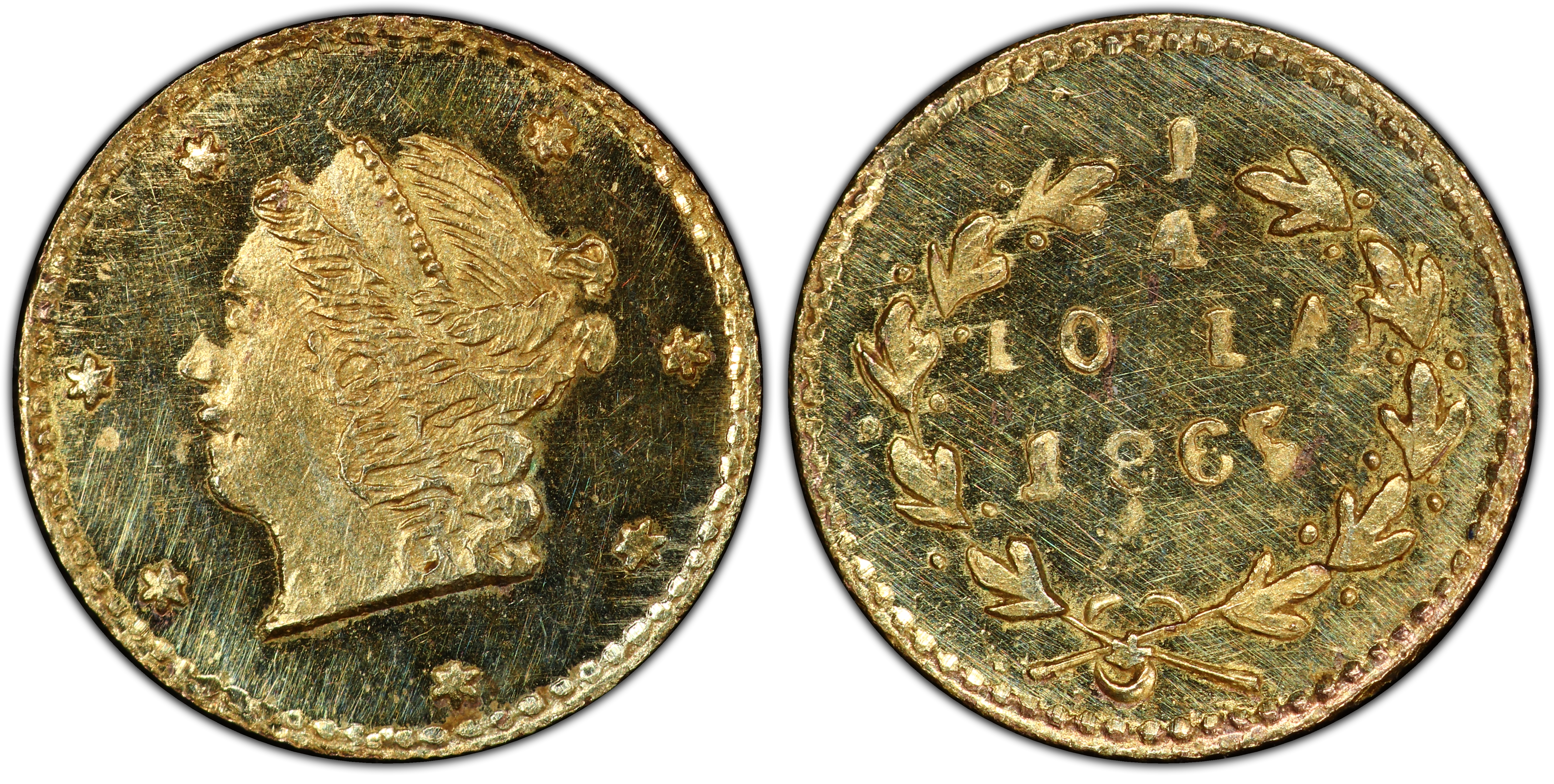
Obverse & Reverse
The 1865 BG-803 25 Cents represents a fascinating chapter in the history of private American coinage, belonging to what numismatists classify as 'Period Two' (1858-1882) of California Fractional Gold. By the mid-1860s, the acute shortage of small change that had plagued California during the initial Gold Rush years had largely been resolved by the output of the U.S. Mint in San Francisco, which opened in 1854. The initial purpose of fractional gold—to serve as a circulating medium of exchange—had thus become obsolete. However, a robust new market had emerged. These miniature gold pieces, tangible relics of the great Gold Rush, became immensely popular as souvenirs, keepsakes, and jewelry items for tourists and residents alike. Entrepreneurs, primarily local jewelers with metalworking skills, stepped in to meet this demand, creating what are now known as 'jeweler's issues.' Unlike the earlier 'Period One' issues which were intended for commerce and generally contained a higher intrinsic value, these later pieces were produced almost exclusively for the souvenir trade. They were often significantly underweight and of a lower, variable fineness. The Coinage Act of April 22, 1864, had made private coinage illegal, but the law was not strictly enforced against these small tokens until the Secret Service cracked down in 1883. Thus, for nearly two decades, jewelers were able to produce these denominated pieces, like the BG-803, with relative impunity. They were typically struck using the primitive 'hammer method,' where a planchet was placed between two dies and struck manually, leading to frequent inconsistencies in strike quality. The BG-803, with its amateurish die work noted in auction catalogs, is a prime example of a piece created not for monetary precision but for commercial appeal as a memento of California's golden era.
Associated EventPost-Gold Rush California Souvenir Trade
Reason For MintingTo satisfy the significant public demand for gold rush souvenirs and keepsakes rather than to alleviate a shortage of circulating coinage.
Minter HistoryThe identity of the specific jeweler or firm that produced the BG-803 variety is lost to history. This is characteristic of the Period Two issues, where many makers did not apply an identifiable hallmark or initial to their work. These craftsmen were typically jewelers located in San Francisco who possessed the skills and equipment for die-sinking and striking small gold items. Their primary business was jewelry and watchmaking, with the production of fractional gold being a profitable sideline capitalizing on the romantic allure of the Gold Rush.
Historical SignificanceThe BG-803 is significant not as a coin intended for commerce but as a cultural artifact. It represents the transition of California fractional gold from a necessary private currency to a nostalgic souvenir. Its existence highlights the enduring legacy of the Gold Rush in the American imagination and the entrepreneurial spirit of California jewelers who catered to the burgeoning tourist trade of the era. These pieces are tangible links to a time when owning a tiny piece of 'California Gold' was a popular way to connect with one of America's most defining historical events.
BG-803
Denomination25 Cents
Minting Period1865
Assayer/MinterUnknown Private Minter / Jeweler
Geographic OriginSan Francisco, California (presumed)
Obverse DescriptionFeatures a Liberty Head portrait facing left, stylistically imitative of contemporary U.S. federal gold coinage. The portrait is surrounded by thirteen stars, representing the original colonies. The date '1865' is below the bust.
Obverse Inscription1865
Reverse DescriptionA simple wreath surrounds the denomination '1/4 DOLLAR'. The wreath is tied with a bow at the bottom.
Reverse Inscription1/4 DOLLAR
CompositionGold
Stated Fineness Actual FinenessVariable; Period Two issues are known to have a lower and inconsistent gold content, often significantly below the .900 fineness of federal issues.
Weight0.24 grams
Diameter9.60 mm
EdgePlain
Unknown
Survival Estimate13 to 30 coins known
Rarity ScaleR-6
The BG-803 is sought after for its high rarity and as a representative of the 'jeweler's issue' period of California Fractional Gold. Its appeal lies in its connection to the post-Gold Rush souvenir market, and the challenge of acquiring such a scarce variety. High-grade examples with a sharp strike and prooflike surfaces command significant premiums.
Key VarietiesNo major die varieties of BG-803 are widely cataloged. As a Period Two 'jeweler's issue,' these were not official coins and thus lack patterns or proof strikings in the traditional sense. The 'PL' (Prooflike) designation in the user's input refers to business strikes made from polished dies on polished planchets, a common characteristic of these souvenir pieces, and not to a separate proof striking.
Authentication TipsAuthentic examples will show the word 'DOLLAR' on the reverse; many common modern replicas lack a denomination or use phrases like 'CALIFORNIA GOLD' with a bear emblem. The strike is often weak in areas, particularly the date and parts of the word 'DOLLAR,' a trait that fakes, which are often sharply struck, may lack. Look for signs of amateurish die cutting, a characteristic of many genuine jeweler's issues. The planchets are typically very thin. Third-party grading is highly recommended as the series is heavily counterfeited.
Shopping ConsiderationsWhen acquiring a BG-803, the quality of the strike is paramount. A 'premium quality' example will exhibit unusual sharpness for the issue, with a fully legible date and denomination. Look for coins with bright, original prooflike or semi-prooflike surfaces that have not been harshly cleaned or polished. Avoid examples that are bent, holed, or show evidence of having been mounted in jewelry, as this is common for the series but significantly detracts from numismatic value. Pay close attention to the high points of the design for excessive die polishing, which can obliterate detail on Liberty's hair and diadem even on uncirculated specimens.
A coin's grade is its condition, rated on a 1-70 scale. For rare coins, this is the most critical factor in determining value, as a tiny difference in preservation can mean a huge difference in price.
Relevant Grade TypesOriginal 1865 issues of BG-803 were business strikes, although many were struck from polished dies to have a prooflike appearance to enhance their appeal as souvenirs. They are found in Circulated (1-58) and, more commonly, Mint State (MS, 60-70) grades. No true Proofs were struck during the original period of issue; the 'PL' designation refers to the surface characteristic of a business strike, not a separate striking method.
Mint State CharacteristicsUncirculated examples of BG-803 are defined by their surface quality and strike. Luster is typically bright and reflective (prooflike), stemming from the polished dies used. However, the strike is characteristically weak. The date is often softly impressed, and parts of the word 'DOLLAR' on the reverse may be faint or missing entirely. Excessive die polishing before the strike can also lead to a loss of detail on the highest points of Liberty's portrait, such as the bridge of the nose and the diadem, even on a coin that has never seen circulation. Contact marks can be present due to the softness of the gold.
Circulated Wear PatternsOn circulated examples, wear first appears on the highest points of Liberty's hair, cheek, and coronet. On the reverse, the highest points of the wreath will show flattening. In lower grades (VF and below), the date and the finer details of the wreath will become indistinct. Given their primary use as souvenirs, many circulated examples suffer from damage like scratches, bending, or evidence of jewelry mounting rather than honest, even wear.
Key Factors For ValueThe primary value driver for a BG-803 is its grade and eye appeal. A sharp, well-centered strike is highly prized and carries a significant premium due to the variety's propensity for weakness. Original, unimpaired prooflike surfaces are more desirable than cleaned or polished examples. Coins with minimal distracting contact marks and a bold overall appearance for the grade will command the highest prices. Given the high rarity, any certified example is valuable, but a sticker from CAC, indicating premium quality for the grade, adds another layer of desirability for discerning collectors.
PCGS Price Guide
| Grade | Price | Population |
|---|---|---|
| 61 | N/A | N/A |
| 64 | $1,000.00 | 1 |