1876 25C BG-881 (Regular Strike)
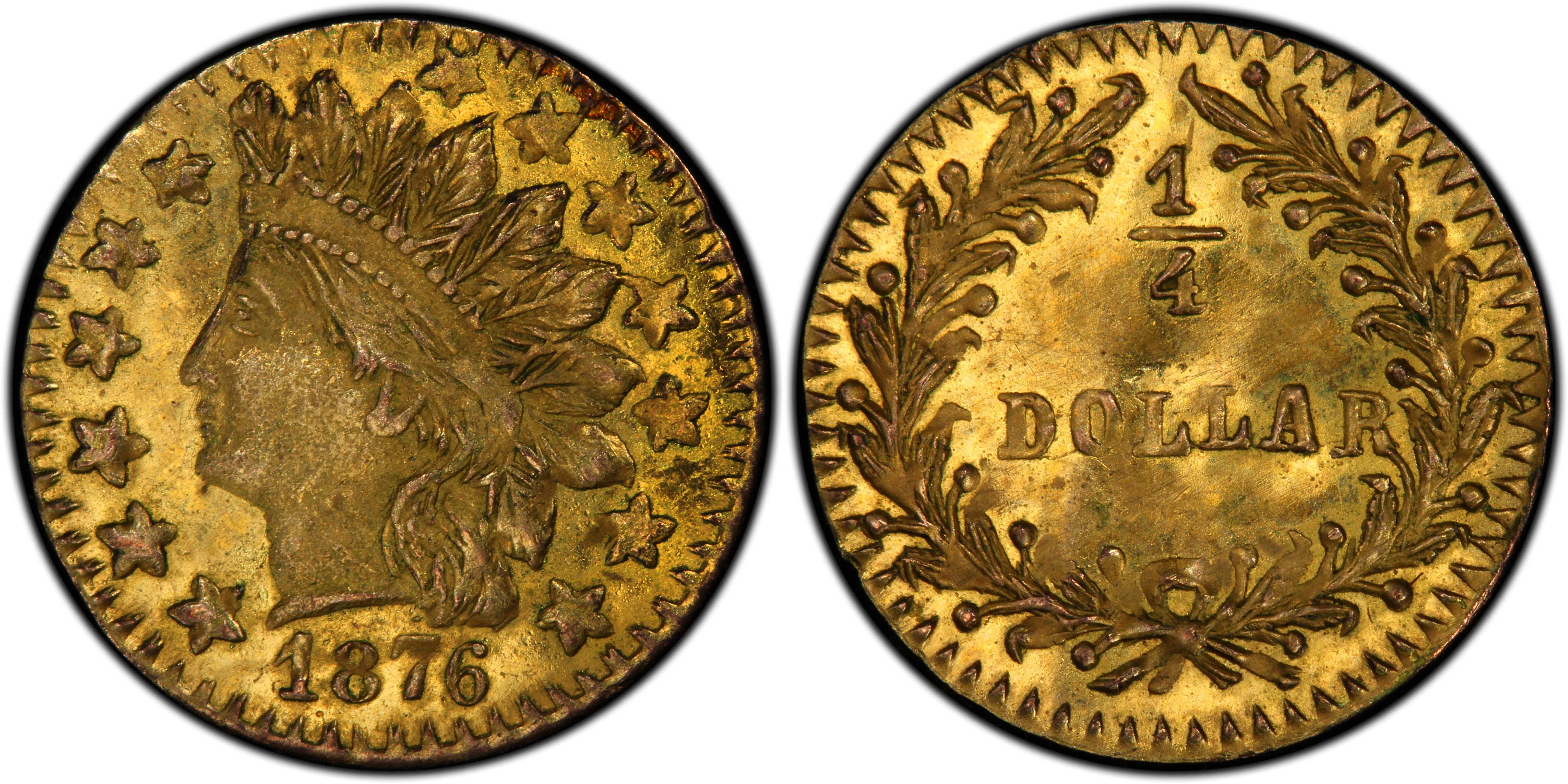
Obverse & Reverse
The 1876 BG-881 25-cent piece emerges from the third and final phase of California Fractional Gold production (1872-1882), a period characterized more by the creation of souvenirs and collector pieces than circulating currency. By the mid-1870s, the acute shortage of small change that plagued California during the Gold Rush had largely subsided. The San Francisco Mint was producing ample federal coinage, and the economic landscape had stabilized. The impetus for producing these minuscule gold pieces shifted from necessity to novelty. Jewelers and private minters, recognizing a market for keepsakes and mementos of the romanticized Gold Rush era, began striking these small-denomination gold coins, often backdating them to the 1850s to enhance their appeal. The year 1876 was particularly significant as it marked the Centennial of the United States, celebrated with the massive Centennial International Exhibition in Philadelphia. This nationalistic fervor spurred the production of countless souvenirs, and it is highly probable that pieces like the BG-881 were struck to capitalize on this celebratory market. These 'Period Two' pieces, as defined by Breen and Gillio, are distinguished from the earlier, functional 'Period One' (1852-1857) issues by their generally lower weight, lower fineness, and more refined, almost prooflike striking quality. They were not intended to pass as currency at face value but were sold as curiosities for slightly more than their minimal gold content. Despite their non-circulating intent, they are an integral part of the Territorial Gold story, representing the commercial evolution of the private minting industry in California and the enduring allure of gold.
Associated EventU.S. Centennial (1876)
Reason For MintingPrimarily struck as souvenirs and collector's items to capitalize on the nostalgia of the Gold Rush and the patriotism of the U.S. Centennial.
Minter HistoryThe specific minter for BG-881 is not definitively known, a common trait for many Period Two California fractionals. However, stylistic elements and punches are often linked to firms known to be active in San Francisco's jewelry and souvenir trade during this era. Robert B. Gray & Co. is a frequently cited potential manufacturer for many of these later issues. These minters were typically skilled metalworkers and jewelers who adapted their craft to produce these popular and profitable gold tokens.
Historical SignificanceThe BG-881 represents the transition of California Fractional Gold from a necessary medium of exchange to a commercial souvenir. It is a tangible artifact of the post-Gold Rush economy and the burgeoning market for historical mementos, particularly during the celebratory atmosphere of the nation's Centennial year. Numismatically, it is a key variety within the extensive Breen-Gillio classification system.
N/A
Denomination25 Cents
Minting Period1876
Assayer/MinterUnknown, possibly Robert B. Gray & Co.
Geographic OriginSan Francisco, California
Obverse DescriptionA beaded border encloses a right-facing portrait of a female figure representing Liberty, wearing a Native American-style feathered headdress. Thirteen stars surround the portrait.
Obverse Inscription[No Inscription]
Reverse DescriptionA continuous wreath of leaves and berries surrounds the denomination. The fraction '1/4' appears at the top, above the word 'DOLLAR'. A notable diagnostic for this variety is the high placement of the fraction above 'DOLLAR'.
Reverse Inscription1/4 DOLLAR
CompositionGold
Stated Fineness Actual FinenessVaries, but typically lower than Period One issues, often in the 10-14 Karat range.
Weight0.25 grams
Diameter9.80 mm
EdgePlain
Unknown
Survival Estimate75-125
Rarity ScaleR-5
This variety is popular due to its specific date coinciding with the U.S. Centennial, its classic 'Indian Head' design, and its status as a relatively affordable entry point into the complex world of Breen-Gillio varieties. The challenge of collecting the vast series of California fractionals makes any specific, attributable variety like BG-881 desirable.
Key VarietiesThe primary variety is the regular business strike. While no original proof strikings are known, many examples of BG-881 were struck with polished dies on polished planchets, resulting in a highly prooflike (PL) or Deep Mirror Prooflike (DMPL) appearance. These are not true proofs but are highly coveted by collectors and command significant premiums. There are no known major die varieties or later restrikes for BG-881.
Authentication TipsGenuine pieces exhibit sharp, well-defined details, especially in the feathers and wreath, despite their minuscule size. The surfaces are often prooflike. Counterfeits are common but often have a mushy or soapy appearance, incorrect weight, or a brassy color. A key diagnostic for authenticity in many California fractionals is a characteristic weak or uneven strike in some areas due to the thinness of the planchets. Many fakes are also missing the denomination (e.g., 'DOLLAR' or 'CENTS'), which is a red flag, though BG-881 does include 'DOLLAR'. Authentication by a major third-party grading service (PCGS or NGC) is highly recommended.
Shopping ConsiderationsA premium quality example will exhibit a sharp strike, particularly on the highest points of the feathers and the details within the wreath. Seek out coins with bright, original prooflike or deep mirror prooflike surfaces that are free of distracting carbon spots or hairlines. A common issue is damage from being mounted in jewelry; inspect the rims and edges carefully for any signs of solder or tooling. Given the prooflike nature of many strikes, cameo contrast between the devices and fields is highly desirable and adds significantly to the coin's eye appeal and value.
A coin's grade is its condition, rated on a 1-70 scale. For rare coins, this is the most critical factor in determining value, as a tiny difference in preservation can mean a huge difference in price.
Relevant Grade TypesOriginal period issues were business strikes, although not intended for circulation, and are found in Mint State (MS, 60-70) grades. Circulated examples (1-58) are scarce, as these were primarily saved as keepsakes. No true Proofs (PR/PF) were struck during the original period. However, many business strikes were made with polished dies, resulting in Prooflike (PL) and Deep Mirror Prooflike (DMPL/DPL) surfaces, which are noted on the grading label and are highly sought after.
Mint State CharacteristicsUncirculated examples of BG-881 are characterized by their strong luster, which is typically reflective and prooflike. The strike can be variable; while some are sharp, many show slight weakness in the center of the obverse or reverse. The fields are prone to tiny contact marks and hairlines due to the mirrored surfaces, which can significantly impact the grade. A distinguishing feature can be die rotation; one noted high-grade example has a 90-degree clockwise reverse rotation.
Circulated Wear PatternsFor the rare circulated examples, wear first appears on the high points of the design: the cheek and feathers of the portrait on the obverse, and the highest leaves and the fraction '1/4' on the reverse. As wear progresses, the thirteen stars on the obverse will begin to lose their definition and merge with the field.
Key Factors For ValueThe primary value driver for BG-881 is the quality of its surfaces. A high-grade example with deep, clean, mirrored fields and frosty devices (Cameo/Deep Cameo) will command a substantial premium over a typical mint state piece. Strike sharpness is secondary but still important. Eye appeal is critical; coins with original, vibrant yellow-gold coloration are preferred over those that are dull or have been cleaned. Certification by PCGS or NGC is standard, and a CAC sticker for this issue indicates superior quality for the grade and will bring a strong premium.
PCGS Price Guide
| Grade | Price | Population |
|---|---|---|
| 58 | $300.00 | 1 |
| 58+ | $330.00 | N/A |
| 60 | $375.00 | N/A |
| 61 | $400.00 | 1 |
| 62 | $450.00 | 6 |
| 62+ | $490.00 | N/A |
| 63 | $575.00 | 10 |
| 63+ | $625.00 | N/A |
| 64 | $675.00 | 14 |
| 64+ | $750.00 | N/A |
| 65 | $1,150.00 | 7 |
| 65+ | $1,600.00 | N/A |
| 66 | $3,000.00 | 1 |
| 66+ | $4,250.00 | N/A |
| 67 | N/A | N/A |