1871-L G50C BG-1029 (Regular Strike)
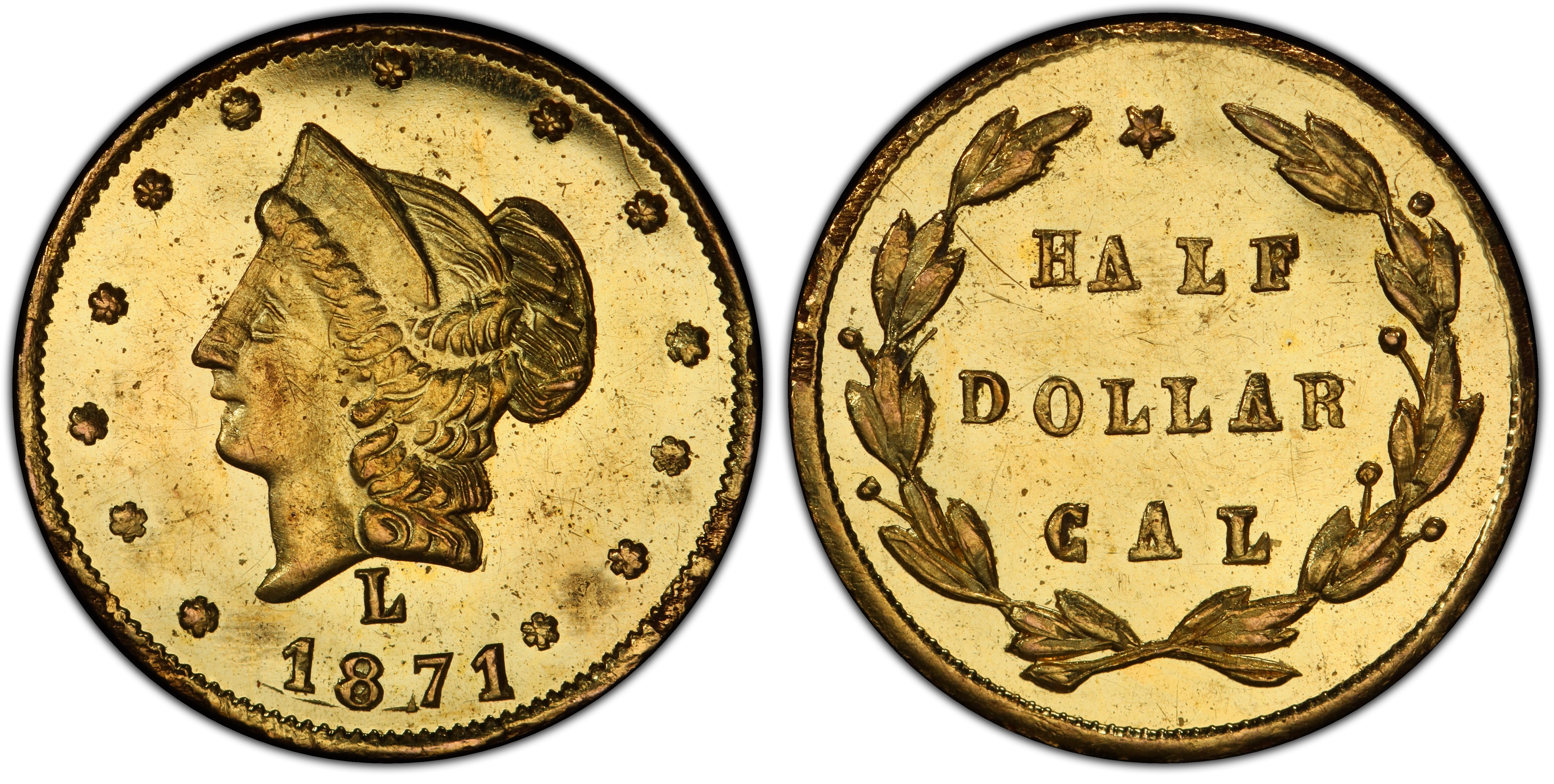
Obverse & Reverse
The 1871-L 50 Cents, cataloged as Breen-Gillio 1029, is a quintessential example from the second period of California Fractional Gold production (1859-1882). Unlike the earlier 'Period One' issues, which arose from a genuine and severe shortage of small-denomination coinage during the initial frenzy of the Gold Rush, these later pieces served a different purpose. By the 1870s, the United States Branch Mint in San Francisco was in full operation, producing ample federal coinage and largely satisfying the region's transactional needs. The impetus for private fractional gold coinage had shifted from necessity to novelty. Enterprising jewelers and metalsmiths, many of French origin like Antoine Louis Nouizillet, recognized a burgeoning market for these miniature gold coins as souvenirs, keepsakes, and jewelry items. They were tangible, affordable mementos of the romanticized Gold Rush era, popular with tourists, locals, and even individuals back East who were captivated by the tales of California's wealth. The Coinage Act of 1864 had officially prohibited private coinage, but enforcement in the West was lax to non-existent for nearly two decades. This legal gray area allowed producers like Nouizillet to continue striking their wares without significant federal interference. These 'jeweler's issues' were typically not intended for vigorous circulation and were often struck with a focus on aesthetic appeal rather than intrinsic value. While made of gold, they were frequently of a lower fineness and lighter weight than their stated denomination would imply, functioning more as tokens than true currency. The production quality, however, was often excellent, with many pieces like the BG-1029 exhibiting sharp details and prooflike or mirrored surfaces, suggesting they were carefully made and preserved by their owners. The production would finally cease around 1883 when the Secret Service began a concerted crackdown on all private minting operations, bringing the fascinating era of California Fractional Gold to a definitive end.
Associated EventPost-Gold Rush California Economy
Reason For MintingPrimarily created to serve the growing demand for souvenirs and jewelry items reminiscent of the Gold Rush era.
Minter HistoryAntoine Louis Nouizillet was one of the prominent San Francisco-based French jewelers involved in the production of 'Period Two' California Fractional Gold. The 'L' initial on the obverse of this and other related varieties is attributed to him (sometimes as part of a partnership). These jewelers capitalized on the romantic appeal of the Gold Rush by creating miniature gold coins that were popular as keepsakes and for use in jewelry. While detailed biographical records are scarce, numismatic scholarship by Walter Breen and Ronald Gillio identifies Nouizillet as a key figure in this souvenir-driven phase of private minting in California.
Historical SignificanceThe BG-1029 represents the maturation of the California Fractional Gold series from a form of necessity-based currency to a commercial souvenir. It highlights a period of weak federal enforcement of private coinage laws and the entrepreneurial spirit of San Francisco's artisans in creating a market for numismatic novelties long before coin collecting was a mainstream hobby.
BG-1029
Denomination50 Cents
Minting Period1871
Assayer/MinterAntoine Louis Nouizillet
Geographic OriginSan Francisco, California
Obverse DescriptionA classic Liberty Head portrait facing left, modeled after the contemporary designs of U.S. federal gold coinage by Christian Gobrecht. The portrait is surrounded by thirteen six-pointed stars, with the letter 'L' (for Louis) below the truncation of the neck and the date '1871' positioned below the 'L'.
Obverse Inscription1871 L
Reverse DescriptionThe denomination '50 CENTS' is displayed prominently within a wreath. The wreath is composed of two branches tied together at the bottom with a bow.
Reverse Inscription50 CENTS
CompositionGold
Stated Fineness Actual FinenessPeriod Two issues are known to be of lower fineness than Period One issues, often ranging from 14 to 22 karats, but the specific fineness for this variety is not consistently documented.
Weight0.75 grams
Diameter11.30 mm
EdgePlain
Unknown
Survival EstimateFewer than 100
Rarity ScaleR-4+ (Sometimes listed as High R-4 or R-5)
This variety is highly collectible due to its direct link to a specific jeweler (Nouizillet), its attractive Liberty Head design, and the frequent availability of high-grade, prooflike specimens that offer tremendous eye appeal for a relatively accessible price compared to Period One issues.
Key VarietiesNo major varieties are noted for the BG-1029 itself during its period of issue. As a 'Period Two' piece, it is considered a 'suppressed jeweler's issue' and was not subject to official restrikes. Modern replicas and fantasy pieces exist for the broader California Fractional Gold series, but they are not considered part of the original numismatic lineage.
Authentication TipsAuthentic examples of BG-1029 often have a 'hammered' appearance, with potential for uneven strike pressure, though many are well-made. The style of the numerals in the date and the lettering should be compared to known genuine examples in reference books like Breen-Gillio. Counterfeits of this era are common; be wary of pieces with incorrect design details, mushy features, or an unnatural surface color. Any pieces featuring a bear on the reverse are fantasy issues and not authentic California Fractional Gold. Third-party certification by a reputable service like PCGS or NGC is highly recommended.
Shopping ConsiderationsA premium quality example of BG-1029 will exhibit sharply struck details on Liberty's hair and the wreath on the reverse. The most desirable specimens are designated as 'Prooflike' (PL) or 'Deep Mirror Prooflike' (DMPL), showcasing highly reflective, mirrored fields. Given their use in jewelry, carefully check the rims and surfaces for evidence of mounting, tooling, or harsh cleaning, which will significantly reduce the value. A coin with original, unmolested surfaces and bright luster commands a significant premium. Damage such as having been 'mount removed' is a common issue and should be noted.
A coin's grade is its condition, rated on a 1-70 scale. For rare coins, this is the most critical factor in determining value, as a tiny difference in preservation can mean a huge difference in price.
Relevant Grade TypesOriginal period issues were business strikes, although primarily intended as souvenirs rather than for circulation. They are found in both Circulated (1-58) and, more commonly, Mint State (MS, 60-70) grades. No official Proofs (PR/PF) were struck during the original period of issue. However, many Mint State examples were struck on polished planchets with polished dies, resulting in Prooflike (PL) or Deep Mirror Prooflike (DMPL) surfaces, which are a separate and highly desirable quality designation, not a strike type.
Mint State CharacteristicsUncirculated examples of BG-1029 are defined by their luster and lack of wear. Luster can range from satiny to intensely mirrored (prooflike). The strike can be uneven, a remnant of the hammer-striking process, but high-quality pieces are expected to have sharp details. Due to the softness of the gold and their status as keepsakes, they are susceptible to small contact marks or hairlines from handling over the years, even if they never circulated.
Circulated Wear PatternsFor circulated examples, wear first appears on the highest points of the design. This includes Liberty's hair curls above the eye and ear, and the high points of the leaves and bow in the reverse wreath. On lower-grade pieces, the stars and legends will begin to soften and merge with the fields.
Key Factors For ValueThe primary value driver for this coin is its grade, with a steep premium for Gem (MS-65 and above) examples. The presence of a Prooflike (PL) or Deep Mirror Prooflike (DMPL) designation dramatically increases value and collector demand. Surface quality is paramount; an example with clean, original surfaces will always be worth more than a cleaned or damaged coin of the same grade. Eye appeal, including attractive original gold toning and the reflectivity of the fields, plays a major role. A CAC sticker for this issue confirms premium quality for the grade and typically adds a significant premium.
PCGS Price Guide
| Grade | Price | Population |
|---|---|---|
| 30 | $225.00 | 1 |
| 35 | $227.00 | 1 |
| 40 | $230.00 | 1 |
| 45 | $235.00 | 1 |
| 45+ | $237.00 | N/A |
| 50 | $240.00 | 5 |
| 50+ | $245.00 | N/A |
| 53 | $250.00 | 2 |
| 53+ | $255.00 | N/A |
| 55 | $260.00 | 9 |
| 55+ | $265.00 | N/A |
| 58 | $270.00 | 7 |
| 58+ | $275.00 | N/A |
| 60 | $325.00 | N/A |
| 61 | $400.00 | 6 |
| 62 | $600.00 | 9 |
| 62+ | $750.00 | N/A |
| 63 | $1,000.00 | 5 |
| 63+ | $1,150.00 | N/A |
| 64 | $1,450.00 | 3 |