1870 G25C BG-835, PL (Regular Strike)
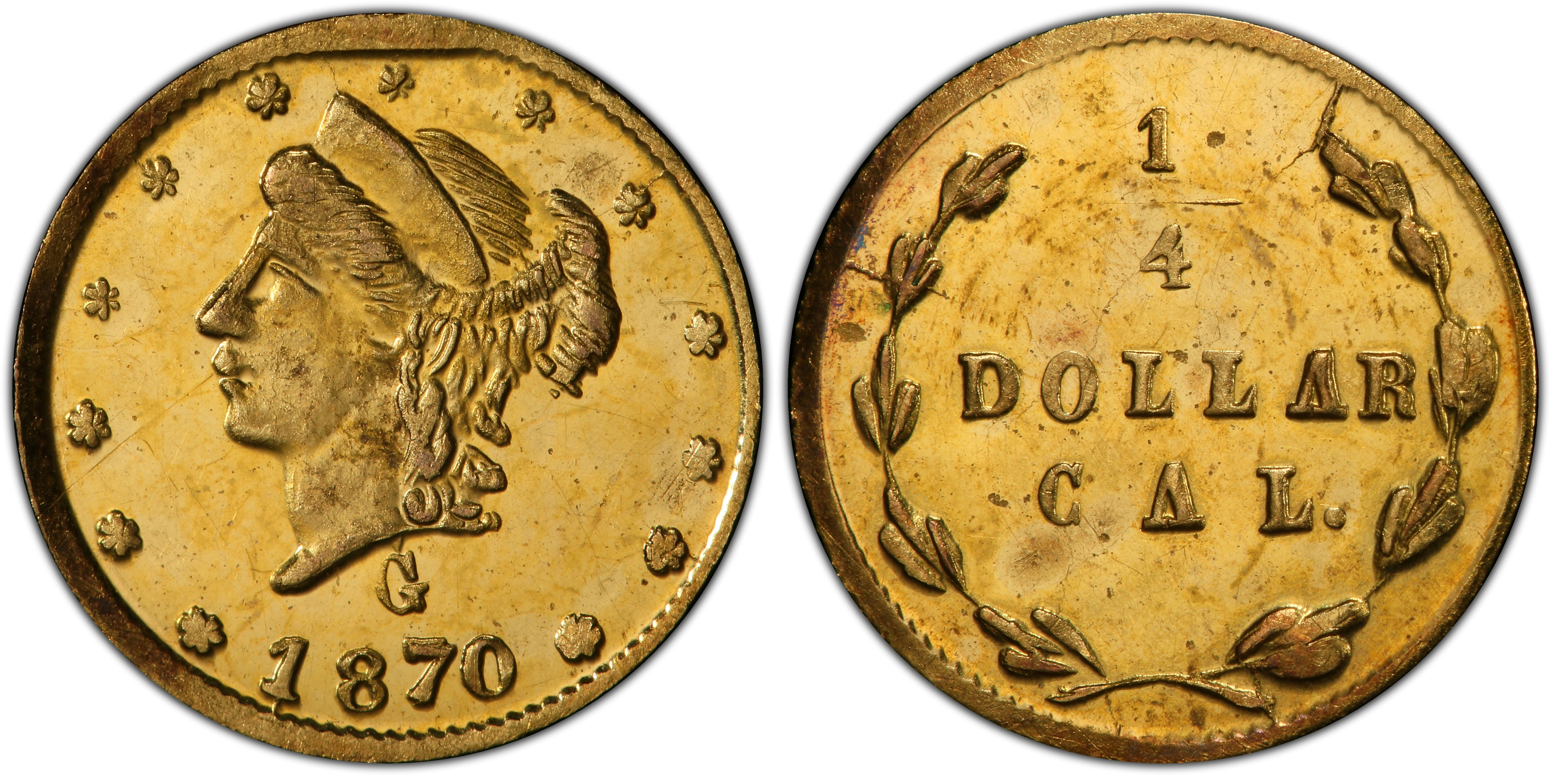
Obverse & Reverse
The 1870 G25C BG-835 is a quintessential example of a 'Period Two' California Fractional Gold piece. The era of these small, privately minted gold coins is divided by numismatists into three periods. Period One (1852-1856) issues were struck out of genuine commercial necessity to alleviate a severe shortage of small change in Gold Rush California. These earlier pieces were generally of good weight and were intended to, and did, circulate. However, by 1870, the context had dramatically shifted. The San Francisco Mint had been in operation for over 15 years, supplying the region with ample federal coinage. The acute need for private issues had evaporated. Consequently, the Period Two (1859-1882) pieces, including this BG-835 variety, were created for a different purpose. They were struck primarily by jewelers and merchants as souvenirs and novelty items to sell to tourists and locals alike, capitalizing on the romantic allure of the Gold Rush. These later issues were notoriously underweight, containing far less gold than their face value would imply, making them profitable trinkets rather than functional currency. Their diverse designs, often featuring Liberty or Indian heads, were meant to be attractive keepsakes of a California visit. The Coinage Act of 1864 had made private coinage illegal, but the law was not strictly enforced against these small tokens until the early 1880s, allowing for a prolific output of hundreds of varieties during this second period. The BG-835 is one such variety, a tangible link to the post-Gold Rush era of California, where the memory and mythology of the '49ers were already becoming a commercial enterprise.
Associated EventPost-California Gold Rush Souvenir Market
Reason For MintingPrimarily produced as a souvenir or keepsake for the tourist trade, not for general circulation.
Minter HistoryThe specific minter or jeweler who produced the BG-835 die marriage is unknown, a common characteristic of Period Two issues. During this era, numerous San Francisco-based jewelers and artisans, many of French origin, engaged in the profitable business of striking these miniature gold pieces. Unlike the more established assayers of the initial Gold Rush period, these producers were often anonymous, operating on a smaller scale and not marking their products with identifiable initials or symbols. Their work is cataloged and identified today solely through the meticulous die-state research pioneered by Walter Breen and Ronald J. Gillio.
Historical SignificanceThe BG-835, like other Period Two fractionals, represents the commercialization of the Gold Rush legacy. It is a numismatic artifact not of a currency crisis, but of a burgeoning tourism industry in San Francisco. Its existence highlights a transitional phase in California's economy and culture, moving from a frontier society defined by the quest for gold to a more settled region that was beginning to market its own recent, dramatic history. For collectors, these pieces are valued for their charm, variety, and direct connection to the romantic lore of the Old West.
BG-835
Denomination25 Cents
Minting Period1870
Assayer/MinterUnknown Private Minter
Geographic OriginSan Francisco, California
Obverse DescriptionA small, crudely rendered Liberty Head facing left, surrounded by thirteen stars. The portrait is simple, with basic details in the hair and coronet. The date '1870' appears below the bust. The overall strike can be weak, particularly on the high points of the portrait and some of the stars.
Obverse Inscription1870
Reverse DescriptionThe reverse features the denomination '1/4 DOLLAR' within a continuous wreath of leaves and berries. The wreath is tied with a bow at the bottom. The lettering is often somewhat unevenly spaced, characteristic of hand-cut dies.
Reverse Inscription1/4 DOLLAR
CompositionGold
Stated Fineness Actual FinenessVariable, but generally lower than federal standards, often around .500 to .800 fine.
EdgePlain
Unknown
Survival Estimate76-200 (Consistent with R-4 Rarity)
Rarity ScaleR-4
This coin is popular due to the affordability of the California Fractional Gold series as a whole and the historical allure of the Gold Rush. The BG-835 is a specific, cataloged variety that allows collectors to delve deeper than just a type set. Its status as a Period Two 'jeweler's issue' tells a fascinating story about the souvenir trade in 19th-century San Francisco.
Key VarietiesThe primary variety is the BG-835 Regular Strike. A Prooflike (PL) or Deep Prooflike (DPL) designation is also recognized by grading services for examples with exceptionally reflective fields. There is also a closely related variety, BG-835A, which is from a different die state and is considered significantly rarer. No later-date restrikes or special collector issues are known.
Authentication TipsAuthentic pieces should have the correct die characteristics for BG-835 as illustrated in the Breen-Gillio reference. Pay close attention to the shape of the numerals in the date and the specific arrangement of leaves in the wreath. Genuine examples often have a slightly crude, hand-made feel. Counterfeits or modern replicas often have a mushy, cast-like appearance, incorrect weight, or may feature a bear on the reverse, which is a definitive sign of a token, not a denominated fractional piece. All genuine Period Two issues must be denominated (e.g., 'DOLLAR' or 'CENTS').
Shopping ConsiderationsA premium quality example for its grade will exhibit a sharp strike, especially on Liberty's hair and the leaves of the wreath. Many examples suffer from die polishing, which can wipe out fine details; coins with minimal polishing are preferred. Original, uncleaned surfaces with some remaining luster are highly desirable. Look for attractive, deep golden or reddish-gold toning. Avoid pieces that have been harshly cleaned, polished, or used in jewelry, as evidenced by scratches, rim damage, or solder marks. Prooflike examples command a significant premium and should have clean, reflective fields with minimal distracting marks.
A coin's grade is its condition, rated on a 1-70 scale. For rare coins, this is the most critical factor in determining value, as a tiny difference in preservation can mean a huge difference in price.
Relevant Grade TypesOriginal issues were business strikes, although they were not intended for widespread circulation. They are found in all Circulated grades (AG-3 to AU-58) and, more commonly for this souvenir issue, in Mint State (MS-60 to MS-70). No true Proofs were struck during the original period of issue. However, some examples were struck from highly polished dies, resulting in reflective surfaces that are designated 'Prooflike' (PL) or 'Deep Prooflike' (DPL) by third-party grading services. These are not a separate issue but rather a quality of the strike and finish.
Mint State CharacteristicsIn uncirculated grades, the quality of BG-835 is defined by strike and surface preservation. The strike is often somewhat weak, with softness seen on the highest points of Liberty's hair curls and the bow on the reverse wreath. Luster is typically satiny rather than frosty. Due to their handling as novelties, even Mint State examples can show tiny contact marks or hairlines. A key feature noted by auction houses for this variety is the potential for weakness due to over-polished dies, which can obliterate parts of the wreath or portrait.
Circulated Wear PatternsWear first appears on the highest points of the design. On the obverse, check for flatness on Liberty's hair above the eye and on the cheekbone. On the reverse, the high points of the wreath's leaves and the knot of the bow will show the first signs of friction. In lower grades (VF and below), the finer details of the hair and leaves will merge, and the legend will begin to soften.
Key Factors For ValueFor the BG-835, the primary value drivers are grade and surface quality. An uncirculated example is worth significantly more than a circulated one. Within Mint State grades, a sharp, well-struck coin with clean surfaces and original luster will command a premium. The presence of a PL or DPL designation significantly increases value. Eye appeal is crucial; coins with pleasing, original color are prized over those that are dull, spotted, or have been cleaned. Certification by PCGS or NGC is standard for the market, and a CAC sticker will add a further premium, confirming quality for the assigned grade.
PCGS Price Guide
| Grade | Price | Population |
|---|---|---|
| 61 | $350.00 | N/A |
| 62 | $425.00 | N/A |
| 62+ | $525.00 | N/A |
| 63 | $700.00 | 2 |
| 63+ | $850.00 | N/A |
| 64 | $1,050.00 | 1 |
| 65 | N/A | N/A |