1871 G25C BG-810 (Regular Strike)
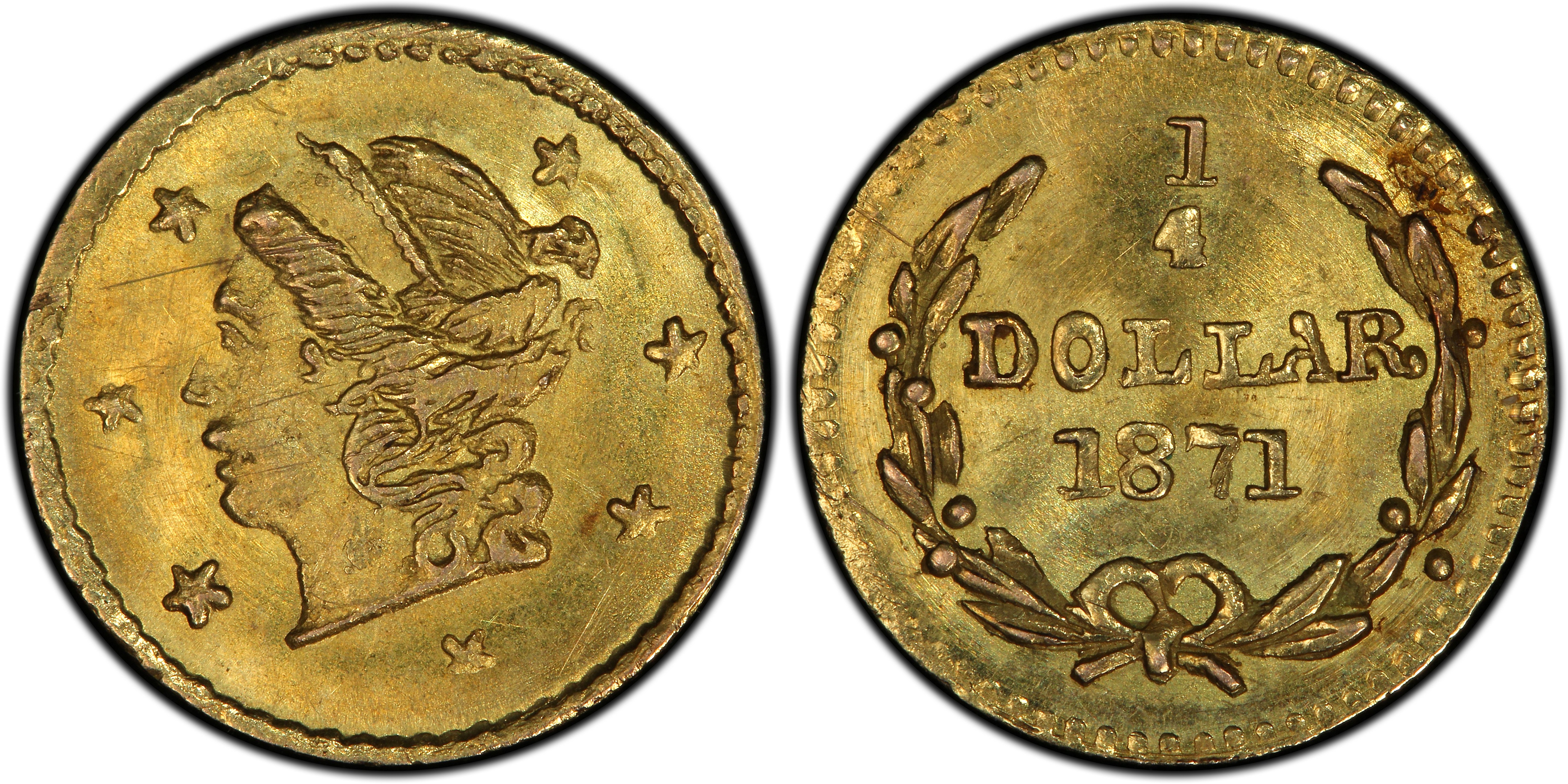
Obverse & Reverse
The 1871 25 Cents, cataloged as Breen-Gillio 810, is a quintessential example of a 'Period Two' California Fractional Gold piece. This era, spanning from 1859 to 1882, saw a significant shift in the purpose and nature of these diminutive coins. The initial wave of 'Period One' issues (1852-1856) arose from a genuine and desperate need for small-denomination currency in the gold fields, where federal coinage was scarce and transactions were often conducted with cumbersome gold dust. By the 1870s, however, the economic landscape of California had matured. The U.S. Mint in San Francisco was in full operation, and the acute shortage of small change had largely subsided. Consequently, the production of fractional gold transitioned from a necessity of commerce to a commercial enterprise in its own right, primarily driven by jewelers who catered to a burgeoning tourist trade and a local appetite for novelty items and keepsakes. These 'jeweler's issues' were often lighter and of lower fineness than their Period One predecessors, valued more for their charm and connection to the Gold Rush romance than their intrinsic metallic worth. The BG-810 was struck within this context. While the specific maker is not definitively known, it was almost certainly produced by one of the many skilled jewelers and die-sinkers operating in San Francisco, such as Robert B. Gray & Co. or their contemporaries, who created a wide array of similar Liberty Head designs. The Coinage Act of 1864 had technically outlawed private coinage, but enforcement was lax until the early 1880s, allowing this cottage industry to persist. These tiny gold pieces were sold as souvenirs, pocket pieces, and adornments, tangible mementos of California's golden identity. Their survival rate is exceptionally low; their minuscule size made them easy to lose, and many were likely spent or incorporated into jewelry over the decades, making any surviving example a rare link to this unique chapter in American numismatic history.
Associated EventCalifornia Gold Rush Aftermath & Tourism Boom
Reason For MintingPrimarily created as commercial keepsakes and souvenirs for tourists and locals, rather than to alleviate a currency shortage.
Minter HistoryThe specific minter of BG-810 is unrecorded. However, the style and period of issue are characteristic of the work of numerous San Francisco jewelers active in the post-Civil War era. Prominent producers of similar 'Period Two' fractionals include Robert B. Gray & Co., who succeeded Antoine Nouizillet, and the Levison Brothers. These firms employed skilled craftsmen to create dies and strike a wide variety of small-denomination gold pieces, often mimicking federal designs but with their own stylistic idiosyncrasies. Their primary business was jewelry and watches, with fractional gold production being a profitable sideline.
Historical SignificanceThe BG-810 represents the evolution of California Fractional Gold from utilitarian currency to commercial souvenir. It is a physical artifact of a post-Gold Rush California that was beginning to mythologize its own recent past, capitalizing on the romantic image of the '49ers. As a 'jeweler's issue,' its existence reflects the lax enforcement of federal anti-privateering laws and the persistent entrepreneurial spirit that defined 19th-century San Francisco.
N/A
Denomination25 Cents
Minting Period1871
Assayer/MinterUnknown San Francisco Jeweler
Geographic OriginSan Francisco, California
Obverse DescriptionA head of Liberty, facing left, with LIBERTY inscribed on her coronet. She is surrounded by 13 six-pointed stars, representing the original colonies. The date, 1871, is positioned below the truncation of the neck.
Obverse InscriptionLIBERTY 1871
Reverse DescriptionThe denomination '1/4 DOLLAR' is enclosed within a wreath composed of two olive branches. The wreath is open at the top and tied with a bow at the bottom.
Reverse Inscription1/4 DOLLAR
CompositionGold
Stated Fineness Actual FinenessVariable, typically between .500 and .900 fine for Period Two issues.
Weight0.25 grams
Diameter10.00 mm
EdgePlain
Unknown
Survival Estimate4-12
Rarity ScaleR-7-
The BG-810 is highly sought after due to its extreme rarity (R-7) and its status as a historic 'Period Two' California Fractional Gold piece. Its appeal lies in its direct connection to the romantic era of the Old West, the charm of its minuscule size, and the challenge of acquiring such a scarce variety. High-grade examples are particularly prized by specialists.
Key VarietiesThe BG-810 is itself a specific die variety. No major sub-varieties, patterns, or official restrikes are known to exist for this specific Breen-Gillio number. The primary variations in the broader series relate to different die pairings (BG numbers), metal composition, and whether they were struck as denominated coins (pre-1883) or undenominated tokens (post-1883).
Authentication TipsAuthenticity is paramount with fractional gold. Genuine BG-810s will exhibit sharp, albeit sometimes uneven, strike characteristics from hand-operated presses. The style of the Liberty head, stars, and wreath should be compared to high-resolution images of certified examples. Many modern replicas and fantasy pieces exist; a common red flag is a bear on the reverse or the lack of a denomination. The surfaces of genuine pieces should show natural luster or wear, not the tool marks or soapy, cast-like appearance of forgeries. Professional authentication by PCGS or NGC, who reference the Breen-Gillio guide, is strongly recommended.
Shopping ConsiderationsFor a premium quality BG-810, a potential buyer should prioritize a sharp strike, particularly on Liberty's coronet, the date, and the details of the wreath. Original, uncleaned surfaces with some remaining mint luster command a significant premium. Given their use as jewelry and souvenirs, check carefully for evidence of mounting, solder, harsh cleaning, or tooling. Eye appeal is critical; examples with smooth, attractive surfaces and a pleasing reddish-gold patina are superior. Due to the high rarity, even problem-free circulated examples are desirable, but any impairments must be factored heavily into the price.
A coin's grade is its condition, rated on a 1-70 scale. For rare coins, this is the most critical factor in determining value, as a tiny difference in preservation can mean a huge difference in price.
Relevant Grade TypesOriginal examples of BG-810 were struck as business strikes intended for commercial sale as souvenirs, not circulation. They are found in both Circulated (Good-4 to AU-58) and Mint State (MS-60 to MS-70) grades. Due to their extreme rarity, they are almost exclusively found and traded in Mint State condition. No Proofs were struck during the original minting period, and there are no known later-date Proof restrikes associated with this variety.
Mint State CharacteristicsUncirculated examples of BG-810 often exhibit a slightly uneven strike due to the manual screw press technology used. Luster is typically satiny rather than deeply frosty. The high points of the design, such as Liberty's hair details and the leaves in the wreath, may show some flatness even on a high-grade piece. Small planchet flaws or adjustment marks are not uncommon and should be assessed for their impact on eye appeal. Contact marks, though tiny, can be distracting on such a small canvas and will significantly affect the grade.
Circulated Wear PatternsOn circulated examples, wear first appears on the highest points: the hair above Liberty's eye and ear, the coronet, and the high points of the wreath leaves. As wear progresses, the stars will begin to lose their points and the letters in the denomination will become soft. In lower grades, the date and the word LIBERTY will be particularly weak or partially obliterated.
Key Factors For ValueRarity is the primary driver of value for the BG-810. Beyond that, the key factors are grade and surface quality. A sharply struck coin with clean, original surfaces and attractive luster will command a significant premium over a weakly struck or cleaned example of the same grade. Eye appeal is paramount; a coin with a pleasing, original 'skin' is far more desirable than one that is bright and shiny from a past dipping or cleaning. A CAC sticker for this issue would denote premium quality for the grade and add a substantial premium.
PCGS Price Guide
| Grade | Price | Population |
|---|---|---|
| 62 | $950.00 | 2 |
| 62+ | $1,000.00 | N/A |
| 63 | $1,075.00 | 2 |
| 63+ | $1,150.00 | N/A |
| 64 | $1,300.00 | 2 |
| 64+ | $1,365.00 | N/A |
| 65 | $1,500.00 | 3 |
| 65+ | $1,750.00 | N/A |
| 66 | $2,250.00 | 4 |
| 66+ | $3,000.00 | N/A |
| 67 | $4,500.00 | 2 |