1882 G50C BG-966 (Regular Strike)
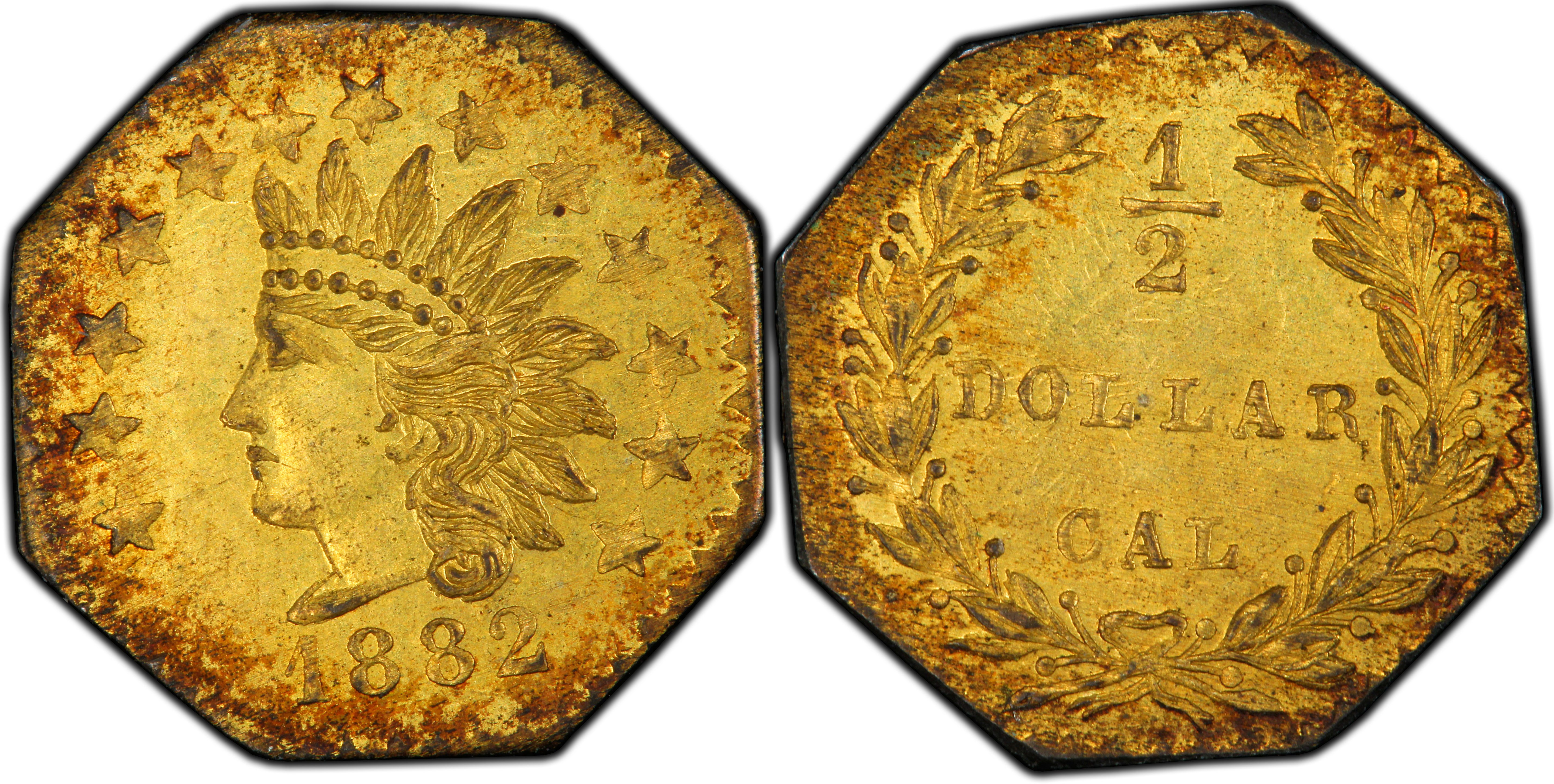
Obverse & Reverse
The 1882 BG-966 50 Cents piece represents the final chapter in the fascinating and complex story of California Fractional Gold. By the early 1880s, the original impetus for these miniature gold coins—a severe shortage of small change during the Gold Rush—had long since vanished. The San Francisco Mint, established in 1854, was producing ample quantities of federal silver and gold coinage, making private issues unnecessary for commerce. The pieces struck during this 'Period Two' (1858-1882) were of a fundamentally different character than their 'Period One' predecessors. They were no longer primarily instruments of trade but were instead souvenirs, curios, and jewelry items produced by local artisans to satisfy a tourist trade and collector demand nostalgic for the 'Days of '49.' Makers like Nast, Greenzweig & Co., a San Francisco jeweler, operated in a legally grey area. The Coinage Act of 1864 had prohibited private coinage, but enforcement was lax, allowing jewelers to continue production so long as the pieces were denominated and intended as tokens rather than fraudulent currency. These late-date issues were often intentionally underweight and sometimes, as is the case with BG-966, not even solid gold, betraying their true nature as keepsakes rather than money. The year 1882 marks the very end of this era. In 1883, the United States Secret Service, concerned about potential confusion with federal coinage and the principle of government monopoly on minting, initiated a widespread crackdown, confiscating dies and effectively shuttering the operations of the remaining fractional gold producers. This action brought an abrupt end to a uniquely Californian 30-year numismatic tradition. The BG-966 is therefore not just a rare token, but a historical artifact from the last moments before a federal clampdown extinguished the final embers of private minting from the Gold Rush.
Associated EventEnd of Private Coinage Era in California
Reason For MintingPrimarily created as a souvenir or collector's item for the tourist trade in San Francisco, not for general circulation.
Minter HistoryNast, Greenzweig & Co. was a jewelry firm operating in San Francisco during the early 1880s. Like several other local jewelers of the period, they engaged in the production of California Fractional Gold pieces, capitalizing on the demand for Gold Rush-era souvenirs. Information on the firm is scarce, but their production places them among the last of the private entities to strike such denominated tokens before the Secret Service crackdown in 1883.
Historical SignificanceThis coin is significant as it represents the twilight of the California Fractional Gold series, produced in the final year before the U.S. Secret Service ended the practice. Its composite metallic structure highlights the evolution of these pieces from functional currency to commercial souvenirs.
BG-966
Denomination50 Cents
Minting Period1882
Assayer/MinterNast, Greenzweig & Co.
Geographic OriginSan Francisco, California
Obverse DescriptionAn Indian princess head facing left, adorned with a feathered headdress. The portrait is encircled by 13 stars, representing the original colonies.
Obverse Inscription[None, design only]
Reverse DescriptionThe denomination '50 CENTS' is enclosed within a wreath of leaves and berries. The date '1882' appears below the wreath, near the rim.
Reverse Inscription50 CENTS 1882
CompositionGold-plated silver on a copper core, as per the Breen-Gillio reference.
Stated Fineness Actual FinenessNot applicable; this is a plated, multi-metallic piece, not a solid gold alloy.
EdgePlain
Extremely low, likely struck on demand or in a very small batch.
Survival EstimateFewer than 10 known. The Breen-Gillio reference lists only six examples on its roster.
Rarity ScaleHigh R-7
The BG-966 is highly coveted as a 'last year of issue' piece from a storied series. Its extreme rarity, octagonal shape, and unusual plated composition make it a trophy coin for advanced specialists in California Fractional Gold.
Key VarietiesThe regular strike BG-966 is the only known variety for this specific issue. No known patterns, proofs, or restrikes exist.
Authentication TipsKey diagnostics for this variety include moderately clashed dies, which can be seen as faint impressions of the reverse wreath on the obverse fields and vice-versa. The dies are also known to be rotated from a standard coin turn. Genuine pieces from this era often exhibit a somewhat weak or uneven strike, whereas modern replicas are often too sharp and perfect. Crucially, all genuine Period Two fractionals must have a denomination; pieces that say 'CALIFORNIA GOLD' without 'CENTS' or 'DOLLAR' are almost always later, non-numismatic tokens. The unusual layered composition is another key identifier.
Shopping ConsiderationsFor a 'premium quality' BG-966, a buyer should seek an example with minimal surface impairments and strong eye appeal. Given the plated nature, look for a specimen with the gold plating intact and not worn through to the underlying silver or copper layers. Evidence of the die clash and rotation should be present. Sharpness on the highest points of the headdress feathers and the leaves of the wreath is desirable, though some inherent softness of strike is typical for the issue. Avoid examples that have been cleaned, which will often have a dull, lifeless surface or microscopic hairlines. A specimen in a PCGS or NGC holder is highly recommended for guaranteed authenticity.
A coin's grade is its condition, rated on a 1-70 scale. For rare coins, this is the most critical factor in determining value, as a tiny difference in preservation can mean a huge difference in price.
Relevant Grade TypesOriginal issues of BG-966 were business strikes, created for sale as souvenirs. They are found in both Circulated (1-58) and, more commonly, Mint State (MS, 60-70) grades, as many were saved as keepsakes. No proofs were struck during the original period of issue, and there are no known later restrikes.
Mint State CharacteristicsUncirculated examples of BG-966 often display a vibrant, prooflike or semi-prooflike luster stemming from the polished dies used by the jeweler-minter. The strike is often somewhat soft in the centers, particularly on the Indian's cheek and the 'CENTS' on the reverse. The fields are the most important area to examine for quality; due to the flashy surfaces, small contact marks or ticks are common and will heavily influence the grade. Evidence of the known die clash is a characteristic, not a flaw.
Circulated Wear PatternsWear first appears on the high points of the design. On the obverse, this includes the feathers of the headdress and the cheek of the Indian princess. On the reverse, the highest points of the wreath's leaves and bow will show rubbing first. On lower grade examples, the gold plating may be worn through, exposing the underlying metal.
Key Factors For ValueFor the BG-966, value is driven by three main factors: rarity, grade, and surface quality. As a High R-7 variety, any example is valuable. The numerical grade (e.g., MS63 vs. MS64) will cause significant price jumps. However, eye appeal is paramount. An example with original, brilliant surfaces and minimal distracting marks will command a substantial premium over a similarly graded piece with scratches or a dull appearance. Given its status as a classic and frequently counterfeited series, certification by a top-tier service like PCGS or NGC is virtually required to achieve maximum value.
PCGS Price Guide
| Grade | Price | Population |
|---|---|---|
| 50 | $1,400.00 | 1 |
| 50+ | $1,475.00 | N/A |
| 53 | $1,600.00 | N/A |
| 53+ | $1,675.00 | N/A |
| 55 | $1,800.00 | N/A |
| 55+ | $1,875.00 | N/A |
| 58 | $2,000.00 | 1 |
| 58+ | $2,050.00 | N/A |
| 60 | $2,100.00 | N/A |
| 61 | $2,200.00 | N/A |
| 62 | $2,300.00 | 1 |
| 62+ | $2,350.00 | N/A |
| 63 | $2,450.00 | 2 |
| 63+ | $2,750.00 | N/A |
| 64 | $4,000.00 | 3 |
| 64+ | $5,000.00 | N/A |
| 65 | $6,500.00 | N/A |