1870 G25C BG-867 (Regular Strike)
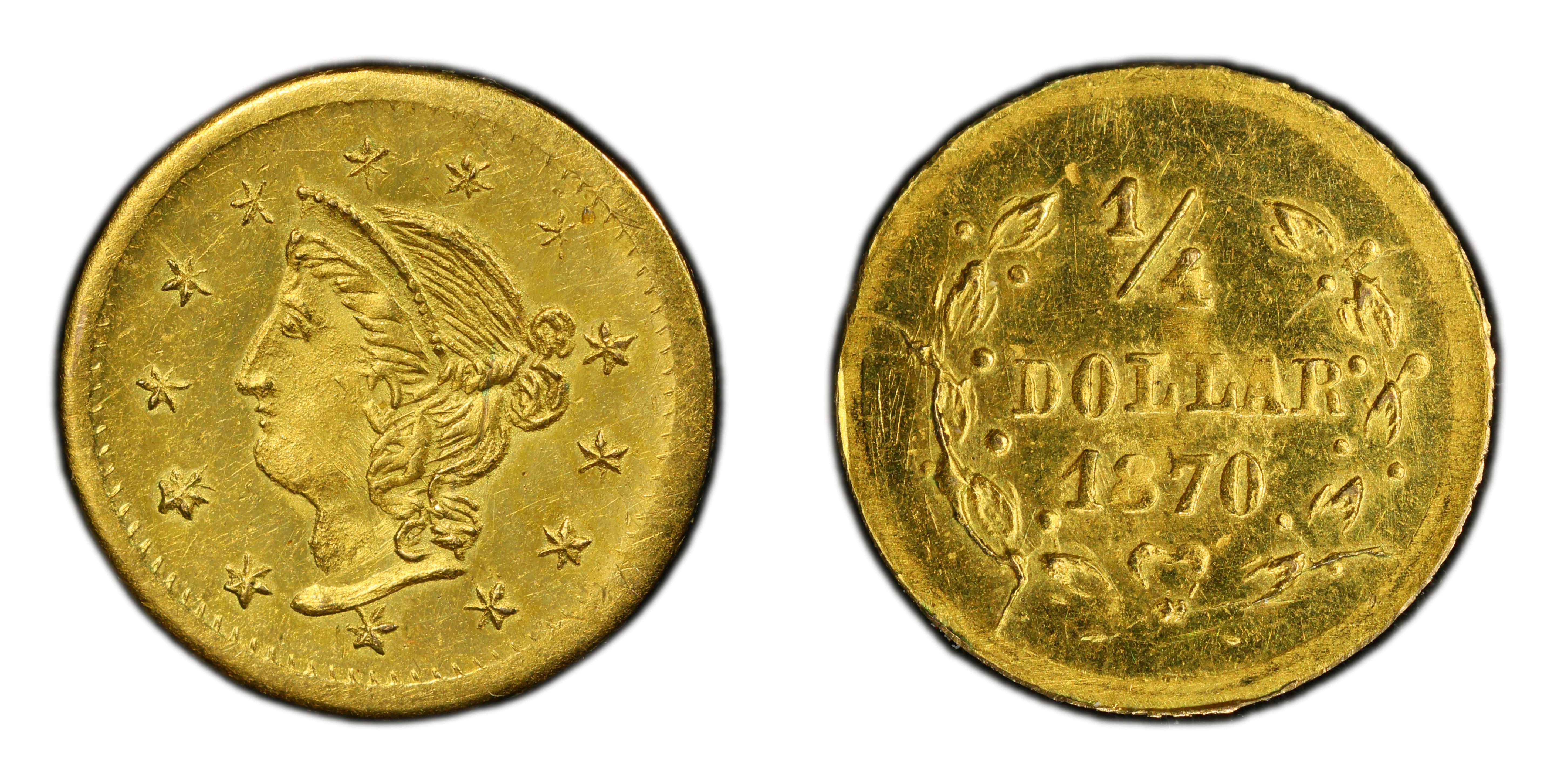
Obverse & Reverse
The 1870 G25C BG-867 emerged during the 'Period Two' (1858-1882) of California Fractional Gold production, a fascinating era that followed the initial gold rush frenzy. By 1870, the economic landscape of California had matured. The massive gold strikes of the late 1840s and early 1850s were history, but gold remained the backbone of the regional economy. However, a persistent shortage of small-denomination coinage plagued daily commerce. The smallest federally issued coin in regular circulation on the West Coast was the silver dime, which was often scarce. This created a significant inconvenience for minor transactions, forcing merchants and consumers to rely on barter, credit, or privately issued tokens. California Fractional Gold pieces were manufactured by private jewelers and minting establishments, primarily in San Francisco, to fill this void. These tiny coins, often called 'charms' or 'tokens' to circumvent federal laws against private coinage, served as a practical substitute for small change. They were widely accepted in local trade, particularly for items costing less than a dime. The BG-867, with its Indian Head obverse, was part of a wave of pieces that mimicked federal designs, likely to enhance their perceived legitimacy and public acceptance. The 'G' in the denomination 'G25C' signifies 'gold,' a common practice on these pieces to distinguish them from base metal tokens. These coins were not official government issues and their gold content often varied, but they were indispensable to the functioning of California's retail economy for three decades until federal efforts to standardize currency and suppress private issues finally took hold in the early 1880s.
Associated EventPost-Gold Rush Economic Development in California
Reason For MintingTo alleviate a chronic shortage of small-denomination coinage for everyday commercial transactions in California.
Minter HistoryThe specific minter of the BG-867 variety is not definitively known, a common trait for many California Fractional Gold pieces. Production was often carried out by various San Francisco-based jewelers and die-sinkers, such as Robert B. Gray & Co., Antoine Nouizillet, or the California Jewelry Company. These firms operated in a quasi-legal space, producing items that functioned as currency but were often legally classified as jewelry or tokens. They possessed the necessary equipment—coining presses and hubbing tools—to strike these miniature gold pieces for merchants and the general public. Their primary business was often jewelry manufacturing, with fractional gold production being a profitable sideline capitalizing on a clear market need.
Historical SignificanceThe BG-867 is a tangible artifact of a unique period in American monetary history where private enterprise directly addressed the failures of federal currency distribution in a remote but economically vital region. It represents the ingenuity of local businesses in solving a practical economic problem and highlights the lingering effects of the California Gold Rush on the state's development long after the initial boom. As a 'Period Two' piece, its standardized design reflects a more mature phase of private minting, aimed at creating a reliable and widely accepted form of subsidiary coinage.
N/A
Denomination25 Cents (Quarter Dollar)
Minting Period1870
Assayer/MinterUnknown, possibly California Jewelry Co. or another San Francisco firm.
Geographic OriginSan Francisco, California
Obverse DescriptionA right-facing bust of a female figure wearing a feathered headdress, colloquially known as an 'Indian Head'. The design is a smaller version of the motif used on the contemporary U.S. Indian Head cent. Thirteen stars encircle the portrait along the rim.
Obverse Inscription(No lettering, only stars)
Reverse DescriptionThe denomination '1/4' is positioned in the center, surrounded by an ornate wreath of leaves and berries tied with a bow at the bottom. The date '1870' is located below the bow, and the legend 'DOLLAR' is situated above the wreath.
Reverse InscriptionDOLLAR 1/4 1870
CompositionGold
Stated Fineness Actual FinenessVaries, but typically in the range of .450 to .600 fine (11-14 karat gold).
Weight0.16 grams
Diameter9.70 mm
EdgePlain
5,000-10,000
Survival Estimate200-300
Rarity ScaleR-5 (Very Scarce)
The 1870 G25C BG-867 is popular among collectors for its classic Indian Head design, affordability relative to rarer varieties, and its status as a representative example of 'Period Two' California Fractional Gold. Its clear date and denomination make it an accessible entry point into this complex and historic series.
Key VarietiesThe primary variety is the regular business strike (BG-867). Breen-Gillio does not list significant die-state varieties for this specific issue. Collectors should be aware of contemporary counterfeits made of gilded base metal. Proof strikings from the original period of issue are unknown and not believed to exist. No known authorized restrikes were made.
Authentication TipsGenuine BG-867 pieces exhibit sharp, well-defined details, particularly in the feathers of the headdress and the leaves of the reverse wreath, despite their small size. The numerals of the date should be properly formed and spaced. Common counterfeits are often cast, showing a porous or soapy surface texture under magnification, and may be incorrect in weight. Many fakes are made of gold-plated brass; a specific gravity test can be conclusive. Authentication by a major third-party grading service is highly recommended.
Shopping ConsiderationsA premium quality example for its grade will possess a sharp, well-centered strike. Look for clarity on the individual feathers and the details within the wreath. The surfaces should be clean and free of distracting marks, tooling, or evidence of having been mounted in jewelry (a common fate for these small pieces). Original, uncleaned surfaces with a touch of reddish-gold toning command a significant premium. Avoid examples with rim bumps, harsh cleanings, or scratches, as these severely impact both the value and the aesthetic appeal of these miniature coins.
A coin's grade is its condition, rated on a 1-70 scale. For rare coins, this is the most critical factor in determining value, as a tiny difference in preservation can mean a huge difference in price.
Relevant Grade TypesOriginal period issues were business strikes intended for circulation and are found in Circulated (AU-58 and below) and Mint State (MS, 60-70) grades. The vast majority of surviving examples are circulated. No Proof (PR/PF) examples of BG-867 were struck during the original period of issue, and there are no known later-date Proof restrikes.
Mint State CharacteristicsAn uncirculated BG-867 will display full, unbroken mint luster, which is typically soft and satiny rather than deeply prooflike. The strike can be variable, but a premium MS example will show sharp detail on the highest points of the feathers and the central wreath. Due to the softness of the gold alloy and the minting process, even Mint State examples may exhibit minor planchet flaws or faint handling marks; a 'gem' (MS-65 or higher) example is exceedingly rare.
Circulated Wear PatternsWear first appears on the high points of the design: the cheek and the upper feathers of the headdress on the obverse. On the reverse, the highest points of the wreath leaves and the bow will show initial friction and flatness. On more heavily worn examples (VF and below), the finer details of the feathers will merge, and the legend and date will begin to lose their sharpness.
Key Factors For ValueThe primary value drivers for an 1870 G25C BG-867 are grade and surface quality. An example with original, uncleaned 'skin' is far more desirable than one that has been polished or dipped. Sharpness of strike is critical; a well-struck coin with full details will always command a premium over a weakly struck counterpart in the same grade. Eye appeal, including attractive original toning and a lack of distracting marks, plays a significant role. Certification by PCGS or NGC is standard for the series, and a CAC sticker, indicating premium quality for the grade, adds a substantial premium.
PCGS Price Guide
| Grade | Price | Population |
|---|---|---|
| 45 | N/A | N/A |
| 50 | $200.00 | 1 |
| 50+ | $205.00 | N/A |
| 53 | $210.00 | 2 |
| 53+ | $215.00 | N/A |
| 55 | $220.00 | 7 |
| 55+ | $225.00 | N/A |
| 58 | $230.00 | 10 |
| 58+ | $240.00 | N/A |
| 60 | $275.00 | 2 |
| 61 | $310.00 | 9 |
| 62 | $360.00 | 18 |
| 62+ | $385.00 | N/A |
| 63 | $425.00 | 16 |
| 63+ | $500.00 | N/A |
| 64 | $750.00 | 12 |
| 64+ | $1,150.00 | N/A |
| 65 | $2,750.00 | 1 |
| 66 | N/A | N/A |