1854 G50C BG-431, PL (Regular Strike)
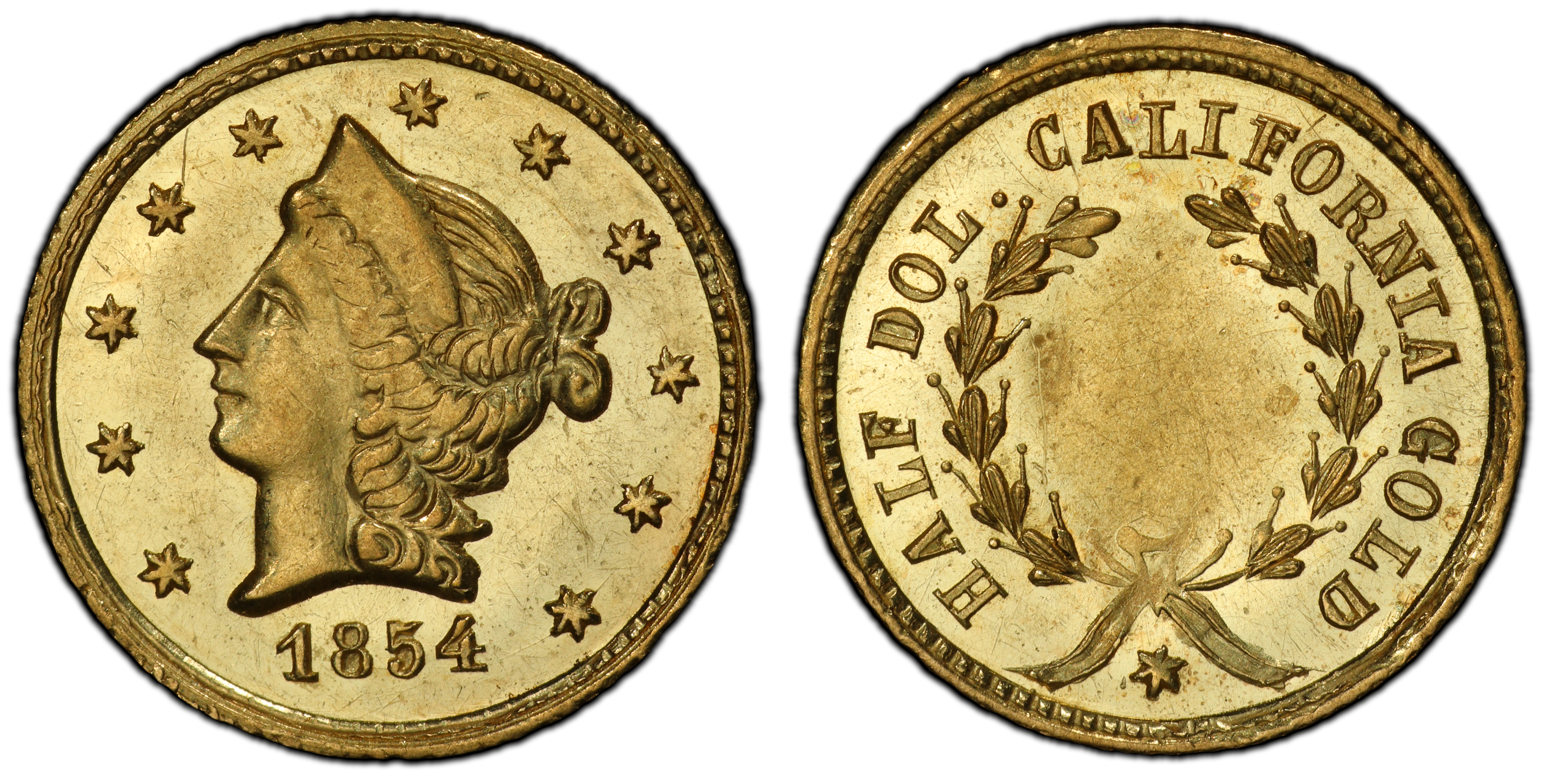
Obverse & Reverse
The 1854 Gold 50 Cents, cataloged as Breen-Gillio 431, is a quintessential artifact from the chaotic and economically vibrant era of the California Gold Rush. These small, privately-issued gold coins belong to what numismatists classify as 'Period One' (1852-1857) of California Fractional Gold production. This period was defined by a critical shortage of small-denomination coinage for everyday transactions. While the tidal wave of gold dust and nuggets transformed San Francisco into a bustling metropolis, the lack of circulating silver coins from the U.S. Mint created a severe bottleneck in commerce. A pinch of gold dust for a drink or loaf of bread was an inaccurate and cumbersome system. Into this void stepped numerous private minters, often jewelers and assayers with the skills to work gold. These entrepreneurs, including the firm believed to be responsible for BG-431, Gaime, Guillemot & Co., began striking quarter dollars, half dollars, and dollars to facilitate trade. The BG-431 was struck in the same year the official United States Branch Mint opened in San Francisco. However, the new mint initially focused on converting massive amounts of bullion into larger denomination coins, leaving the demand for 'small change' largely unmet. Thus, the production of fractional gold continued unabated. These pieces were not official U.S. tender but were generally accepted in local commerce out of sheer necessity, trading on the reputation of their issuer and the intrinsic value of their gold content. Most Period One fractionals, including the BG-431, were intentionally struck with a gold value slightly less than their face value, ensuring a profit for the minter and technically making them tokens. Despite this, their utility was undeniable. They circulated freely in the boomtowns and mining camps, passing through the hands of miners, merchants, and gamblers. Their rudimentary production, typically by the 'hammer method' where dies were struck by hand, resulted in coins of varying strike quality, adding to their rustic charm. The Coinage Act of 1864 eventually outlawed all private currency, bringing an end to this fascinating chapter of American monetary history. Today, the BG-431 is a tangible link to the ingenuity and necessity that defined the Gold Rush economy, representing a time when private enterprise directly solved a failure in the national money supply.
Associated EventCalifornia Gold Rush
Reason For MintingTo alleviate a severe shortage of small-denomination coinage for daily commercial transactions in Gold Rush-era California.
Minter HistoryGaime, Guillemot & Company was a firm of French jewelers and watchmakers located on Kearny Street in San Francisco during the early 1850s. Like many skilled artisans of the period, they leveraged their expertise in metallurgy to meet the region's desperate need for circulating coinage. They produced a variety of fractional gold denominations, and their issues are noted for their distinctive design elements. While not as prolific as some other private minters, their coinage is a key component of the Period One fractional gold series and is highly sought after for its historical importance and connection to the city's French immigrant community.
Historical SignificanceThe BG-431 is a prime example of a privately issued coin that functioned as a crucial circulating medium in the absence of sufficient federal coinage. It represents a period of monetary improvisation and highlights the direct role of private enterprise in building the economic infrastructure of the American West. Its existence in 1854, the same year the San Francisco Mint opened, underscores the continued demand that the official mint could not immediately satisfy.
N/A
Denomination50 Cents
Minting Period1854
Assayer/MinterAttributed to Gaime, Guillemot & Company
Geographic OriginSan Francisco, California
Obverse DescriptionA small bust of Liberty facing left, her hair tied in a bun. She is surrounded by thirteen six-pointed stars, which are typically unevenly spaced and struck. The date, 1854, is positioned below the bust. The portrait style is crude, typical of the hand-engraved dies of the period.
Obverse Inscription1854
Reverse DescriptionThe central device is a 'defiant' eagle with outstretched wings, head turned to its right, clutching branches and arrows in its talons. The eagle is relatively large for the planchet. The denomination is expressed around the upper periphery.
Reverse InscriptionCALIFORNIA GOLD / HALF DOL.
CompositionGold
Stated Fineness Actual FinenessPeriod One fractionals typically used native California gold, with fineness varying but often in the .800 to .885 range. The intrinsic value was intentionally less than the face value.
Weight0.80 grams
Diameter11.50 mm
EdgePlain
Unknown
Survival Estimate75-125
Rarity ScaleR-5 (Low R-5)
The BG-431 is highly prized by collectors for its status as a genuine, circulating 'Period One' issue, its attractive and historically significant 'defiant eagle' reverse, and its direct connection to the peak of the Gold Rush. Its tangible history as a coin used in the saloons and shops of 1850s San Francisco provides a powerful allure.
Key VarietiesThere are no major varieties of the BG-431 itself, as it is a specific die marriage. However, within the broader series, collectors distinguish between Period One (1852-1857) issues like this one, which were primarily intended for commerce, and later 'Period Two' (1859-1882) issues, which were often lighter and increasingly made as souvenirs or 'jeweler's pieces'. No known restrikes or patterns exist for this specific variety.
Authentication TipsGenuine examples were made by the hammer method and often show weakness in some areas and better strikes in others. Look for a slightly irregular shape and soft, lustrous surfaces, not hard, prooflike fields like many modern replicas. The die work should be sharp but manually engraved, lacking the perfection of modern minting. Counterfeits often have a soapy, cast appearance, incorrect weight, or feature a bear on the reverse (no authentic Period One fractionals had bears). Any piece that looks too perfect should be viewed with suspicion.
Shopping ConsiderationsA premium quality BG-431 will exhibit a bold strike for the issue, especially on the eagle's head and wings and on the date. Original, uncleaned surfaces with some remaining mint luster command a significant premium. Many survivors are found in circulated grades, so well-preserved examples are rare. Check for common problems such as having been previously mounted in jewelry, which can leave solder marks or rim damage. Also avoid examples that have been harshly cleaned, polished, or tooled to improve details. The overall eye appeal, combining strike, surface quality, and attractive original color, is paramount.
A coin's grade is its condition, rated on a 1-70 scale. For rare coins, this is the most critical factor in determining value, as a tiny difference in preservation can mean a huge difference in price.
Relevant Grade TypesOriginal BG-431 coins were business strikes produced for circulation. They are found in Circulated grades (AG-3 to AU-58) and, very rarely, in Mint State (MS, 60-70). The term 'PL' (Prooflike) attached to the input refers to a regular strike coin with reflective surfaces, which is a desirable characteristic but does not make it a Proof. No true Proofs were struck during the original minting period. Any piece offered as a 'Proof' would be a later-made replica or fantasy piece.
Mint State CharacteristicsAn uncirculated BG-431 is exceptionally rare. Quality is defined by the strength of the strike; most examples exhibit some weakness, particularly on the highest points of Liberty's hair and the eagle's feathers. Luster is typically soft and satiny, a result of the hammer-striking process, though some can be prooflike (PL). Due to the softness of the gold and their use in commerce, even MS examples may show small, scattered contact marks. A truly mark-free specimen with a sharp strike and full luster is a major prize.
Circulated Wear PatternsWear first appears on the high points of Liberty's hair above her eye and ear, and on the cheek. On the reverse, the highest points of the eagle's head, breast, and the upper edges of the wings will show friction first. As wear progresses, the finer details of the feathers and Liberty's hair will merge, and the legends will begin to soften.
Key Factors For ValueFor the BG-431, value is driven by several key factors. First and foremost is surface preservation: an example with original, lustrous 'skin' is far more valuable than one that has been cleaned or polished. Second is the strike; coins with sharp details, a full date, and clear legends are highly prized. Third is overall eye appeal, where an attractive, original reddish-gold toning enhances value. Finally, certification by a top-tier grading service (PCGS or NGC) is essential for market acceptance, and a CAC sticker indicating premium quality for the grade will add a significant premium.
PCGS Price Guide
| Grade | Price | Population |
|---|---|---|
| 63+ | $2,000.00 | 1 |
| 64 | N/A | N/A |