1869 G25C BG-826, PL (Regular Strike)
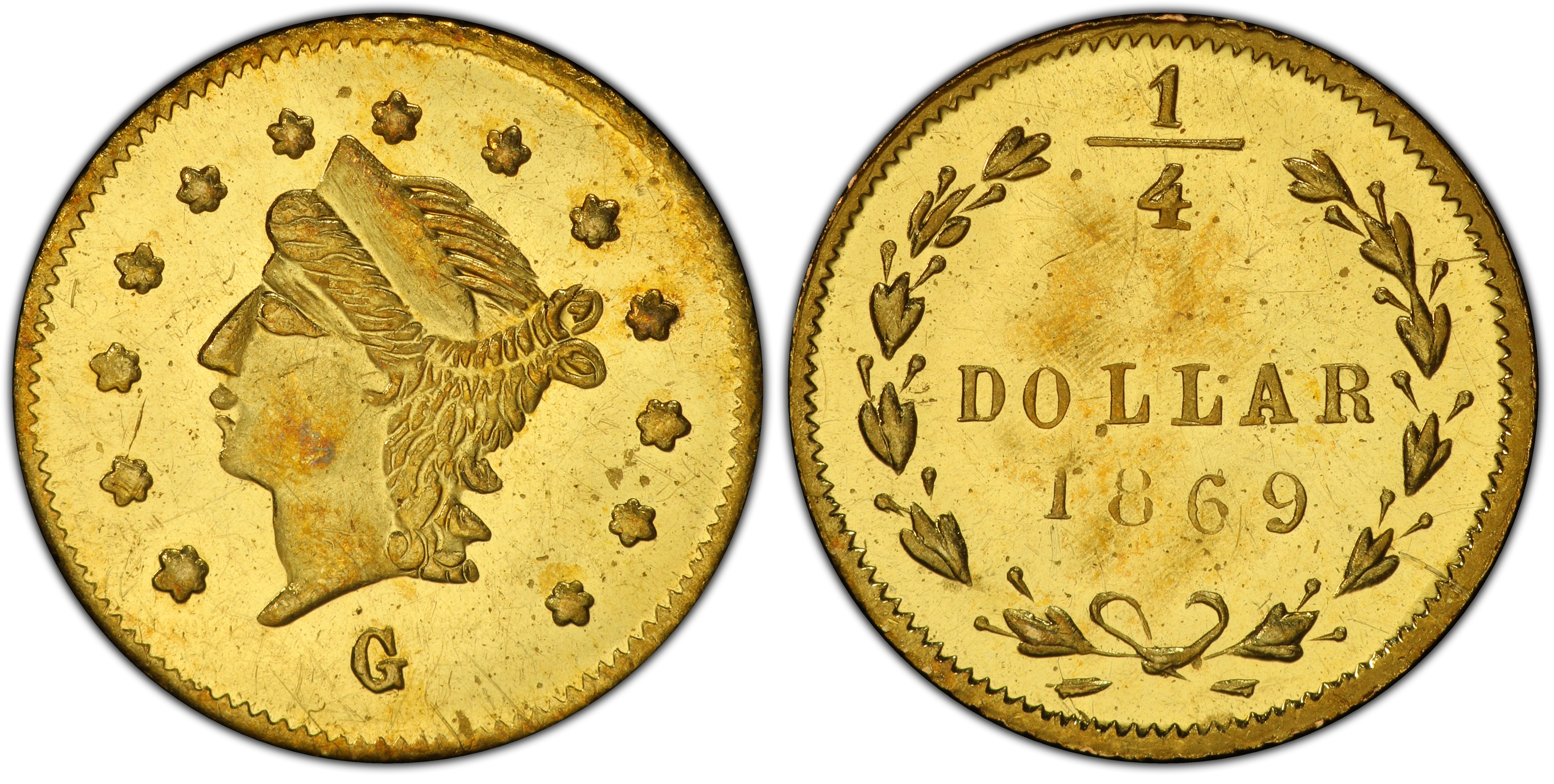
Obverse & Reverse
The 1869 BG-826 25 Cents is a quintessential example of a 'Period Two' California Fractional Gold piece, a series cataloged exhaustively by Walter Breen and Ronald J. Gillio. Unlike the 'Period One' issues (1852-1857), which were struck with a genuine, albeit limited, commercial purpose to alleviate the chronic shortage of small change during the initial Gold Rush, the Period Two pieces (1859-1882) served a different function. By 1869, the San Francisco Mint was in full operation, supplying the region with ample federal coinage. The raison d'être for these later, smaller gold pieces shifted from commerce to curiosity. They were primarily manufactured by jewelers and novelty makers as souvenirs, keepsakes, and jewelry items, capitalizing on the romantic allure of the California Gold Rush that still captivated the nation. The passage of the Private Coinage Act of 1864 had made such private issues illegal, but enforcement was lax, and the public appetite for these charming miniatures ensured their continued, if clandestine, production. These 'suppressed jewelers' issues,' as Breen and Gillio termed them, were often intentionally underweight and of a lower fineness than their stated denomination would imply, confirming their status as tokens rather than true coinage. The BG-826, attributed to the hand of die-sinker Robert Gray, is a product of this environment. It was likely struck in a small San Francisco workshop, using a screw press or even a simpler hammer method, producing coins for sale to locals and tourists. The 'PL' or Prooflike designation on some specimens indicates that they were struck using highly polished dies on polished planchets, resulting in a mirrored finish intended to appeal directly to the collector and souvenir market. These pieces never truly circulated; their existence is a testament to the popular mythology of the Gold Rush and the entrepreneurial spirit of the jewelers who met the demand for its tangible symbols.
Associated EventPost-Gold Rush California Economy
Reason For MintingPrimarily created as souvenirs and for use in jewelry, capitalizing on the romanticism of the Gold Rush, rather than for circulation.
Minter HistoryRobert Gray was a notable San Francisco die-sinker active during the era. He is credited with the design and die work for several California Fractional Gold varieties. His work is characterized by a particular style, often featuring a 'bug-eyed' or 'archaic' Liberty head, as seen on some die states of this issue. While not a large-scale minting operation in the vein of the earlier assayers, Gray was a key producer in the 'Period Two' souvenir market, creating the tools necessary for jewelers to strike these popular gold tokens.
Historical SignificanceThe BG-826 is historically significant not as a coin for commerce, but as a cultural artifact of its time. It represents the commercialization of the Gold Rush mythos and the transition of private gold pieces from functional money to collectible souvenirs. Its existence, more than five years after the Private Coinage Act of 1864, also highlights the federal government's initially ambivalent enforcement of private minting laws in the Far West.
N/A
DenominationG25C (Gold 25 Cents)
Minting Period1869
Assayer/MinterRobert Gray & Co.
Geographic OriginSan Francisco, California
Obverse DescriptionA Liberty Head facing left, with 13 stars surrounding the portrait. The depiction of Liberty is somewhat crude, a common characteristic of Period Two issues. On some die states, the eye is pronounced and bulging, a diagnostic for Robert Gray's work.
Obverse Inscription(No lettering, 13 stars)
Reverse DescriptionThe denomination '1/4' is centered within a wreath composed of two branches tied with a bow at the bottom. The wreath is typically open at the top. The date '1869' is located below the wreath, directly above the lower rim.
Reverse Inscription1/4 1869
CompositionGold
Stated Fineness Actual FinenessVaries, but generally lower than monetary-issue gold, often around .500 to .750 fine.
Diameter9.70 mm
EdgePlain
Unknown
Survival Estimate76-125
Rarity ScaleR-4
This variety appeals to collectors for its specific Breen-Gillio attribution, the identifiable style of its engraver Robert Gray, and its status as a classic 'Period Two' jeweler's issue. The availability of Prooflike (PL) specimens adds another layer of collecting interest, as these mirrored pieces represent the pinnacle of production quality for this type.
Key VarietiesThe primary variety is the regular business strike. A notable sub-variety is the Prooflike (PL) striking, which is not a true proof coin but a business strike from highly polished dies, commanding a significant premium. Heritage Auctions has noted a 'Die State II' with an 'archaic bulging eye suggesting an ancient Greek coin,' which is a key diagnostic for Gray's work and highly sought after. No later-date restrikes are known to exist.
Authentication TipsAuthentic examples often show a slightly crude, soft strike, especially on the stars and wreath details. Check for the specific die markers of BG-826, such as the exact positioning of the date relative to the wreath and any known die cracks or file marks. Counterfeits may be cast, showing porosity under magnification, or have incorrect weights and diameters. The 'bulging eye' on certain die states is a key, if not universal, diagnostic.
Shopping ConsiderationsA premium quality example for this variety, especially in Mint State, will exhibit sharp details on Liberty's hair and the leaves of the wreath. For PL examples, the quality and depth of the mirrored fields are paramount. Look for coins with minimal contact marks, as the small size and soft gold make them susceptible to damage. Avoid examples that have been harshly cleaned, which destroys the original luster, or those showing evidence of being mounted in jewelry, a common fate for these pieces. Eye appeal is critical; coins with a pleasing, original reddish-gold patina are highly desirable.
A coin's grade is its condition, rated on a 1-70 scale. For rare coins, this is the most critical factor in determining value, as a tiny difference in preservation can mean a huge difference in price.
Relevant Grade TypesOriginal period issues were business strikes, technically intended for souvenir sales rather than circulation. They are found in Circulated (1-58) and Mint State (MS, 60-70) grades. No true Proofs were struck in 1869. However, special strikings from polished dies resulted in Prooflike (PL) examples, which are designated as such by grading services (e.g., MS-63 PL). These are considered a distinct and desirable category from the regular business strikes.
Mint State CharacteristicsUncirculated examples of BG-826 often exhibit a soft, satiny luster. The strike can be inconsistent; a well-struck piece will show clear definition in Liberty's hair strands and the fine details of the wreath, but many are somewhat soft in the centers. Small planchet flaws or adjustment marks are not uncommon. Prooflike specimens will have reflective, mirror-like fields, though they may still show the same strike weaknesses as their business-strike counterparts.
Circulated Wear PatternsWear first appears on the highest points: Liberty's cheek, the hair above her eye, and the knot of the bow on the reverse. As wear progresses, the stars will lose their sharpness and begin to merge with the field. On the reverse, the leaves and berries in the wreath will become flat. In lower grades (VF and below), the date and the fraction '1/4' will show significant flattening.
Key Factors For ValueFor the BG-826, value is driven by several factors. First is the grade; a jump from MS-62 to MS-64 can double the price. Second is the surface quality; an example with clean, original surfaces and strong eye appeal will always command a premium over a cleaned or marked-up specimen in the same grade. The presence of a Prooflike (PL) designation significantly increases value. Finally, a CAC sticker, indicating premium quality for the grade, adds a strong premium, as it confirms the coin's superior eye appeal and originality in a series where such attributes are highly prized.
PCGS Price Guide
| Grade | Price | Population |
|---|---|---|
| 61 | N/A | N/A |
| 62 | N/A | N/A |
| 63 | $600.00 | 1 |
| 63+ | $725.00 | N/A |
| 64 | $1,100.00 | 1 |