1875 G50C BG-1035 (Regular Strike)
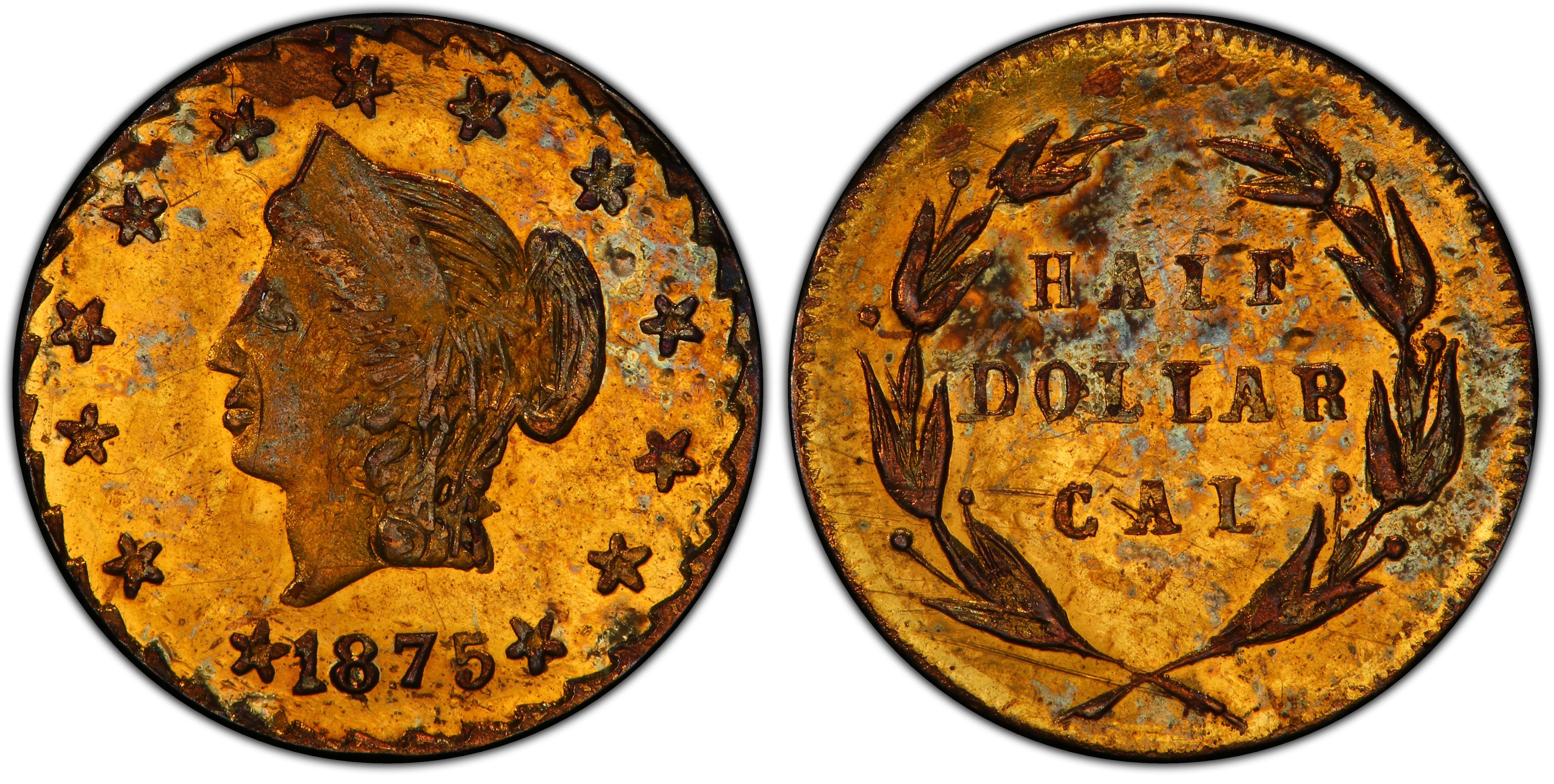
Obverse & Reverse
The 1875 BG-1035 50 Cents represents a fascinating and complex chapter in the history of U.S. private coinage, belonging to what numismatists classify as 'Period Two' (1859-1882) of California Fractional Gold. By the mid-1870s, the socio-economic landscape of California had matured significantly from the chaotic, early days of the Gold Rush. The initial, acute shortage of small change that spurred the creation of 'Period One' (1852-1857) pieces had been largely alleviated by the steady output of the San Francisco Mint. However, a different market emerged. These later 'jeweler's issues,' as they are often termed, were produced not primarily to satisfy a dire commercial need, but to cater to a burgeoning souvenir and novelty trade. Jewelers and private minters in San Francisco recognized the romantic allure that the Gold Rush held for both locals and tourists. These tiny gold pieces served as perfect, affordable mementos of California's golden identity. Unlike their predecessors, Period Two coins were often deliberately struck underweight, containing less gold than their face value implied, a clear indication of their souvenir-driven purpose. The Coinage Act of 1864 had officially prohibited private coinage, but enforcement was lax, allowing this cottage industry to persist until a federal crackdown in the early 1880s finally extinguished it. The BG-1035 was born into this environment. It was a product of skilled die-sinkers, yet its creation was more an act of commercial artistry than a response to monetary crisis. These pieces likely never saw widespread circulation in the traditional sense; instead, they were purchased as keepsakes, tucked away in jewelry boxes, or sent back East as curious examples of frontier enterprise. Their modern numismatic significance lies in this very duality: they are at once a continuation of the private minting tradition and a reflection of California's transition from a raw frontier to a place with a marketable history.
Associated EventPost-Gold Rush Era Souvenir Trade
Reason For MintingPrimarily created to be sold as souvenirs and keepsakes to tourists and locals, capitalizing on the romanticism of the Gold Rush.
Minter HistoryThe specific minter of the BG-1035 variety is not definitively known or is poorly documented. During 'Period Two,' many small-scale jewelers and metalworkers in San Francisco produced fractional gold pieces. Prominent names from the general period include Robert B. Gray & Co. and the California Jewelry Co., but a direct attribution for this specific die marriage remains elusive in mainstream numismatic references. Production was often clandestine due to the questionable legality, leading to a lack of clear maker's marks or records for many varieties.
Historical SignificanceThe BG-1035 is historically significant not as a circulating medium of exchange, but as a tangible artifact of the commercialization of the Gold Rush legacy. It represents the 'souvenir phase' of private gold coinage, illustrating how the mythology of the Forty-Niners was packaged and sold, and marks the final chapter of a uniquely American form of private enterprise before federal laws were fully enforced.
N/A
Denomination50 Cents
Minting Period1875
Assayer/MinterUnknown Private Minter
Geographic OriginSan Francisco, California
Obverse DescriptionFeatures a Liberty Head portrait facing left, reminiscent of contemporary federal gold coinage but often cruder in execution. The portrait is surrounded by thirteen six-pointed stars, representing the original colonies. The date '1875' is positioned below the bust.
Obverse Inscription1875
Reverse DescriptionThe central device is a simple wreath composed of two branches tied with a ribbon at the bottom. Within the wreath, the denomination is expressed as '50 CENTS'. The inscription 'CALIFORNIA GOLD' encircles the wreath along the upper periphery.
Reverse InscriptionCALIFORNIA GOLD / 50 CENTS
CompositionGold
Stated Fineness Actual FinenessVariable, but generally lower than federal standards for this period.
Weight0.25 grams
Diameter10.00 mm
EdgePlain
Unknown
Survival EstimateFewer than 75; likely in the 31-75 range based on rarity rating.
Rarity ScaleHigh R-5
This variety appeals to specialists in California Fractional Gold due to its high rarity (R-5) and its representation of the later 'jeweler's issue' period. Collecting these tiny gold pieces offers a tangible connection to the post-Gold Rush history of San Francisco at a more accessible price point than the larger territorial gold coins.
Key VarietiesNo major varieties of BG-1035 are recorded from the original minting period. Unlike some territorial series, California Fractional Gold is not associated with official, later-date restrikes by the U.S. Mint. The primary variations in the broader series relate to the numerous different die pairings (BG numbers), shapes (round vs. octagonal), and designs (Liberty vs. Indian heads) produced by various private minters.
Authentication TipsAuthentic examples are struck, not cast, so look for sharp details and defined rims. The fabric should be thin and lightweight. Many fakes are thicker, have a soapy or porous appearance, incorrect weight, or feature designs (like bears) not found on genuine denominated pieces. A key diagnostic for genuine Period Two issues is their often-crude but sharp strike quality. Comparing the coin to high-resolution images of certified examples is the most effective authentication method, as die characteristics for each BG number are unique.
Shopping ConsiderationsA premium quality example for its grade will exhibit a sharp, well-centered strike, particularly on Liberty's hair details and the numerals of the date. Surfaces should be free of distracting marks, cleaning, or evidence of having been mounted in jewelry, a common fate for these pieces. Luster is a key value driver; look for coins with original, satiny mint bloom rather than a flat, dull appearance from circulation or harsh cleaning. Eye appeal is paramount for these tiny coins, and examples with a smooth, problem-free surface command significant premiums. Given the high rarity, any certified, problem-free example is a significant acquisition.
A coin's grade is its condition, rated on a 1-70 scale. For rare coins, this is the most critical factor in determining value, as a tiny difference in preservation can mean a huge difference in price.
Relevant Grade TypesOriginal issues of BG-1035 were business strikes. Although intended for souvenir sales rather than heavy circulation, they can be found in both Circulated (1-58) and Mint State (MS, 60-70) grades. No proofs are known to have been struck during the original period of issue, and there are no known later-date Proof restrikes.
Mint State CharacteristicsUncirculated examples of BG-1035 are defined by their luster, which is typically soft and satiny. Strike quality can be inconsistent; a fully struck example with sharp definition on the highest points of Liberty's hair and the wreath on the reverse is highly desirable. Due to their small size and handling over the years, even Mint State examples may show minor ticks or hairlines, but an absence of significant marks is crucial for a premium grade.
Circulated Wear PatternsWear first appears on the highest points of the design. On the obverse, this includes Liberty's cheek, the hair just above the ear, and the coronet. On the reverse, the high points of the wreath's leaves and the bow will show the first signs of friction. In lower grades (VF and below), the fine details of the hair will merge, and the legends will begin to soften.
Key Factors For ValueFor the BG-1035, value is driven by three main factors: 1) Grade and Surface Quality: A problem-free coin with original surfaces and luster will always be worth multiples of a cleaned, damaged, or jewelry-mounted piece. 2) Strike: A sharp, well-centered strike is a significant premium factor, as many were produced hastily. 3) Rarity: As an R-5 variety, any certified example is in demand. A sticker from CAC, indicating premium quality for the grade, adds a substantial premium and is highly sought after by discerning collectors.
PCGS Price Guide
| Grade | Price | Population |
|---|---|---|
| 55 | $350.00 | 3 |
| 55+ | $365.00 | N/A |
| 58 | $380.00 | N/A |
| 58+ | $390.00 | N/A |
| 60 | $425.00 | 1 |
| 61 | $450.00 | 3 |
| 62 | $475.00 | 4 |
| 62+ | $520.00 | N/A |
| 63 | $600.00 | 6 |
| 63+ | $675.00 | N/A |
| 64 | $800.00 | 3 |
| 64+ | $950.00 | N/A |
| 65 | $1,650.00 | 1 |
| 66 | N/A | N/A |