1871 G50C BG-910 (Regular Strike)
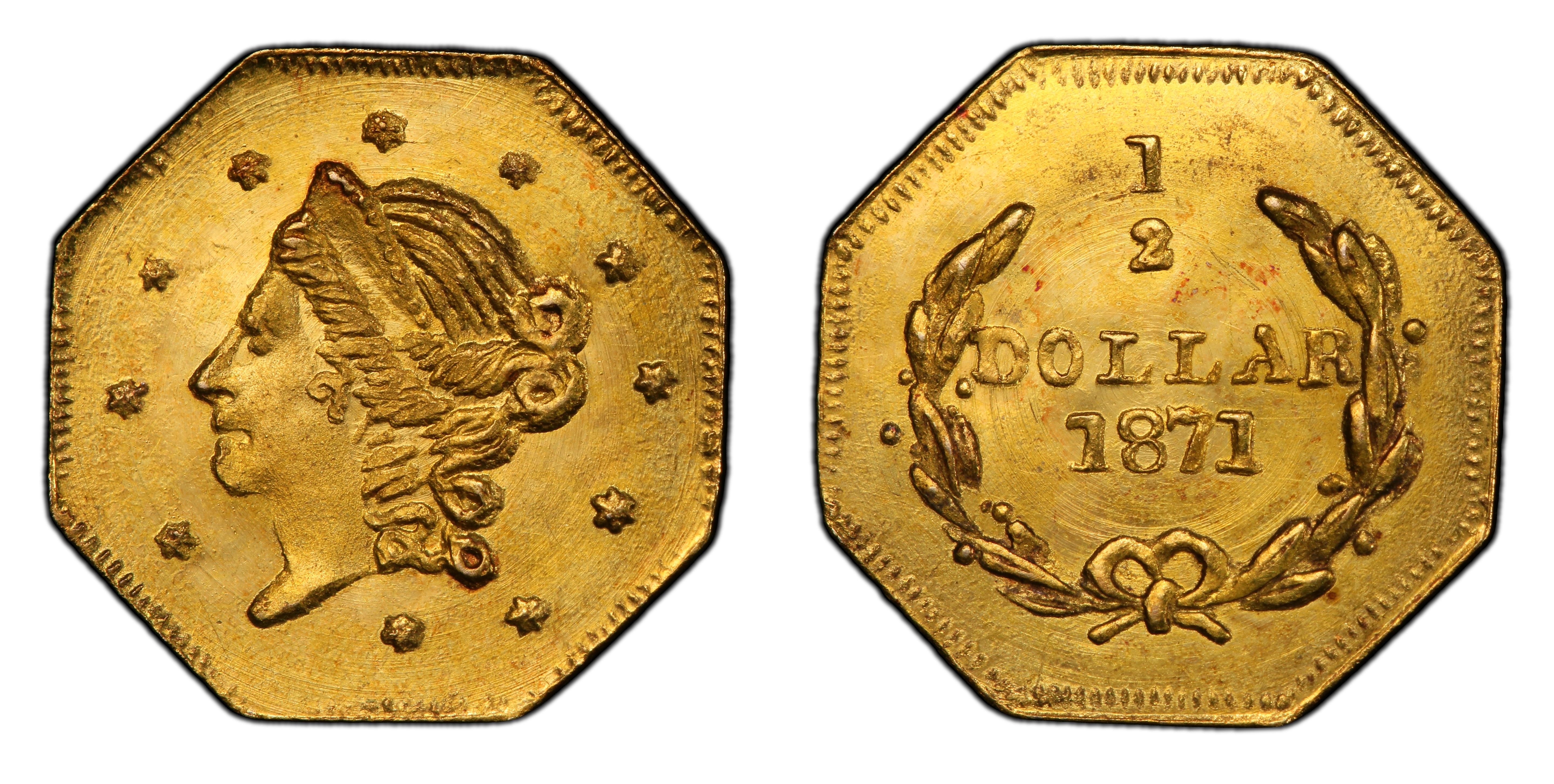
Obverse & Reverse
The 1871 BG-910 50 Cents is a quintessential example of a 'Period Two' California Fractional Gold piece. The series was born out of a severe shortage of small denomination coinage that plagued California following the 1849 Gold Rush. With a massive influx of population and gold dust being the primary medium of exchange, simple transactions became incredibly cumbersome. To fill this void, private jewelers and metallurgists began striking their own coins in 25 cent, 50 cent, and one dollar denominations starting in 1852. These initial 'Period One' (1852-1857) issues were generally of high purity and intended for actual circulation. However, by the time the BG-910 was produced in 1871, the landscape had changed. The U.S. Branch Mint in San Francisco, which opened in 1854, had largely resolved the coinage shortage. The purpose of fractional gold shifted from necessity to novelty. These 'Period Two' (1858-1882) pieces, often called 'jeweler's issues,' were primarily created as souvenirs and keepsakes for tourists and locals nostalgic for the Gold Rush heyday. While denominated, their gold content was often less than their face value, and they served more as charms or pocket pieces than as circulating money. The Coinage Act of 1864 made private coinage illegal, but it was not strictly enforced by the Secret Service until the early 1880s, allowing these pieces to be openly produced and sold for nearly two more decades. The BG-910, with its Liberty Head design mimicking federal coinage, represents this fascinating transitional phase, where a once-vital private currency evolved into a memento of one of America's most defining economic and social upheavals.
Associated EventPost-Gold Rush California Economy
Reason For MintingPrimarily struck as souvenirs and jewelry items for a public fascinated with the Gold Rush, long after the acute coinage shortage had ended.
Minter HistoryThe specific minter of the BG-910 variety is unknown, which is characteristic of the 'Period Two' issues. These coins were produced by a number of San Francisco jewelers, many of whom were French immigrants, who saw a commercial opportunity in selling these small gold tokens. Unlike the earlier period's assayers who often marked their work (e.g., Moffat & Co.), the jewelers of the 1860s and 1870s typically remained anonymous, focusing on producing a wide variety of designs to appeal to the souvenir trade rather than establishing a reputation for monetary integrity.
Historical SignificanceThe BG-910 is significant not as a circulating coin, but as a numismatic artifact representing the commercialization of the Gold Rush legacy. It demonstrates the evolution of private coinage from a practical necessity to a nostalgic commodity. The entire series of California Fractional Gold is a testament to the economic autonomy and unique challenges of the American West during the 19th century.
N/A
Denomination50 Cents
Minting Period1871
Assayer/MinterUnknown Private Minter (Jeweler)
Geographic OriginSan Francisco, California
Obverse DescriptionA classic Liberty Head design, facing left, closely modeled on the federal gold coinage of the era. The portrait is surrounded by thirteen stars, representing the original colonies. The date, 1871, is positioned below the truncation of the neck.
Obverse Inscription1871
Reverse DescriptionThe central device is the denomination '1/2' surrounded by a wreath of leaves and berries. The inscription 'DOLLAR' appears within the wreath, below the fraction. The legend 'CALIFORNIA GOLD' is inscribed around the periphery, outside the wreath.
Reverse InscriptionCALIFORNIA GOLD / 1/2 DOLLAR
CompositionGold, though often of lower fineness than Period One issues. Some examples are described as gold-plated.
Stated Fineness Actual Fineness Weight0.25 grams
Diameter10.00 mm
EdgePlain
Unknown
Survival Estimate31-75
Rarity ScaleR-5+
The BG-910 is highly sought after for its direct connection to the California Gold Rush era, its octagonal shape, and its status as a high-rarity (R-5+) variety. It appeals to collectors of territorial gold, tokens, and U.S. history buffs, offering a tangible piece of the Old West at a more accessible price point than the larger denomination territorial coins.
Key VarietiesThe BG-910 is itself a specific die marriage cataloged in the Breen-Gillio reference. Within the broader 1871 50C series, numerous die varieties (BG numbers) exist, differing in date placement, star arrangement, and reverse wreath details. No later-date proof restrikes or special collector issues of the BG-910 variety are known to exist; all known examples are considered original business strikes from the period.
Authentication TipsAuthenticity is a major concern with fractional gold. Original BG-910s have a characteristic 'soft' strike, particularly on the details of Liberty's hair and often on the 'D' in DOLLAR. The surfaces of genuine pieces can be somewhat prooflike, but with a subdued luster. A key diagnostic mentioned in auction records for high-grade examples is the presence of 'tiny air bubbles trapped beneath the gold plating, as produced,' suggesting some pieces may have been gilt. Modern counterfeits are numerous and often have a 'brassy' color, sharp wire rims, or incorrect design details and lettering fonts. Comparison with certified examples is essential.
Shopping ConsiderationsWhen acquiring an 1871 BG-910, a potential buyer should prioritize surface quality and originality. A premium quality example will possess lustrous, prooflike surfaces that have not been harshly cleaned, polished, or damaged. Given the nature of their production, a sharp strike is rare; however, seek an example with as much detail as possible in Liberty's portrait and the reverse wreath. Pay close attention to the fields for signs of tooling or scraping. A weakly struck but original and attractive piece is often preferable to a more sharply detailed but cleaned coin. Certification by a major grading service (PCGS or NGC) is highly recommended for this series due to the prevalence of fakes.
A coin's grade is its condition, rated on a 1-70 scale. For rare coins, this is the most critical factor in determining value, as a tiny difference in preservation can mean a huge difference in price.
Relevant Grade TypesAll original BG-910 coins were produced as business strikes, intended for sale as souvenirs. They are found in Circulated grades (About Good-3 to About Uncirculated-58) and, more commonly, in Mint State grades (MS-60 to MS-70). No original Proofs were struck during the 1871 minting period, and no later-date Proof restrikes are known to exist for this variety.
Mint State CharacteristicsUncirculated examples of BG-910 are known for having splendid prooflike (PL) or deep mirror prooflike (DMPL) fields. The luster is often flashy but can be subdued. The strike is characteristically soft, with the 'D' in DOLLAR on the reverse often appearing weak or incomplete. The high points of the design, such as Liberty's hair curls and the leaves in the wreath, may lack full definition even on Gem-quality specimens. Small planchet flaws or the aforementioned 'air bubbles' from the plating process can be present and are considered characteristic, not necessarily detrimental if minor.
Circulated Wear PatternsOn circulated examples, wear first appears on the highest points of the design. For the obverse, this includes Liberty's cheek, the hair above the eye and ear, and the tips of the stars. On the reverse, the fraction '1/2' and the high points of the wreath leaves will show the first signs of friction and flattening. In lower grades (VF and below), the date and legends will become soft and can merge with the fields.
Key Factors For ValueFor the 1871 BG-910, the most significant value drivers are surface preservation and eye appeal. A coin with original, undisturbed prooflike surfaces commands a substantial premium over one that has been cleaned, even if the technical grade is the same. Strike sharpness, while a secondary consideration due to the typically weak production, can also add value; a coin with an unusually bold strike for the variety is highly desirable. Attractive, original toning, often a deep golden-brown or reddish-gold, enhances eye appeal and value. A CAC sticker for this issue indicates superior quality for the grade and will result in a significant price premium.
PCGS Price Guide
| Grade | Price | Population |
|---|---|---|
| 55 | $325.00 | 3 |
| 55+ | $335.00 | N/A |
| 58 | $350.00 | 3 |
| 58+ | $365.00 | N/A |
| 60 | $385.00 | N/A |
| 61 | $400.00 | N/A |
| 62 | $420.00 | 6 |
| 62+ | $450.00 | N/A |
| 63 | $550.00 | 10 |
| 63+ | $650.00 | N/A |
| 64 | $825.00 | 6 |
| 64+ | $1,050.00 | 1 |
| 65 | $1,750.00 | 3 |
| 65+ | $2,250.00 | 1 |
| 66 | N/A | N/A |