1872 G50C BG-914 (Regular Strike)
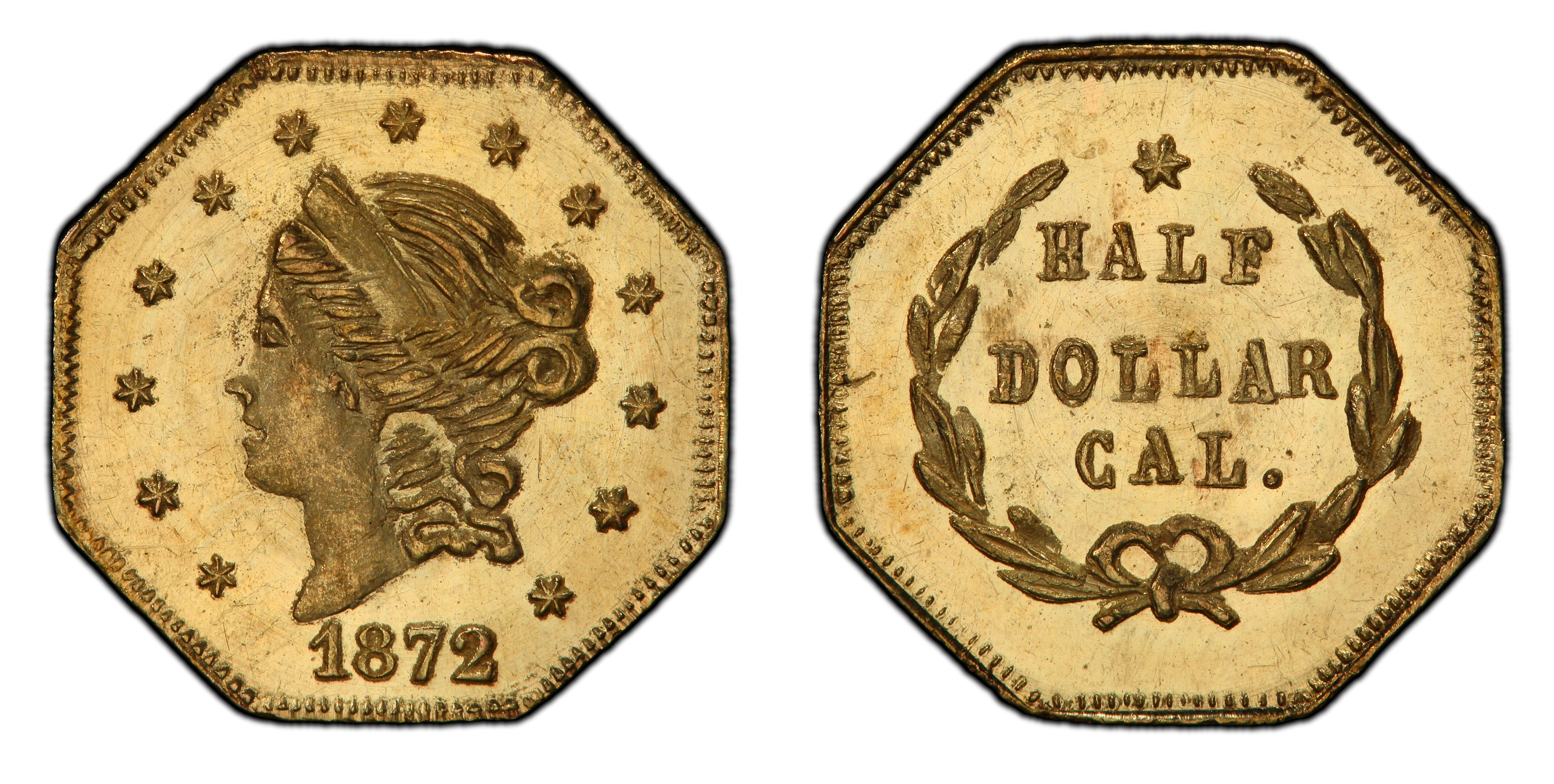
Obverse & Reverse
The 1872 G50C BG-914 octagonal half dollar emerges from the second major phase of California's private gold coinage, a period numismatically defined as 'Period Two' (1859-1882). Unlike the 'Period One' issues, which were struck out of genuine commercial necessity to alleviate a severe shortage of small change during the initial Gold Rush boom, the pieces from this later era served a different purpose. By the 1870s, the United States Mint in San Francisco was in full operation, supplying the region with ample federal coinage. The persistent production of fractional gold pieces by jewelers and private minters shifted from filling a monetary void to capitalizing on a burgeoning market for souvenirs and curiosities. California had become a tourist destination, a land of legend, and these miniature gold coins were the perfect keepsakes for visitors and mementos for residents to send to relatives back East. The socio-economic landscape of California in the early 1870s was one of maturation and diversification, but the romanticism of the Gold Rush was still very much alive. Minters, many of whom were skilled French jewelers who had settled in San Francisco, recognized this sentiment. This issue is attributed to the firm of Frontier & Bellemere, one of several such partnerships involving Pierre Frontier that produced these popular items. These pieces were not intended to meet a strict bullion value standard; their gold content was often less than their face value would imply, a fact widely understood at the time. Their value was in their novelty and their tangible connection to the great California gold phenomenon. The Coinage Act of 1864 had explicitly outlawed private coinage, but enforcement was lax, particularly for these small-denomination pieces which were not seen as a serious threat to federal currency. This legal gray area allowed production to flourish through the 1870s. The BG-914, with its distinctive 'Baby Head' Liberty portrait, is a prime example of the era's charming, if not entirely monetary, output. Production of all such pieces ceased by 1883 after the Secret Service, under Chief James J. Brooks, finally cracked down on their manufacture, deeming them a potential avenue for fraud.
Associated EventPost-Gold Rush California Tourism
Reason For MintingPrimarily struck to be sold as popular souvenirs and keepsakes, not for general circulation.
Minter HistoryThe BG-914 is attributed to Frontier & Bellemere. This firm was one of several partnerships involving Pierre Frontier, a French jeweler active in San Francisco. Throughout 'Period Two' of California Fractional Gold, firms like Frontier & Co., Frontier & Deviercy, and others were prolific producers. These jewelers employed shared die punches and hubs, creating a complex and interrelated series of issues. Their business model pivoted from the monetary necessity of the 1850s to the lucrative souvenir market of the 1860s and 1870s, creating beautifully designed but often underweight pieces for a public fascinated with the Gold Rush.
Historical SignificanceThe BG-914 is significant not as a coin for circulation, but as a historical artifact representing the commercialization of the Gold Rush legacy. It marks the transition of private minting in California from a practical necessity to a nostalgic enterprise, reflecting the public's enduring fascination with gold and the American West. It is a key example of the 'jeweler's issues' that thrived in a climate of lax federal oversight.
N/A
Denomination50 Cents
Minting Period1872
Assayer/MinterAttributed to Frontier & Bellemere
Geographic OriginSan Francisco, California
Obverse DescriptionA stylized Liberty Head facing left, often referred to by specialists as the 'Baby Head' variety due to its rounded, juvenile features and snub nose. Liberty wears a coronet inscribed with 'LIBERTY'. Thirteen stars encircle the portrait within the octagonal border.
Obverse InscriptionLIBERTY
Reverse DescriptionThe denomination '1/2' and the word 'DOLLAR' are enclosed within a wreath of two olive branches tied with a bow at the bottom. The date '1872' is positioned just below the bow, outside the wreath. The legend 'CALIFORNIA GOLD' encircles the wreath along the upper octagonal border.
Reverse InscriptionCALIFORNIA GOLD 1/2 DOLLAR 1872
CompositionGold
Stated Fineness Actual FinenessVariable, often below the .900 standard of federal coinage.
Weight0.25 grams
Diameter10.00 mm
EdgePlain
Unknown
Survival Estimate75-125
Rarity ScaleR-4
This variety is highly popular due to its distinctive and charming 'Baby Head' Liberty design. As a representative of the later 'souvenir' period of fractional gold, it tells a fascinating story of post-Gold Rush California. Its octagonal shape and clear Breen-Gillio attribution make it a desirable piece for type collectors and specialists alike.
Key VarietiesThe primary recognized variety is the BG-914 itself, characterized by the 'Baby Head' portrait. A significant diagnostic mentioned in auction catalogs is a widely repunched 'DOL' in DOLLAR, with the repunching visible to the north of the original letters. No later-date proof restrikes or special collector issues are known to exist for this specific variety; all known examples are considered original business strikes from the period.
Authentication TipsGenuine examples are characteristically thin, roughly the thickness of a business card. Counterfeits are often thicker and have a more modern, cast or sharply-stamped look. On originals, the strike can be uneven, with areas of softness or slight planchet depressions, a feature rarely seen on fakes. The lettering and stars on authentic pieces, while sometimes crude, should not have the porous or soapy appearance of cast copies. The 'Baby Head' portrait style and the repunched 'DOL' are key diagnostics to look for. Replicas made for jewelry often have a bear on the reverse, a motif never used on genuine fractional gold from this period.
Shopping ConsiderationsA premium quality example for its grade will exhibit a sharp, well-centered strike, particularly on the delicate features of Liberty's face and the digits of the date. Seek out pieces with smooth, lustrous surfaces and original 'skin'. These coins often have a bright, flashy appearance, and examples designated 'PL' (Prooflike) command a significant premium. Avoid coins that have been harshly cleaned, which strips the original surface and imparts a dull or hairlined texture. Also, be wary of pieces that have been used in jewelry, looking carefully for evidence of removed solder, tooling, or excessive rim damage.
A coin's grade is its condition, rated on a 1-70 scale. For rare coins, this is the most critical factor in determining value, as a tiny difference in preservation can mean a huge difference in price.
Relevant Grade TypesOriginal period issues were business strikes intended for sale as souvenirs, and are found in both Circulated (1-58) and Mint State (MS, 60-70) grades. Due to their novelty purpose, many were saved in high grades. No true Proofs (PR/PF) were struck during the original minting period, and there are no known later-date Proof restrikes for this specific variety. Some Mint State examples are found with highly reflective, prooflike surfaces (designated PL) and are highly prized.
Mint State CharacteristicsAn uncirculated BG-914 is defined by the presence of original mint luster. The quality of this luster can range from satiny to intensely prooflike. Strike is a key differentiator; many examples are weakly struck in the centers, with softness on Liberty's hair and the wreath on the reverse. A coin with a bold, sharp strike is highly desirable. Due to the softness of the gold and the minting process, even high-grade uncirculated coins will typically show small planchet flaws or minor contact marks. A truly 'gem' example (MS-65 or higher) would have nearly flawless surfaces, a crisp strike, and vibrant luster.
Circulated Wear PatternsWear first appears on the highest points of the design. On the obverse, friction will dull the luster on Liberty's cheek, the hair above the ear, and the coronet. On the reverse, the high points of the wreath's leaves and the bow will show wear first. In lower circulated grades (VF and below), the word 'LIBERTY' on the coronet will begin to merge, and the individual leaves of the wreath will become indistinct.
Key Factors For ValueBeyond the numerical grade, value is driven by several key factors. Firstly, surface quality: a coin with original, undisturbed luster and rich reddish-gold or caramel toning is worth significantly more than a cleaned or dipped specimen. Secondly, sharpness of strike: a fully struck-up example with all details clear is a rarity and commands a strong premium. Thirdly, eye appeal: coins designated as Prooflike (PL) are especially sought after. Finally, certification by a top-tier grading service (PCGS or NGC) is essential for market acceptance, and a CAC sticker indicating premium quality for the grade will add a further substantial premium.
PCGS Price Guide
| Grade | Price | Population |
|---|---|---|
| 50 | $225.00 | 2 |
| 50+ | $235.00 | N/A |
| 53 | $250.00 | 3 |
| 53+ | $260.00 | N/A |
| 55 | $270.00 | 5 |
| 55+ | $280.00 | N/A |
| 58 | $300.00 | 18 |
| 58+ | $315.00 | N/A |
| 60 | $340.00 | 2 |
| 61 | $365.00 | 2 |
| 62 | $400.00 | 18 |
| 62+ | $420.00 | N/A |
| 63 | $450.00 | 23 |
| 63+ | $550.00 | N/A |
| 64 | $700.00 | 11 |
| 64+ | $850.00 | 1 |
| 65 | $1,650.00 | 1 |
| 65+ | $1,950.00 | N/A |
| 66 | $2,600.00 | 2 |
| 66+ | $3,000.00 | N/A |
| 67 | $3,500.00 | N/A |