1870 G25C BG-832, PL (Regular Strike)
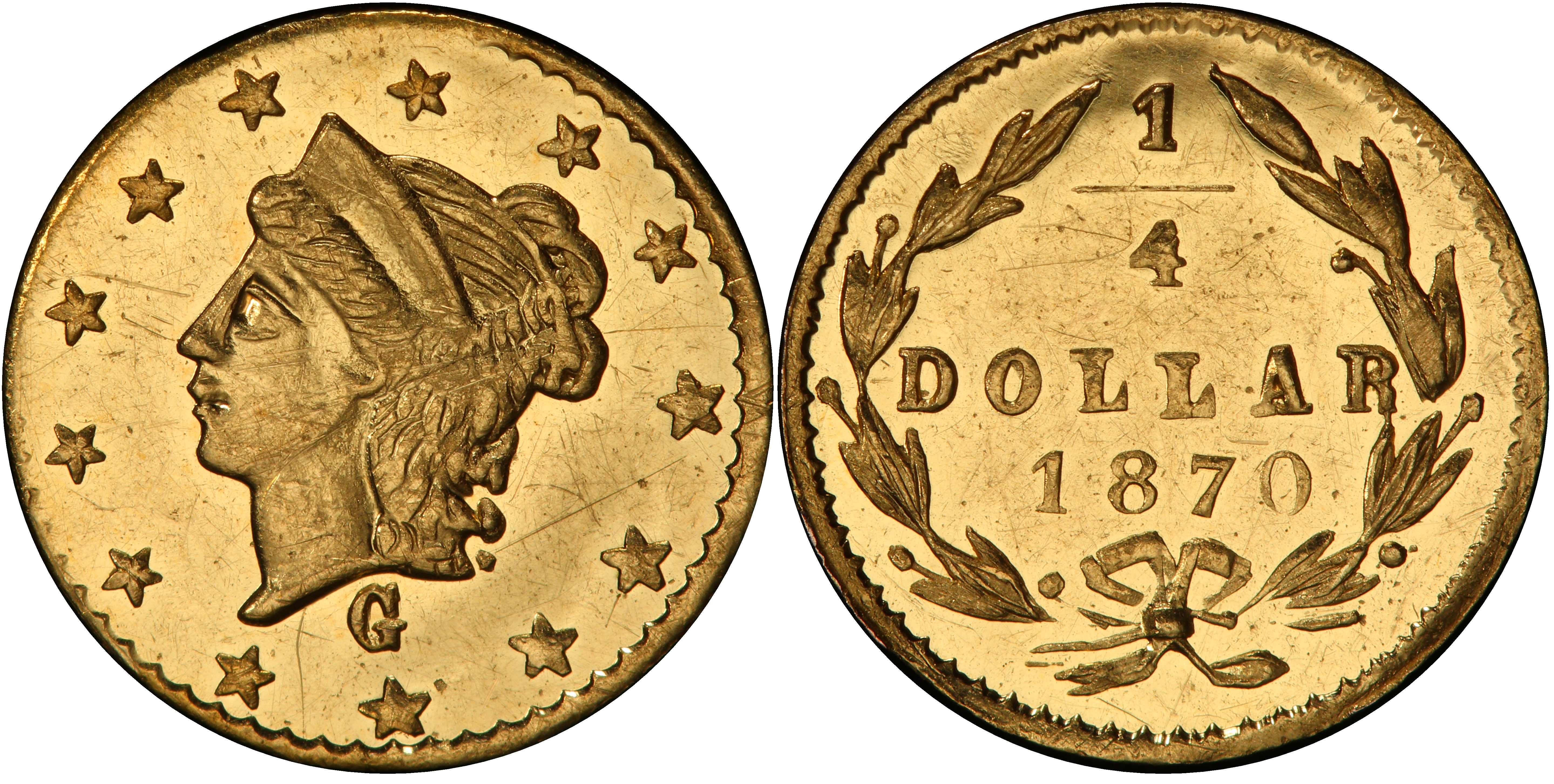
Obverse & Reverse
The 1870 BG-832 25 Cent piece emerges from the second major phase of California Fractional Gold production, often termed 'Period Two' (1858-1882). By 1870, San Francisco had transformed from the chaotic boomtown of the early Gold Rush into a burgeoning metropolis of nearly 150,000 people. The initial, desperate need for small circulating coinage that spurred the creation of 'Period One' fractionals had largely been met by the output of the San Francisco Mint. However, the allure of California gold remained a powerful force, drawing tourists and fueling a robust market for souvenirs and keepsakes. Enterprising jewelers, many of French origin like Gaime, Guillemot & Co., stepped into this new economic niche. They recognized that the romance of the Gold Rush could be minted into tiny, tangible treasures for visitors and locals alike. Unlike their predecessors, these 'jeweler's issues' were not primarily intended to function as currency. Their gold content was often inconsistent and intentionally less than their face value, making them profitable charms rather than instruments of commerce. The Coinage Act of 1864 had prohibited private coinage, but enforcement was lax, particularly for pieces that were tacitly understood to be novelties. The BG-832 was a product of this environment. It was struck not to pay for a shave or a drink, but to be tucked into a pocket as a memento of the Golden State, a miniature symbol of the vast wealth the region represented. Its production in 1870 coincides with a period of immense industrial and financial growth in the city, financed by the silver spoils of the Comstock Lode, which turned San Francisco into a hub of finance and speculation. These tiny gold pieces, therefore, represent a maturing of the California economy, where gold was not just a medium of exchange, but a powerful brand to be marketed and sold.
Associated EventPost-Gold Rush Economic Expansion / Comstock Lode Era
Reason For MintingPrimarily produced as a souvenir or charm for the tourist and jewelry trade rather than for circulation as currency.
Minter HistoryGaime, Guillemot & Co. was a prominent San Francisco jewelry firm active during the era of 'Period Two' fractional gold production. Comprised of French artisans, they were among the most prolific issuers of these popular souvenir coins. Their work is characterized by a distinctive, somewhat crude but charming style, featuring a stylized Liberty Head. Like other jewelers of the period, their primary business was not minting, but creating fine jewelry and watches, with the fractional gold pieces being a profitable and popular sideline that capitalized on the mystique of the California Gold Rush.
Historical SignificanceThe BG-832 is significant not as a coin that circulated, but as a historical artifact representing the commercialization of the Gold Rush myth. It marks the transition of fractional gold from a necessary form of currency to a collectible souvenir, reflecting San Francisco's own evolution from a frontier outpost to a major American city with a burgeoning tourist trade.
BG-832
Denomination25 Cents
Minting Period1870
Assayer/MinterGaime, Guillemot & Co.
Geographic OriginSan Francisco, California
Obverse DescriptionA stylized bust of Liberty facing left, with thirteen stars encircling the portrait. The design is characteristic of Gaime, Guillemot & Co., often featuring somewhat crude but sharply defined details. A prominent 'G' initial for the minter is located below the bust.
Obverse InscriptionG
Reverse DescriptionA wreath composed of two branches tied with a ribbon at the bottom. Inside the wreath, the denomination '25' and 'CENTS' are displayed, with the date '1870' below. The wreath is typically composed of 10 berries on the left branch and 9 on the right.
Reverse Inscription25 CENTS 1870
CompositionGold
Stated Fineness Actual FinenessVariable, often between .500 and .750 fine, as was common for Period Two jeweler's issues.
Weight0.25 grams
Diameter10.00 mm
EdgePlain
Unknown
Survival Estimate13-20 coins
Rarity ScaleR-6-
The BG-832 is highly sought after due to its high rarity (R-6), its connection to the well-known jewelers Gaime, Guillemot & Co., and its status as a quintessential 'Period Two' fractional. The availability of high-grade, Prooflike (PL) examples adds significant appeal for collectors who prize exceptional surface quality and eye appeal.
Key VarietiesThe primary issue is the business strike, which often comes with prooflike surfaces (PL or DPL). No later-date restrikes or contemporary proof-only issues are known to exist for this variety. Minor die states may exist, such as faint obverse die cracks, but these are not typically collected as distinct varieties.
Authentication TipsAuthentic pieces are very thin and lightweight. The strike can be uneven, but the details should be sharp, not mushy or cast-looking. The 'G' initial on the obverse should match the known punch style of Gaime, Guillemot & Co. Fakes are often thicker, have incorrect weight, and may display a soapy or porous texture. A key diagnostic is the precise arrangement of berries in the wreath. All genuine California Fractional Gold from this period must have a denomination; pieces marked 'CAL GOLD' with no denomination are later tokens.
Shopping ConsiderationsA premium quality example is defined by a sharp, well-centered strike and pristine, reflective fields. For a coin designated PL (Prooflike), look for deep, clear reflectivity in the fields on both sides, ideally with frosty devices creating a cameo contrast. As these were not made for circulation, most known examples are in Mint State, so heavy marks or signs of wear are significant detractors. Avoid coins that have been cleaned, as this strips the original skin and destroys the prooflike qualities. Look for attractive, original reddish-gold or orange-peel toning. Given the rarity, any certified example is significant, but one with a CAC sticker would confirm premium quality for the grade.
A coin's grade is its condition, rated on a 1-70 scale. For rare coins, this is the most critical factor in determining value, as a tiny difference in preservation can mean a huge difference in price.
Relevant Grade TypesAll original 1870 BG-832 issues were business strikes intended for the souvenir market, not circulation. They are found in Circulated grades (AU-50 to AU-58 are very rare) and, more commonly, Mint State (MS, 60-70) grades. No true Proofs were struck in 1870. The Prooflike (PL) and Deep Prooflike (DPL) designations are not separate types but rather desirable surface characteristics of a standard business strike, resulting from striking with freshly polished dies. These designations add a significant premium.
Mint State CharacteristicsUncirculated examples are defined by their luster and strike. A typical BG-832 may show some weakness in the center of the reverse. Luster is typically bright and flashy; examples with deeply reflective, mirror-like fields qualify for the PL designation. Due to the softness of the gold and the minting process, even high-grade specimens can have small planchet flaws or tiny mint-made adjustment marks, which should be distinguished from post-minting damage.
Circulated Wear PatternsOn the rare occasion a circulated example is found, wear first appears on the highest points: Liberty's cheek, the hair just above her eye, and the highest leaves and berries of the wreath on the reverse. As wear progresses, the stars on the obverse will begin to lose their definition, starting with those closest to the rim.
Key Factors For ValueFor the BG-832, value is driven by three primary factors: rarity, grade, and surface quality. The R-6 rarity makes any example valuable. The numerical grade (e.g., MS-63 vs. MS-64) is the next determinant. The most significant value multiplier is the surface designation; a PL coin is worth substantially more than a standard MS example, and a DPL (or DMPL) commands the highest premium. Superb eye appeal, characterized by clean surfaces and attractive original toning, is paramount. A CAC sticker confirming quality for the grade provides an additional, often substantial, premium.
PCGS Price Guide
| Grade | Price | Population |
|---|---|---|
| 62 | $850.00 | 1 |
| 62+ | $1,000.00 | N/A |
| 63 | $1,450.00 | N/A |