1853 G$1 BG-531, PL (Regular Strike)
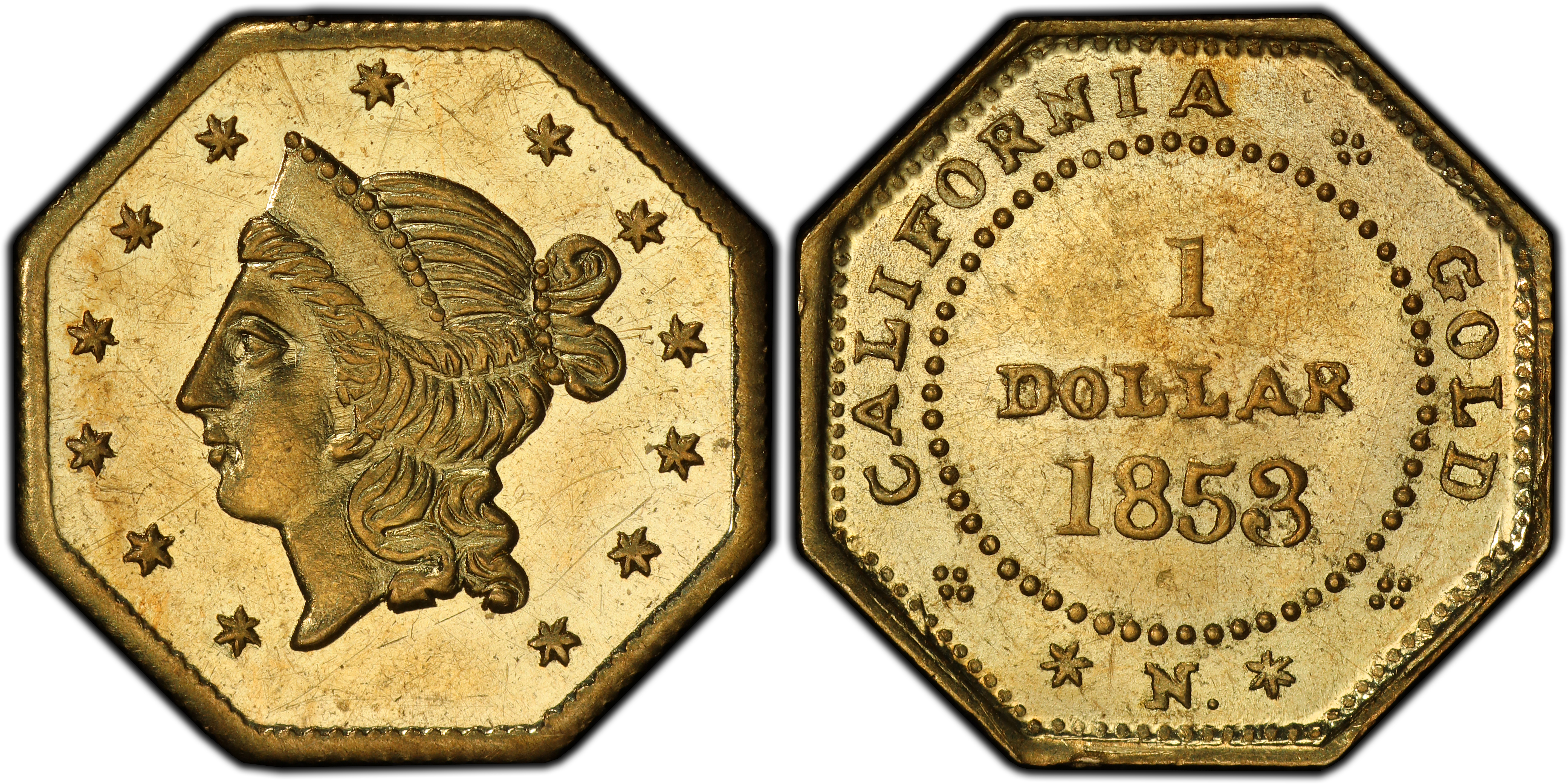
Obverse & Reverse
The 1853 Octagonal Gold Dollar, cataloged as Breen-Gillio 531, is a quintessential artifact from the chaotic and economically vibrant era of the California Gold Rush. Following the discovery of gold at Sutter's Mill in 1848, a massive influx of prospectors and merchants flooded into California, creating a booming economy almost overnight. However, this rapid growth far outpaced the supply of official United States coinage. Gold dust, while plentiful, was an imprecise and cumbersome medium for daily transactions, and the smallest denomination federal gold coin was the relatively large quarter eagle ($2.50). The U.S. Mint in Philadelphia was too distant to solve the problem, and the San Francisco Mint would not begin operations until 1854. This severe shortage of small change created a vacuum that private enterprise rushed to fill. Jewelers and metalworkers in San Francisco began striking their own small-denomination gold coins in quarter, half, and one-dollar sizes starting in 1852. These pieces, now known as California Fractional Gold, were intended for actual circulation to facilitate commerce. The BG-531 is a product of this initial, utilitarian phase, known to numismatists as 'Period One' (1852-1857). Struck by an unknown maker, it represents the ingenuity and necessity of the time. However, the practicality of these tiny gold coins was short-lived. They were easily lost and their intrinsic gold value was often significantly less than their face value. As the San Francisco Mint began to issue federal coinage and foreign silver coins circulated more widely, the fractional gold pieces quickly fell out of favor for commerce. Yet, their story did not end there. They became immensely popular as souvenirs and keepsakes—a tangible piece of the Gold Rush that could be easily mailed back East or worn as jewelry. This transition from circulation currency to popular memento ensured their survival in far greater numbers than if they had been heavily used and subsequently melted. Today, the BG-531 is a prized collectible, a direct link to a time when private citizens minted their own money to keep the wheels of commerce turning on the American frontier.
Associated EventCalifornia Gold Rush
Reason For MintingTo alleviate a severe shortage of small-denomination coinage for everyday commercial transactions in Gold Rush-era California.
Minter HistoryThe specific minter of the BG-531 variety is unknown, which is common for many Period One California Fractional Gold issues. They were typically produced by jewelers or metalworkers in San Francisco who possessed the requisite skills and equipment to strike coins. These operations were often small-scale, and the makers frequently did not apply a personal mark, leaving their identities lost to history. Prominent known producers of the era included figures like Antoine Louis Nouzillet and M. Deriberpie, but no definitive link has been established for this specific variety.
Historical SignificanceThe BG-531 and its contemporaries are historically significant as a solution to a critical economic problem on the American frontier. They represent a rare instance of widespread, privately issued currency being accepted in commerce out of necessity. Their evolution from utilitarian coins to souvenirs also reflects the national fascination with the California Gold Rush and the desire for tangible relics of that transformative event.
N/A
Denomination$1
Minting Period1853
Assayer/MinterAnonymous
Geographic OriginSan Francisco, California
Obverse DescriptionA Liberty Head, facing left, closely resembling the design of contemporary federal gold coins. The portrait is surrounded by 13 five-pointed stars, representing the original colonies.
Obverse Inscription Reverse DescriptionThe denomination '1' and the word 'DOLLAR' are enclosed within a wreath of leaves and berries. The wreath is open at the top.
Reverse Inscription1 DOLLAR
CompositionGold
Stated Fineness Actual FinenessVaries, but typically between .800 and .900 fine. The bullion value was intentionally less than the face value.
Weight0.90 grams
Diameter11.50 mm
EdgePlain
Unknown, but likely in the low thousands.
Survival Estimate75-125
Rarity ScaleR-4 (76-200 known)
This octagonal dollar is highly sought after for its direct connection to the historic California Gold Rush, its charmingly crude yet classic design, and its status as a Period One issue made for circulation. The octagonal shape is particularly evocative of the larger Assay Office 'slugs' of the era. High-grade examples with proof-like surfaces are especially prized.
Key VarietiesThe primary variety is the BG-531 itself. There are no major, intentional varieties from the time of minting. No known patterns, trial pieces, or official restrikes exist for this specific variety. The term 'PL' (Proof-Like) associated with this coin by collectors is a grading descriptor referring to the reflectivity of the fields, not a separate variety or special striking.
Authentication TipsAuthentic BG-531 pieces have a characteristic strike style that is often sharp on the central devices but may show softness near the borders. The lettering and stars, while sometimes crude, should have a consistent style. Be wary of modern replicas, which often have a soapy, cast-like appearance, incorrect weight, or feature a bear on the reverse (no authentic Period One fractionals have a bear). Genuine pieces are made of gold, not brass or gold-plate. Professional authentication and grading by a top-tier service like PCGS or NGC is highly recommended.
Shopping ConsiderationsA premium quality BG-531 is defined by a sharp strike on Liberty's hair and the details of the wreath. Look for examples with clean, original surfaces that have not been harshly cleaned or polished. Many surviving examples exhibit partially proof-like fields, and those with deep, flashy mirrors command a significant premium. Common problems include cleaning, previous mounting in jewelry (check edges for solder or smoothing), and minor planchet flaws. An attractive, original reddish-gold toning adds to the eye appeal. Given the high number of counterfeits and replicas, purchasing a specimen certified by a leading grading service is the safest approach.
A coin's grade is its condition, rated on a 1-70 scale. For rare coins, this is the most critical factor in determining value, as a tiny difference in preservation can mean a huge difference in price.
Relevant Grade TypesOriginal BG-531 issues were business strikes intended for circulation. Therefore, they are found in Circulated grades (AG-3 to AU-58) and Mint State grades (MS-60 to MS-70). No true Proofs were struck during the original minting period. The 'PL' or 'Proof-Like' designation seen on certified holders is a descriptor for business strike coins that were struck with fresh, polished dies, resulting in mirrored fields. This is not a separate issue but rather a desirable characteristic of a well-struck business strike.
Mint State CharacteristicsUncirculated examples of BG-531 often exhibit a surprisingly sharp strike, especially on the central elements. Luster can range from satiny to semi-proof-like. The fields, particularly on the obverse, are known to be partially proof-like, creating a cameo contrast with the devices. Due to the softness of the gold and primitive minting and handling, even high-grade Mint State examples will typically show some light contact marks or planchet irregularities.
Circulated Wear PatternsWear first appears on the highest points of the design: Liberty's hair above the eye and ear, and the high points of her cheek. On the reverse, the leaves and berries of the wreath will show initial flatness. In lower grades (VF and below), the stars on the obverse and the letters in 'DOLLAR' will become weak and begin to merge with the fields.
Key Factors For ValueThe primary value drivers for a BG-531 are grade and surface quality. An example with original, uncleaned surfaces will always be worth more than a cleaned one of the same grade. Strike is critical; a sharply struck coin with full details is highly desirable. The degree of proof-like reflectivity in the fields significantly increases value and eye appeal. Finally, a CAC sticker, indicating premium quality for the grade, adds a substantial premium for this and other California Fractional Gold issues.
PCGS Price Guide
| Grade | Price | Population |
|---|---|---|
| 63+ | $4,000.00 | 1 |