1871 G50C BG-1025 (Regular Strike)
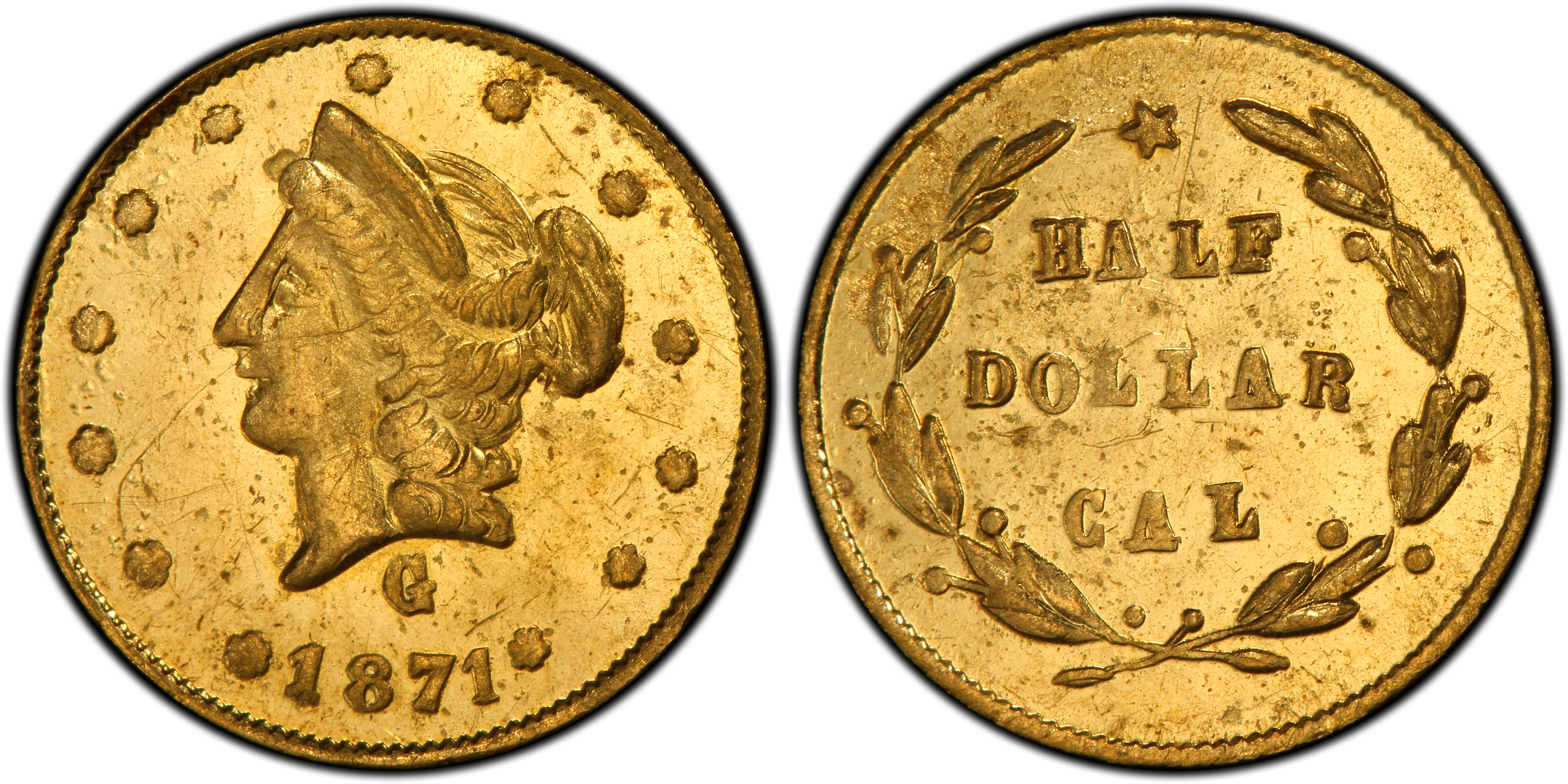
Obverse & Reverse
The 1871 50 Cents, cataloged as Breen-Gillio 1025, is a quintessential example of 'Period Two' California Fractional Gold. The socio-economic landscape of California had evolved significantly since the heady days of the Gold Rush. The initial, urgent need for circulating small change, which gave rise to the heavier, more utilitarian 'Period One' (1852-1857) fractionals, had been largely met by the output of the official San Francisco Mint, which began full-scale operations in 1854. By the 1870s, the economic purpose of these tiny gold pieces had shifted. They were no longer essential instruments of commerce but had transformed into objects of novelty and memorabilia, primarily produced by jewelers for the tourist trade and as keepsakes. These 'jeweler's issues' were often lighter and of lower fineness than their predecessors, existing in a gray area of legality. The Coinage Act of 1864 had prohibited private coinage, but enforcement by the Secret Service was inconsistent and not fully effective in California until the early 1880s. This permissive environment allowed a variety of jewelers and artisans, most of whom remain anonymous to history, to strike a plethora of designs. The BG-1025 was born of this era. It was not intended to pay for a shave or a drink in a mining camp, but rather to be sold as a charming souvenir of the Golden State. Its creation reflects a burgeoning tourism industry and a sense of nostalgia for the now-fading Gold Rush era. While the specific minter of BG-1025 is not definitively recorded, prolific producers of the period, such as Robert B. Gray & Co. (who sold his business in 1871), are possible candidates. These pieces were typically struck by hand, using a hammer and anvil method, resulting in coins of inconsistent strike quality. Their survival is owed to the fact that they were saved as curiosities rather than being spent, though their minuscule size made them exceptionally easy to lose.
Associated EventPost-Gold Rush California Commerce and Tourism
Reason For MintingPrimarily produced as a souvenir or keepsake for California's burgeoning tourist trade, rather than to alleviate a coinage shortage.
Minter HistoryThe specific minter for BG-1025 is unrecorded, a common trait for Period Two issues. San Francisco jewelers, such as Robert B. Gray & Co. (who sold his business in 1871 to the California Jewelry Co.) and others, were the primary producers of such pieces during this time. They operated in a legal gray area, creating denominated tokens that were technically illegal but tolerated until stricter enforcement began in the 1880s.
Historical SignificanceThis coin is historically significant not as circulating currency, but as a material artifact of the transition of California from a raw frontier to a place of romance and tourism. It represents the commercialization of the Gold Rush legacy and is part of a numismatically complex and widely collected series of private issues.
BG-1025
Denomination50 Cents
Minting Period1871
Assayer/MinterUnknown San Francisco Jeweler
Geographic OriginSan Francisco, California
Obverse DescriptionA head of Liberty facing left, her hair tied in a bun. She is surrounded by 13 six-pointed stars, typically arranged seven to the left and six to the right. The date '1871' is below the truncation of the neck.
Obverse Inscription1871
Reverse DescriptionThe denomination '50 CENTS' is enclosed within a wreath of two olive branches tied with a ribbon at the bottom. The legend 'CALIFORNIA GOLD' is inscribed above the wreath, following the curvature of the coin's edge. A small decorative element may appear below the ribbon.
Reverse InscriptionCALIFORNIA GOLD / 50 CENTS
CompositionGold
Stated Fineness Actual FinenessVariable, often between .400 and .600 fine for Period Two issues.
EdgePlain
Unknown
Survival EstimateFewer than 30 known
Rarity ScaleR-5 (Very Scarce: 31-75 surviving)
BG-1025 is sought after by specialists in California fractional gold and collectors of Gold Rush-era material. Its appeal lies in its specific Breen-Gillio catalog number, its 1870s vintage, and the challenge of acquiring these tiny, often-lost historical tokens in high grades.
Key VarietiesNo major varieties from the original minting period are recorded for BG-1025. Unlike some territorial issues, there are no known official Proofs or later restrikes associated with this specific variety. The series as a whole is plagued by contemporary counterfeits and modern replicas, but BG-1025 itself is a distinct die marriage.
Authentication TipsAuthentic examples must match the die characteristics illustrated in the Breen-Gillio reference. Look for a correct style of lettering and stars for the period. Replicas are extremely common; many are brass or thinly gold-plated and feature a bear on the reverse, which is never present on genuine fractional gold. Genuine pieces often have a slightly crude, hand-struck appearance, and may exhibit softness in some areas. Weight and specific gravity can be key, but are difficult to measure on such small items.
Shopping ConsiderationsA premium quality example for its grade will exhibit a sharp strike, particularly on Liberty's hair and the leaves of the wreath. Luster is a key value driver; look for coins with original, vibrant surfaces rather than those that are dull or have been cleaned or polished. Because they were made as jewelry items, check carefully for evidence of having been mounted, soldered, or holed. A specimen with smooth, mark-free fields and strong eye appeal will always command a significant premium.
A coin's grade is its condition, rated on a 1-70 scale. For rare coins, this is the most critical factor in determining value, as a tiny difference in preservation can mean a huge difference in price.
Relevant Grade TypesOriginal period issues of BG-1025 were business strikes, although intended as souvenirs rather than for heavy circulation. They are found in Circulated (1-58) and, more commonly, Mint State (MS, 60-70) grades. No Proof (PR/PF) examples were struck during the original period of issue, and there are no known later-date Proof restrikes for this variety.
Mint State CharacteristicsIn uncirculated (MS) condition, the BG-1025 typically exhibits a soft, satiny luster. Strike quality varies significantly due to the hand-hammering process; many show some weakness in the central details of Liberty's hair or the wreath. The gold is soft, so even high-grade examples can show minuscule handling marks or planchet imperfections. Prooflike (PL) or Deep Mirror Prooflike (DMPL) surfaces are sometimes encountered and command a substantial premium.
Circulated Wear PatternsWear first appears on the highest points of the design. On the obverse, this includes Liberty's cheek, the hair above her ear, and the coronet. On the reverse, the highest leaves and berries of the wreath will show rubbing and loss of detail first. On lower-grade circulated examples, the stars and legends will begin to weaken and merge with the fields.
Key Factors For ValueThe primary drivers of value for this coin are grade and surface quality. An example with original, undisturbed luster will be worth multiples of a cleaned or polished one. Strike sharpness is critical; a fully struck piece is rare and highly prized. Eye appeal, including attractive original gold toning, adds to the value. Finally, certification by a top-tier grading service (PCGS or NGC) is essential for market acceptance, with a premium often paid for coins approved by CAC.
PCGS Price Guide
| Grade | Price | Population |
|---|---|---|
| 40 | $240.00 | 3 |
| 45 | $245.00 | N/A |
| 45+ | $250.00 | N/A |
| 50 | $255.00 | 3 |
| 50+ | $260.00 | N/A |
| 53 | $265.00 | N/A |
| 53+ | $270.00 | N/A |
| 55 | $275.00 | 7 |
| 55+ | $300.00 | N/A |
| 58 | $325.00 | 11 |
| 58+ | $350.00 | N/A |
| 60 | $385.00 | 1 |
| 61 | $450.00 | 2 |
| 62 | $550.00 | 14 |
| 62+ | $600.00 | N/A |
| 63 | $700.00 | 6 |
| 63+ | $900.00 | N/A |
| 64 | $1,250.00 | 2 |
| 65 | N/A | N/A |