1871 G25C BG-856A (Regular Strike)
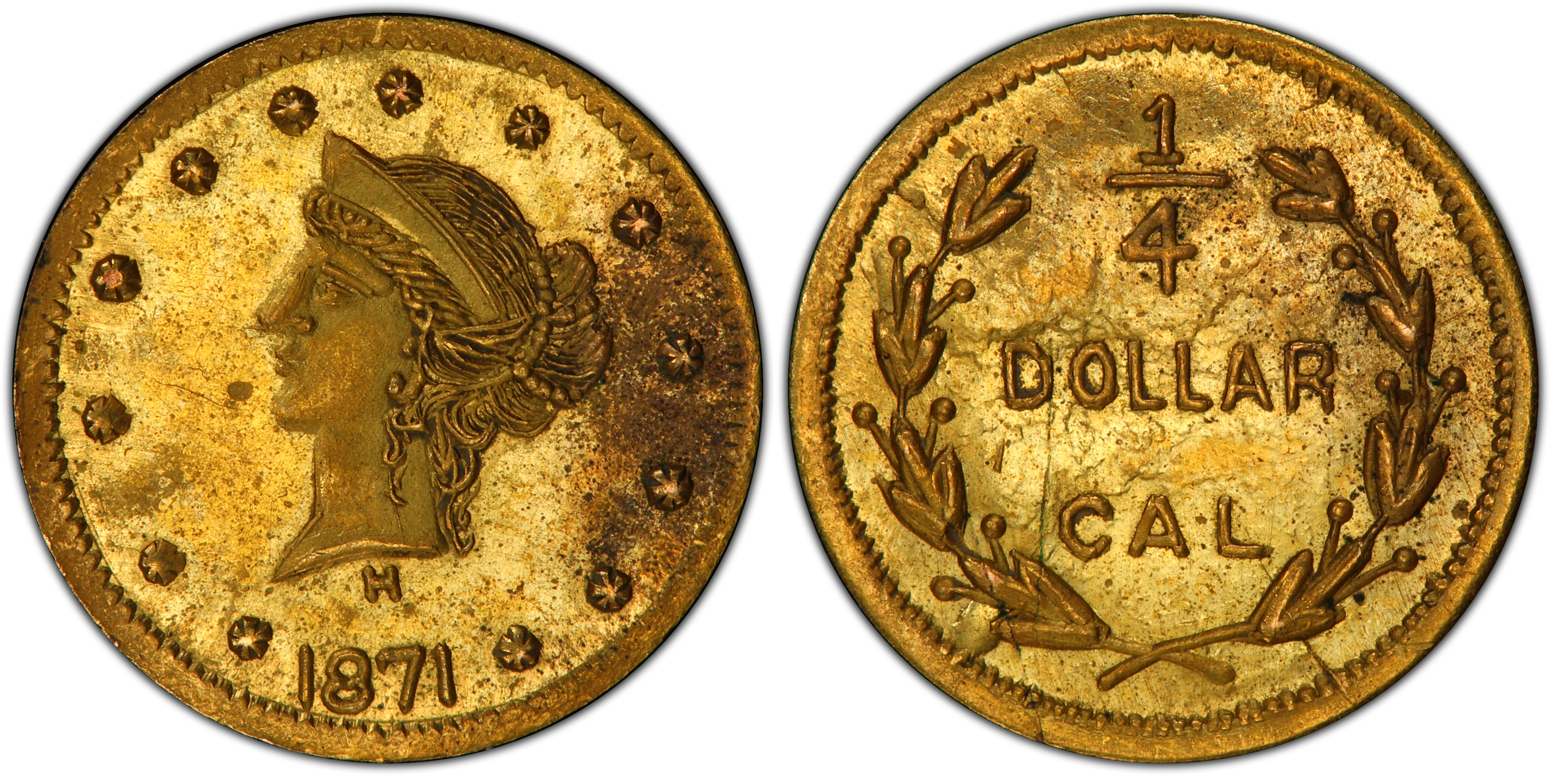
Obverse & Reverse
The 1871 G25C BG-856A is an artifact from the second period (1858-1882) of California Fractional Gold production. Unlike the 'Period One' issues (1852-1857), which were struck to alleviate a shortage of small change during the initial frenzy of the Gold Rush, these later pieces were not intended to serve as circulating currency. By the 1870s, the United States Mint in San Francisco was producing sufficient quantities of federal coinage for the region's commerce. Instead, Period Two fractionals were created by jewelers and private minters primarily as souvenirs and novelty items for tourists and collectors, capitalizing on the romantic allure of the Gold Rush. This variety is an exemplar of that trend, struck years after the Coinage Act of 1864 made private coinage illegal, a law that was not strictly enforced by the Secret Service until 1883. Many makers of these Period Two pieces were jewelers, some of French origin, who often produced a wide array of designs with varying quality. The likely minters of this and other 1871-dated fractionals were Reuben N. Hershfield and Noah Mitchell. Uniquely, while their products are categorized as 'California Gold,' research indicates their operation was based in Leavenworth, Kansas. Their enterprise was short-lived; in August 1871, the U.S. Secret Service seized their production, effectively ending their minting activities. This seizure contributes significantly to the rarity of all Hershfield & Mitchell issues. The BG-856A is one of the most elusive of all California Fractional Gold varieties, designated R-9 in the Breen-Gillio reference, signifying that it is unique or that only two examples are known to exist. Its survival in, typically, high grades is characteristic of a souvenir piece that was saved as a keepsake rather than spent.
Associated EventPost-Gold Rush Era Souvenir Production
Reason For MintingTo be sold as a souvenir or collectible keepsake capitalizing on the fame of the California Gold Rush.
Minter HistoryReuben N. Hershfield and Noah Mitchell were jewelers who engaged in the private minting of 'California Fractional Gold' in 1871. Their operation was notable for being located not in California, but in Leavenworth, Kansas. They produced a variety of 25-cent, 50-cent, and dollar pieces dated 1871. Their venture was abruptly terminated in August of the same year when the Secret Service, beginning to enforce the long-standing but often ignored 1864 law against private coinage, raided their facility and seized their coining equipment and inventory. This government action makes their output exceptionally rare and historically significant as it marks one of the key enforcement actions that brought the era of private U.S. coinage to a close.
Historical SignificanceThis coin represents the twilight of private minting in the United States. As a 'Period Two' souvenir, it illustrates the commercial shift from creating utilitarian coinage out of necessity to producing nostalgic tokens for a growing collector and tourist market. The likely seizure of its mintage by the Secret Service provides a direct link to the federal government's efforts to standardize currency and suppress private issues.
N/A
Denomination25 Cents
Minting Period1871
Assayer/MinterPossibly Reuben N. Hershfield & Noah Mitchell
Geographic OriginLeavenworth, Kansas
Obverse DescriptionLiberty Head facing left, similar in style to contemporary U.S. gold coinage but often of less refined artistry. The portrait is typically surrounded by 13 stars representing the original colonies. The date '1871' is below the bust.
Obverse Inscription1871
Reverse DescriptionA wreath of two branches tied with a ribbon at the bottom encircles the denomination. The specific details of the wreath, such as the number of berries or leaves, are key diagnostics for Breen-Gillio attribution.
Reverse Inscription1/4 DOLLAR CAL
CompositionGold
Stated Fineness Actual FinenessTypically varied from .500 to .900, often inconsistent.
EdgePlain
Extremely low, possibly fewer than 5 pieces.
Survival Estimate1-2
Rarity ScaleR-9 (Unique or Nearly Unique)
The BG-856A is a numismatic trophy of the highest order. Its appeal lies in its ultimate rarity as an R-9 coin, its connection to the fascinating 'Period Two' souvenir era of California Gold, and the compelling backstory of its likely minters, Hershfield & Mitchell, whose operation was shut down by the Secret Service.
Key VarietiesThe BG-856A is a singular variety. No major variations from its original minting period are known, nor are there any known restrikes, patterns, or trial pieces. Its rarity precludes the existence of such related issues.
Authentication TipsAuthentication requires expert examination and comparison with the known genuine specimen(s), likely held in major collections. Key diagnostics are precise die markers, the style of the Liberty portrait, and the specific arrangement and fonts of the reverse wreath and legends, as cataloged by Breen-Gillio. Most fakes have incorrect details, a soapy or cast-like appearance, or are the wrong weight and composition. Any piece that is not denominated (i.e., lacks 'DOLLAR' or 'CENTS') is a token and not a Period Two fractional.
Shopping ConsiderationsAcquiring this coin is an event-driven opportunity, likely only possible if one of the 1-2 known examples is offered at a major auction. A potential buyer should demand impeccable provenance and certification by PCGS or NGC. For a coin of this nature, 'premium quality' is defined by its mere existence and authenticity. However, one should still look for sharp strike details (many fractionals are weakly struck), clean surfaces free of distracting marks or damage, and original, uncleaned luster. Given its status as a souvenir, it would likely be found in Mint State, and any signs of circulation or jewelry use would be highly unusual and would require careful evaluation.
A coin's grade is its condition, rated on a 1-70 scale. For rare coins, this is the most critical factor in determining value, as a tiny difference in preservation can mean a huge difference in price.
Relevant Grade TypesOriginal issues of BG-856A were business strikes, although produced as souvenirs and not for general circulation. Therefore, they are found in Circulated (1-58) and, more commonly, Mint State (MS, 60-70) grades. Due to their non-circulating purpose, high-grade examples (e.g., MS62-MS65) are the norm for surviving Period Two fractionals. No Proof (PR/PF) examples were struck during the original period of issue, and no later-date Proof restrikes are known to exist.
Mint State CharacteristicsAn uncirculated BG-856A would be judged on the sharpness of the strike, particularly on the highest points of Liberty's hair and the leaves of the reverse wreath. Luster is a key factor; original pieces often have a vibrant, slightly prooflike or satiny texture from freshly polished dies. Because they were made by jewelers and handled as novelties, even Mint State examples can have small planchet flaws, die polish lines, or minor handling marks. The overall eye appeal, combining luster, strike, and surface preservation, is paramount.
Circulated Wear PatternsWhile circulation is highly unlikely for this variety, any wear would first appear on the highest points: the hair over Liberty's ear and eye, her cheekbone, and the tips of the leaves and bow ribbon on the reverse. In lower grades, the stars and legends would begin to soften and merge with the fields. Any specimen showing wear would be extraordinary and require careful analysis to distinguish it from post-minting damage.
Key Factors For ValueFor an ultimate rarity like the BG-856A, the primary value driver is its very existence and authenticity. Beyond that, value is determined by the grade assigned by a top-tier grading service (PCGS or NGC). An example with superior surface quality—free of excessive marks, cleaning, or scratches—and a sharp, well-centered strike would command a significant premium. Eye appeal is critical; a coin with brilliant, flashy luster will be prized over a dull or hazy specimen. The presence of a CAC sticker, indicating premium quality for the grade, would add another substantial layer of value.
PCGS Price Guide
| Grade | Price | Population |
|---|---|---|
| 62 | $8,000.00 | 1 |
| 62+ | $9,500.00 | N/A |
| 63 | $12,000.00 | 1 |