1876 G50C BG-932 (Regular Strike)
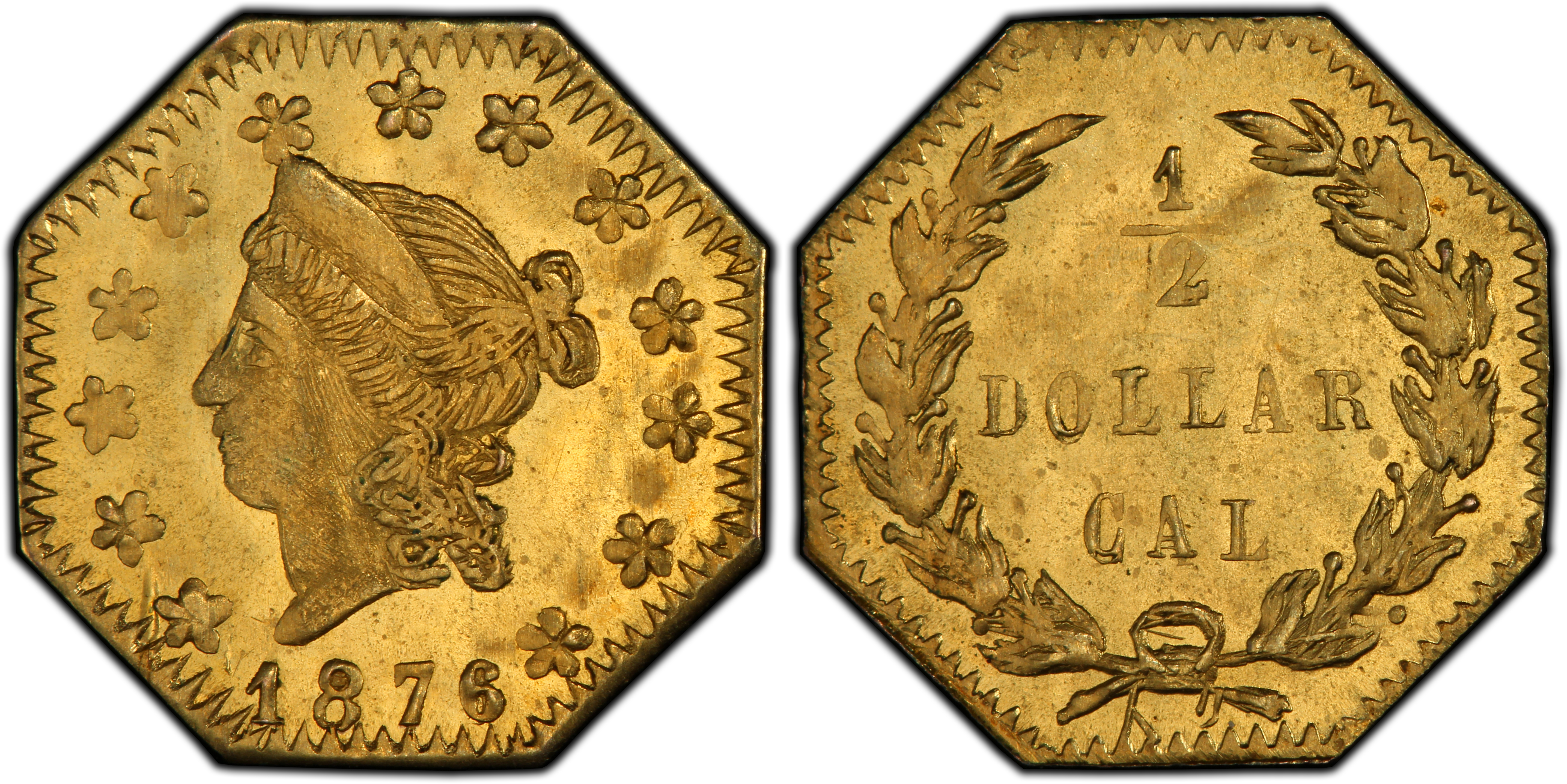
Obverse & Reverse
The 1876 Octagonal 50 Cents, cataloged as Breen-Gillio 932, is a quintessential example of a 'Period Two' California Fractional Gold piece. By the mid-1870s, the initial, desperate need for small denomination coinage that characterized the Gold Rush had long subsided. The San Francisco Mint, established in 1854, was in full operation, producing ample quantities of federal silver and gold coins for local commerce. The impetus for striking minuscule gold pieces had thus shifted entirely from utility to novelty. These later issues, produced by various jewelers and artisans in San Francisco from 1858 to 1882, were created not as circulating money but as souvenirs, keepsakes, and jewelry items. They catered to a burgeoning tourist trade and a sense of local pride, tangible mementos of the wild Gold Rush era that was rapidly passing into legend. The year 1876 was particularly significant as it marked the Centennial of the United States' independence, celebrated with the grand Centennial International Exhibition in Philadelphia. This nationwide patriotic fervor fueled a massive market for souvenirs and memorabilia. While there is no direct evidence linking BG-932's production to the Exposition, it is almost certain that its creation was part of this broader cultural phenomenon. San Francisco jewelers capitalized on the moment, producing these charming, nostalgic tokens for visitors and residents alike. Unlike their 'Period One' predecessors, which contained gold value somewhat commensurate with their denomination, these 'jeweler's issues' were tokens whose intrinsic worth was substantially less than their face value. They were struck by the hammer method, often resulting in inconsistent strike quality. The passage of the Coinage Act of 1864 had made private coinage illegal, but the law was not strictly enforced against these small souvenir pieces until the early 1880s, allowing for a vibrant final chapter in the story of California's private gold.
Associated EventCalifornia Gold Rush (Later Souvenir Period)
Reason For MintingTo serve as a souvenir or keepsake of the California Gold Rush era, likely capitalizing on the patriotism of the U.S. Centennial year.
Minter HistoryThe specific minter or jeweler who produced the BG-932 variety is unknown, which is common for many 'Period Two' issues. During this era, several San Francisco-based jewelers and engravers, many of French origin (such as Deriberpe & Nouizillet or Frontier & Deviercy), created dies and struck these small gold pieces. However, most did not sign their work, leaving attribution of many varieties to numismatic scholarship based on stylistic analysis and die links, which in the case of BG-932 has not yet yielded a definitive maker.
Historical SignificanceBG-932 represents the final evolution of private gold coinage in California, shifting from a necessary medium of exchange to a commercial souvenir product. It is a tangible artifact of 19th-century tourism and the romantic mythology that had already enveloped the Gold Rush just a quarter-century after its peak. Its existence underscores the lax enforcement of federal coinage laws in the West during this period and the continued entrepreneurial spirit of San Francisco's artisans.
N/A
Denomination50 Cents
Minting Period1876
Assayer/MinterUnknown Private Minter
Geographic OriginSan Francisco, California
Obverse DescriptionA youthful, almost cherubic Liberty Head facing left, a design often referred to by collectors as the 'Baby Head' variety. The portrait is somewhat crude in execution compared to federal coinage. The head is surrounded by thirteen five-pointed stars, typically arranged with seven to the left and six to the right. The date '1876' appears below the bust.
Obverse Inscription1876
Reverse DescriptionThe denomination '1/2' is enclosed within a wreath of two olive branches tied with a bow at the bottom. The legend 'CALIFORNIA GOLD' encircles the wreath along the upper border. The octagonal planchet is a defining characteristic.
Reverse InscriptionCALIFORNIA GOLD / 1/2
CompositionGold
Stated Fineness Actual FinenessTypically ranges from 14 to 22 karats for Period Two issues, but the specific fineness for BG-932 is not documented.
Weight0.25 grams
Diameter10.00 mm
EdgePlain
Unknown
Survival EstimateFewer than 75 believed to exist
Rarity ScaleR-5+
This variety is highly sought after due to its distinctive 'Baby Head' design, its octagonal shape, and its connection to the U.S. Centennial year. As a 'Period Two' issue, it is more accessible than many of the circulation-era 'Period One' coins, yet its R-5+ rarity makes it a significant challenge to acquire, especially in high grades.
Key VarietiesThe primary variety is the regular strike BG-932. No major sub-varieties from the period of issue are widely recognized. Unlike some other private issues, there are no known patterns, trial pieces, or official later-date restrikes associated with this specific variety. Collectors should be aware of a large number of modern replicas and fantasy pieces that imitate the style of California Fractional Gold but are not listed in the Breen-Gillio reference.
Authentication TipsAuthentic examples must have a stated denomination ('1/2'). Replicas often say '1/2 CAL GOLD CHARM' or lack a denomination entirely. The strike is often somewhat soft, particularly on the stars and the finer details of the hair and wreath. Look for the characteristic die markers of the BG-932 variety; referencing high-resolution images of certified examples is crucial. The luster on original pieces should be frosty or prooflike, not glassy or dull like many cast counterfeits. The gold color can range from a light yellow to a deeper orange-gold.
Shopping ConsiderationsA premium quality example for this issue is defined by a sharp strike, especially on the high points of Liberty's cheek and hair, and the details of the wreath. Many examples are found with prooflike or semi-prooflike surfaces, and these command a significant premium. Given their use in jewelry, check carefully for evidence of mounting, solder, or harsh cleaning, which will drastically reduce the value. Original, unmolested surfaces with a hint of reddish-gold toning are highly desirable. Due to the high number of counterfeits, purchasing examples certified by major grading services like PCGS or NGC is strongly recommended.
A coin's grade is its condition, rated on a 1-70 scale. For rare coins, this is the most critical factor in determining value, as a tiny difference in preservation can mean a huge difference in price.
Relevant Grade TypesAll original 1876 BG-932 issues are considered business strikes, though many were produced with prooflike surfaces for souvenir purposes. They are found in Circulated (1-58) and, more commonly, Mint State (MS, 60-70) grades due to their nature as keepsakes. There were no official Proofs struck during the original period of issue, and there are no known later-date Proof restrikes.
Mint State CharacteristicsIn uncirculated grades, the quality is judged by the sharpness of the strike, the quality of the luster, and the presence of contact marks. A superior MS example will have sharp details on the hair above Liberty's eye and on the leaves of the wreath. Luster can range from satiny to deeply prooflike (PL); fully PL examples are rare and highly prized. As these were handled as novelties, even Mint State coins can have small, scattered contact marks from being stored with other items.
Circulated Wear PatternsWhen wear is present, it first appears on the highest points of the design. On the obverse, this includes Liberty's cheek, the hair bun, and the eyebrow. On the reverse, the high points of the wreath's leaves and the bow will show the first signs of friction and flattening. In lower circulated grades, the stars and legends will begin to weaken and merge with the fields.
Key Factors For ValueThe primary value drivers for BG-932 are grade and surface quality. A high-grade Mint State coin (e.g., MS-64 or MS-65) is worth many multiples of a circulated or impaired example. The presence of prooflike (PL) or deep prooflike (DMPL) surfaces adds a significant premium. Eye appeal is paramount; coins with sharp strikes, clean surfaces, and attractive original color will always command the highest prices. A CAC sticker for this issue is highly desirable, indicating a premium quality coin for the grade.
PCGS Price Guide
| Grade | Price | Population |
|---|---|---|
| 50 | $210.00 | 3 |
| 50+ | $215.00 | N/A |
| 53 | $225.00 | N/A |
| 53+ | $235.00 | N/A |
| 55 | $250.00 | N/A |
| 55+ | $260.00 | N/A |
| 58 | $275.00 | 7 |
| 58+ | $290.00 | N/A |
| 60 | $375.00 | N/A |
| 61 | $425.00 | 4 |
| 62 | $475.00 | 8 |
| 62+ | $575.00 | N/A |
| 63 | $875.00 | 16 |
| 63+ | $925.00 | N/A |
| 64 | $975.00 | 14 |
| 64+ | $1,025.00 | N/A |
| 65 | $1,300.00 | 6 |
| 65+ | $1,500.00 | 1 |
| 66 | $2,000.00 | 1 |
| 67 | N/A | N/A |