1860/56 G50C BG-1014 (Regular Strike)
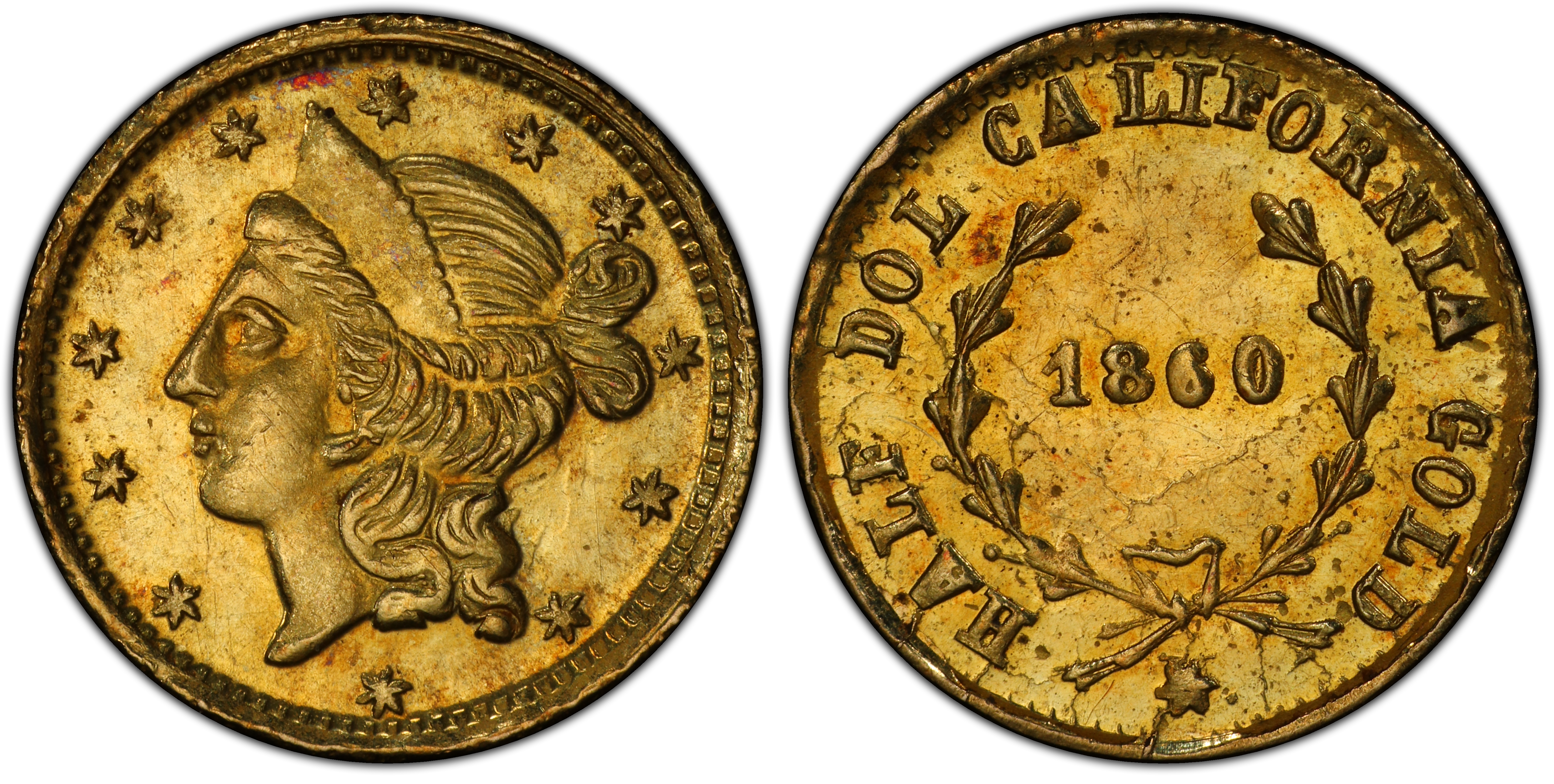
Obverse & Reverse
The 1860/56 50 Cents, cataloged as Breen-Gillio 1014, is a quintessential example of a 'Period Two' California Fractional Gold piece. These coins, struck from 1859 to 1882, emerged in a different economic climate than their 'Period One' predecessors. The initial acute shortage of small change that plagued the early Gold Rush had been largely alleviated by the output of the San Francisco Mint, which opened in 1854. Consequently, the primary purpose of Period Two fractionals shifted from fulfilling a dire transactional need to serving as souvenirs, keepsakes, and jewelry items. They were colloquially known as 'jeweler's issues' because they were primarily manufactured by San Francisco jewelers and watchmakers, many of whom were French immigrants like the firm of Gaime, Guillemot & Co., to whom this issue is often attributed. These artisans brought sophisticated die-sinking and striking skills to their work, resulting in coins that were often more refined in design than the cruder, utilitarian Period One issues. However, they were also notoriously underweight, containing gold value far below their stated face value, a fact that was of little concern to the tourists and locals who purchased them as mementos of the Golden State. The BG-1014 is a particularly fascinating variety due to its nature as an overdate; the minter repurposed an older die from 1856 by punching a '0' over the final '6'. This thrifty practice provides a direct link to the earlier Period One coinage era and highlights the pragmatic, small-scale nature of these private minting operations. Despite their non-monetary primary function, these tiny gold pieces are an integral part of the numismatic story of the American West, representing the enduring legacy and romanticism of the California Gold Rush.
Associated EventCalifornia Gold Rush Aftermath
Reason For MintingPrimarily created as souvenirs and for use in the jewelry trade rather than to alleviate a coinage shortage.
Minter HistoryGaime, Guillemot & Co. was a prominent firm of French jewelers and watchmakers operating in San Francisco during the mid-19th century. Like other 'French Jewelers' such as Frontier & Deviercy and Antoine Nouizillet, they entered the lucrative business of producing small-denomination gold coins. These pieces were not intended to be full-weight coins for circulation but were sold as popular and easily transportable souvenirs of the California Gold Rush. Their craftsmanship was often of high quality, though their products were consistently underweight, reflecting their true purpose as tokens or charms rather than circulating money.
Historical SignificanceThe BG-1014 is significant as an overdate (1860/56), demonstrating the reuse of dies by private minters and providing a tangible link between different production years. It represents the evolution of fractional gold from necessary currency (Period One) to commercial souvenirs (Period Two), reflecting the changing economic landscape of California after the initial frenzy of the Gold Rush subsided.
N/A
Denomination50 Cents
Minting Period1860
Assayer/MinterGaime, Guillemot & Co. (Attributed)
Geographic OriginSan Francisco, California
Obverse DescriptionA fairly crude Liberty Head facing left, reminiscent of the official U.S. gold coinage but stylistically distinct. The portrait is surrounded by thirteen five-pointed stars. The date '1860' is below the bust. Diagnostic for this variety is the clear '0' punched over the final digit of an earlier date, '6', creating the 1860/56 overdate.
Obverse Inscription1860
Reverse DescriptionA simple wreath composed of two branches tied with a bow at the bottom. Inside the wreath is the denomination '50 CENTS'. The legend 'CALIFORNIA GOLD' is inscribed outside of and following the curvature of the wreath at the top. The design is simple and typical of jeweler's issues of the period.
Reverse InscriptionCALIFORNIA GOLD 50 CENTS
CompositionGold
Stated Fineness Actual FinenessVariable, typically lower than official U.S. coinage.
EdgeReeded
Unknown
Survival Estimate76-200 (Consistent with R-4 rating)
Rarity ScaleHigh R-4
This variety is highly sought after by specialists due to its status as a dramatic and clear overdate (1860/56). Overdates provide insight into the minting process and are a popular collecting theme. Its reeded edge is also a less common feature for the series, adding to its appeal.
Key VarietiesThe primary variety is the 1860/56 overdate business strike. No proof or special collector restrikes from the period of issue are known to exist for this specific BG number. Later 20th-century copies and fantasy pieces exist for the California Fractional Gold series in general, but are not considered part of the original Breen-Gillio catalog.
Authentication TipsAuthentication requires comparison with known genuine examples, ideally using the Breen-Gillio reference 'California Pioneer Fractional Gold'. The key diagnostics are the precise positioning of the date, stars, and lettering, and the specific characteristics of the 0-over-6 overdate. Genuine pieces have a feel and strike quality distinct from modern replicas, which often have mushy details or incorrect luster. Watch for tokens that omit the denomination 'CENTS' or 'DOLLAR' as they are typically later souvenirs.
Shopping ConsiderationsA premium quality example for this variety would exhibit a bold overdate and a sharp strike, especially on Liberty's hair and the leaves of the wreath. Luster on these jeweler's issues is often subdued, but any remaining original mint frost is a significant plus. Look for coins with smooth, problem-free surfaces, as these tiny pieces were easily damaged or used in jewelry, leading to common issues like scratches, rim bumps, or evidence of having been soldered. The reeded edge should be well-defined. Be wary of harshly cleaned or polished examples which will appear unnaturally bright and exhibit fine hairline scratches.
A coin's grade is its condition, rated on a 1-70 scale. For rare coins, this is the most critical factor in determining value, as a tiny difference in preservation can mean a huge difference in price.
Relevant Grade TypesOriginal period issues were business strikes intended for souvenir sales, not circulation in the traditional sense. They are found in Circulated (1-58) and Mint State (MS, 60-70) grades. No Proofs (PR/PF) were struck during the original period of issue, and there are no known authorized later-date Proof restrikes for this specific variety.
Mint State CharacteristicsAn uncirculated BG-1014 will show some degree of original mint luster, which can range from satiny to semi-prooflike. The strike can be inconsistent; a well-struck example with full details on the highest points of Liberty's hair and the wreath is highly desirable. Small planchet flaws or die polish lines are not uncommon and generally do not detract unless they are severe. Contact marks, while common due to the softness of the gold, should be minimal and away from the focal points of the design for a high grade.
Circulated Wear PatternsWear first appears on the highest points of the design: Liberty's cheek, hair details above the ear, and the coronet. On the reverse, the highest points of the wreath's leaves and the bow will show initial friction and flattening. In lower grades (VF and below), the stars will begin to lose their sharpness, and the finer details of the overdate may become less distinct.
Key Factors For ValueThe primary value driver for this specific coin is the boldness and clarity of the 1860/56 overdate. An example where both the '0' and the underlying '6' are clearly visible commands a significant premium. Beyond that, overall surface quality is paramount. An example with original, uncleaned surfaces and attractive eye appeal will be worth substantially more than a cleaned or damaged piece of the same grade. Strike sharpness and the quality of the reeded edge are also key factors. A CAC sticker adds a strong premium, confirming quality for the assigned grade.
PCGS Price Guide
| Grade | Price | Population |
|---|---|---|
| 45 | $210.00 | 2 |
| 45+ | $215.00 | N/A |
| 50 | $225.00 | 1 |
| 50+ | $235.00 | N/A |
| 53 | $250.00 | 3 |
| 53+ | $265.00 | N/A |
| 55 | $290.00 | 10 |
| 55+ | $315.00 | N/A |
| 58 | $340.00 | 15 |
| 58+ | $375.00 | N/A |
| 60 | $425.00 | 3 |
| 61 | $475.00 | 6 |
| 62 | $525.00 | 18 |
| 62+ | $575.00 | N/A |
| 63 | $650.00 | 8 |
| 63+ | $750.00 | N/A |
| 64 | $1,250.00 | N/A |
| 64+ | $1,650.00 | N/A |
| 65 | $3,250.00 | 2 |