1866 G50C BG-904 (Regular Strike)
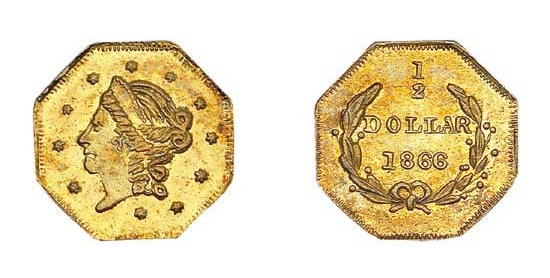
Obverse & Reverse
The 1866 BG-904 50 Cent piece emerges from the second period of California Fractional Gold production (1859-1882), a fascinating era that saw these miniature gold issues transition from economic necessity to commercial keepsakes. The initial wave of fractional gold (1852-1857) was a direct response to a severe shortage of small change during the chaotic height of the Gold Rush. By the mid-1860s, however, the economic landscape of California had matured. The San Francisco Mint, established in 1854, was in full operation, supplying the region with ample federal coinage and rendering the private fractionals functionally obsolete for circulation. Despite this, production of fractional gold by private jewelers and artisans in San Francisco continued, and even flourished. The motivation had shifted entirely. These 'Period Two' issues, including the BG-904, were created to satisfy a burgeoning tourist and souvenir market. Post-Civil War America saw increased westward travel, and San Francisco became a popular destination. Visitors, fascinated by the romanticism of the Gold Rush, sought tangible mementos of their journey. The tiny gold coins, often sold in sets, perfectly filled this niche. The Coinage Act of April 22, 1864, had made private coinage illegal, but the law was not strictly enforced against these small, low-value pieces until the Secret Service cracked down in the early 1880s. This legal gray area allowed dozens of jewelers to produce a myriad of varieties. The BG-904, like its contemporaries, was likely struck using hand-engraved dies and a simple screw press or even a hammer, resulting in inconsistent strike quality. Their gold content was often less than their face value would imply, but as they were sold as novelties at a premium, this was of little concern to the buyers. The existence of so many distinct die pairs from this period speaks to a competitive market among jewelers, each creating their own proprietary designs to attract customers. These 'jeweler's issues' are a testament to the enduring legacy of the Gold Rush and the entrepreneurial spirit of the craftsmen who catered to a new wave of California dreamers—the tourists.
Associated EventCalifornia Gold Rush (Aftermath)
Reason For MintingPrimarily created to be sold as souvenirs and keepsakes to tourists in a post-Gold Rush San Francisco.
Minter HistoryThe specific minter of the BG-904 die pair is unknown, as was common for 'Period Two' jeweler's issues. The work is attributed to one of the many private jewelers and goldsmiths active in San Francisco during the 1860s. Prominent minters of the era included firms like Deriberpe & Nouizillet and Frontier & Deviercy, though many artisans who produced these pieces remain anonymous, their identifying marks being the die characteristics of the coins themselves.
Historical SignificanceThe BG-904 is historically significant not as a circulating coin, but as a numismatic artifact representing the commercialization of the Gold Rush legacy. It marks the transition of fractional gold from a vital medium of exchange to a nostalgic souvenir, reflecting the changing economy and culture of California in the decade following the initial rush.
N/A
Denomination50 Cents
Minting Period1866
Assayer/MinterUnknown Private Minter (Jeweler)
Geographic OriginSan Francisco, California
Obverse DescriptionOctagonal planchet. Features a Liberty Head motif, facing left, stylistically similar to contemporary U.S. federal gold coinage. The portrait is surrounded by 13 six-pointed stars, representing the original colonies.
Obverse InscriptionNo textual inscription; design consists of Liberty Head and 13 stars.
Reverse DescriptionA wreath composed of two branches tied together by a bow at the bottom encircles the denomination. The design is characteristic of the 'jeweler's issues' of the period.
Reverse Inscription50 CENTS 1866
CompositionGold
Stated Fineness Actual FinenessTypically varied from 14 to 22 karats for Period Two issues.
EdgePlain
Unknown
Survival EstimateFewer than 75
Rarity ScaleR-5
The BG-904 appeals to collectors specializing in the diverse and intricate field of California Fractional Gold. Its allure lies in its status as a 'Period Two' issue, its octagonal shape, and the challenge of acquiring a piece from an era of anonymous private minting. It represents a tangible link to the souvenir trade that capitalized on the Gold Rush legend.
Key VarietiesThe primary variety is the regular business strike. No known proof issues, restrikes, or patterns are recorded for the BG-904 die pair. Varieties within the broader series are distinguished by Breen-Gillio (BG) numbers, each representing a unique combination of obverse and reverse dies.
Authentication TipsAuthenticity should be confirmed by comparing the coin to high-resolution images of certified examples. Pay close attention to the style of the Liberty portrait, the shape and placement of the stars, and the wreath details, as these are key die markers. Genuine pieces have a denomination; souvenir tokens produced after 1883 often lack one and may say 'CAL GOLD' instead. Modern replicas are common and are typically gold-plated base metal, feeling lighter and having a different luster than genuine gold pieces.
Shopping ConsiderationsA premium quality BG-904 will exhibit a sharp, well-centered strike, which is uncommon for these privately produced issues. Look for strong details on Liberty's hair and the leaves of the wreath. Original, lustrous surfaces are highly desirable and command a significant premium. Avoid examples that have been harshly cleaned, polished, or used as jewelry, as evidenced by solder marks, excessive hairlines, or rim damage. Given the production method, some planchet roughness or minor striking weakness may be acceptable, but eye appeal is paramount.
A coin's grade is its condition, rated on a 1-70 scale. For rare coins, this is the most critical factor in determining value, as a tiny difference in preservation can mean a huge difference in price.
Relevant Grade TypesOriginal period issues of BG-904 were business strikes, although intended for sale as souvenirs rather than circulation. They are found in both Circulated (1-58) and Mint State (MS, 60-70) grades. Due to their nature as keepsakes, high-grade Mint State examples are more common than for the earlier, heavily circulated 'Period One' issues. No Proof (PR/PF) examples were struck during the original period of issue, and no later-date restrikes are known.
Mint State CharacteristicsAn uncirculated BG-904 is defined by its luster, which is typically somewhat subdued and satiny rather than frosty. Strike quality varies; many are weakly struck on the high points of Liberty's hair or the bow of the wreath. A premium MS example would be well-centered with sharp details. Small, intrinsic planchet flaws or adjustment marks made prior to striking are common and should not be confused with post-strike damage. Bag marks are less common than on federal issues, but small nicks from handling are typical.
Circulated Wear PatternsOn circulated examples, wear first appears on the highest points of the design. For the obverse, this is Liberty's hair curls above the ear and the cheek. On the reverse, the highest points of the wreath's leaves and the bow will show friction and loss of detail first. In lower grades (VF and below), the stars will begin to lose their points and the numerals in the date will become less distinct.
Key Factors For ValueThe primary driver of value is the grade and surface quality. An example with original, uncleaned surfaces and strong luster will command a significant premium over a cleaned or damaged piece of the same grade. Strike sharpness is a key differentiator; a coin with a full strike is far more desirable than a weakly impressed one. Eye appeal, encompassing attractive original toning and a lack of distracting marks, is crucial. For this series, certification by a major grading service (PCGS or NGC) is essential for market acceptance, and a CAC sticker indicating premium quality for the grade adds a further layer of value.
PCGS Price Guide
| Grade | Price | Population |
|---|---|---|
| 63 | $2,750.00 | 1 |
| 63+ | $3,500.00 | N/A |
| 64 | $4,500.00 | 1 |
| 64+ | $5,000.00 | N/A |
| 65 | $7,500.00 | 1 |