1852 G50C BG-963, PL (Regular Strike)
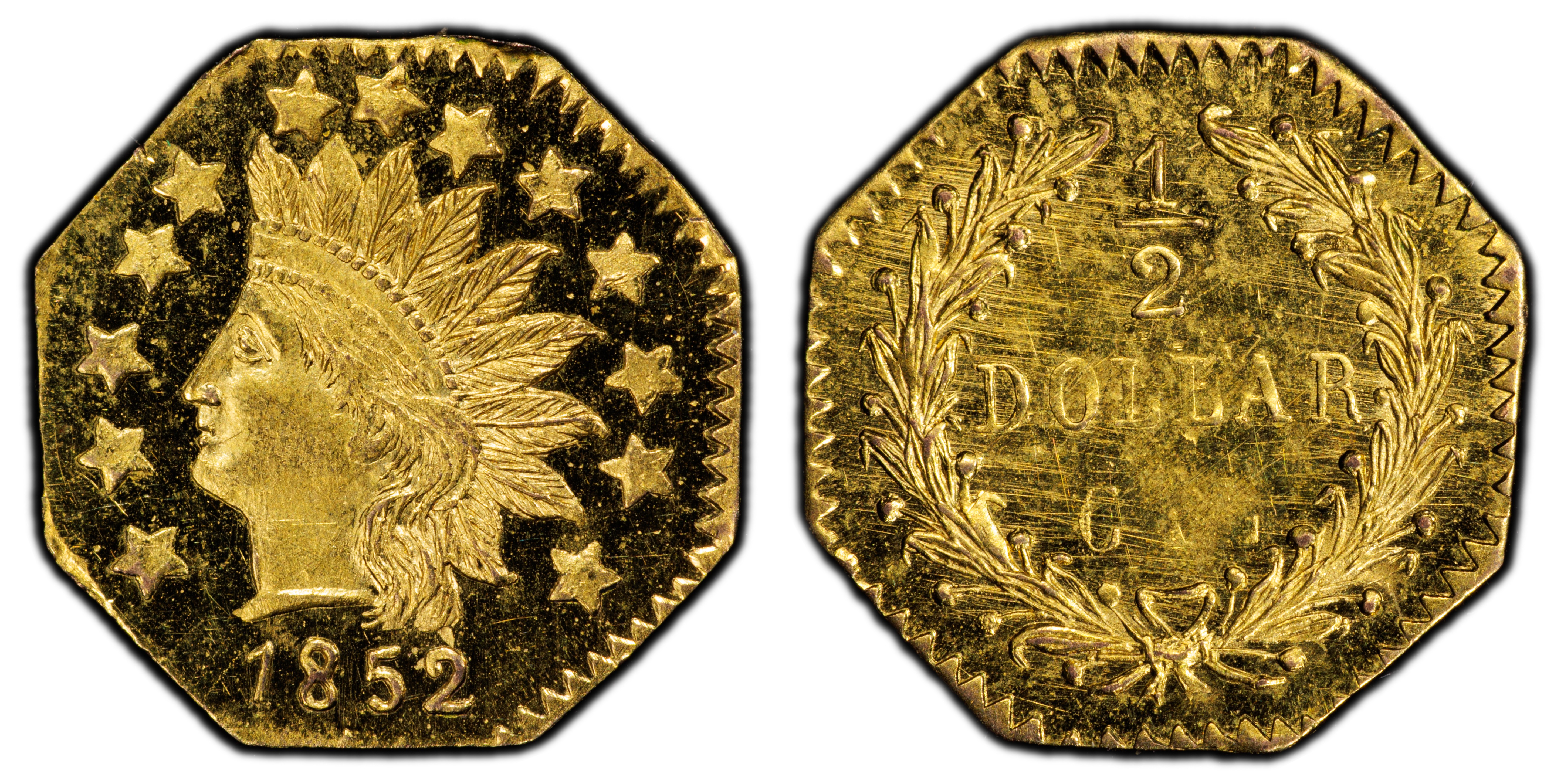
Obverse & Reverse
The 1852 Octagonal 50 Cents, cataloged as Breen-Gillio 963, is a quintessential artifact from the chaotic, formative years of the California Gold Rush. Following James Marshall's 1848 discovery, a massive influx of over 300,000 'Forty-Niners' descended upon California, transforming it from a sparsely populated territory into a booming economic frontier. This explosive growth created an acute crisis in commerce: a severe shortage of small-denomination coinage. Gold dust, the primary medium of exchange, was impractical and susceptible to fraud for everyday transactions like buying a meal or a drink. While large-denomination private and, eventually, federal gold coins handled significant sums, there was virtually no circulating specie to make change. This void spurred enterprising jewelers and metallurgists in booming San Francisco to action. Gaime, Guillemot & Co., French jewelers by trade, were among these private minters who stepped in to meet the commercial need. Their production of fractional denominations—$0.25, $0.50, and $1.00 pieces in both round and octagonal shapes—provided a tangible, albeit unofficial, solution. These 'Period One' (1852-1856) issues, including the BG-963, were intended for actual circulation and saw use in the bustling mining camps and commercial districts. The crude but effective 'hammer method' of striking, where dies were hammered onto gold planchets by hand, resulted in coins of varying strike quality. Many of these early fractional pieces were notoriously underweight for their stated value, making them profitable for the minters but eventually leading to public distrust and their gradual rejection as the U.S. Branch Mint in San Francisco began operations in 1854, supplying official coinage. The Coinage Act of 1864 officially outlawed private coinage, but by then, most Period One issues had already been withdrawn, melted, or lost. The BG-963, with its distinctive Indian Head motif—a popular design choice evoking a uniquely American feel—is a direct link to this period of economic improvisation and necessity, representing a fascinating chapter in U.S. monetary history when private enterprise literally created the money supply.
Associated EventCalifornia Gold Rush
Reason For MintingTo alleviate a severe shortage of small-denomination coinage for everyday commercial transactions in Gold Rush-era California.
Minter HistoryGaime, Guillemot & Co. was a firm of French jewelers and watchmakers operating in San Francisco during the early 1850s. Like several other jewelers of the period, they leveraged their expertise in working with precious metals to capitalize on the critical shortage of circulating small change. By striking their own fractional gold pieces, they not only provided a vital service to the local economy but also engaged in a profitable enterprise. Their issues are often identified by the 'GG' initials found on some varieties. The BG-963 is a key example of their contribution to the unofficial currency of the Gold Rush, produced before the U.S. Branch Mint in San Francisco could adequately supply the region with federal coinage.
Historical SignificanceThe BG-963 is historically significant as a 'Period One' California Fractional Gold piece, representing a tangible solution to the severe coinage shortage during the peak of the Gold Rush. It exemplifies the private ingenuity that filled an economic vacuum before official U.S. coinage became prevalent in the West, serving as a vital medium of exchange in the region's nascent economy.
K-Unlisted
Denomination50 Cents
Minting Period1852
Assayer/MinterGaime, Guillemot & Co.
Geographic OriginSan Francisco, California
Obverse DescriptionAn Indian Head portrait facing left, wearing a feathered headdress. The portrait is somewhat crudely rendered, characteristic of these private issues. Thirteen stars encircle the portrait along the octagonal border, and the date '1852' appears below the bust.
Obverse Inscription1852
Reverse DescriptionA simple wreath composed of two branches tied with a bow at the bottom. Within the wreath, the denomination is expressed on two lines. The legend 'CALIFORNIA GOLD' is inscribed above the wreath.
Reverse InscriptionCALIFORNIA GOLD / 50 CENTS
CompositionGold
Stated Fineness Actual Fineness EdgePlain
Unknown
Survival EstimateFewer than 75; likely in the 31-75 range
Rarity ScaleR-6
This coin is highly sought after as a genuine 'Period One' California fractional that actually circulated. Its appeal lies in its direct connection to the Gold Rush, its scarce R-6 rarity, and the classic, popular Indian Head design on an octagonal planchet, making it a cornerstone piece for specialists in territorial and private gold.
Key VarietiesThe BG-963 itself is the key variety. No major variations from the original minting period are noted. Unlike some later-date or larger denomination territorial coins, there are no known patterns, trial pieces, or official restrikes associated with this specific early, private issue. Collectors should be aware that the broader California Fractional Gold series includes many die varieties and issues from different minters across three distinct historical periods.
Authentication TipsAuthentic BG-963 specimens are very thin and were struck by hand, often resulting in weak or uneven strikes and unstruck areas. Look for the correct die markers and overall 'feel' of a genuine piece; the style of the engraving is crude but distinctive. Counterfeits are common and often appear too thick, have a soapy or cast-like surface, incorrect weight, or exhibit incorrect design details and lettering fonts. Any piece should be carefully compared to known genuine examples. Third-party grading by a reputable service like PCGS or NGC is highly recommended for authentication.
Shopping ConsiderationsA premium quality example for its grade will exhibit a bold strike for the issue, especially on the high points of the Indian's headdress and the details within the reverse wreath. Look for original, undisturbed surfaces with some remaining mint luster, often appearing as prooflike (PL) due to the polished dies used. Avoid examples that have been harshly cleaned, tooled, or have significant rim damage or planchet problems. Attractive natural toning, often a deep honey-gold or reddish color, adds significantly to eye appeal. Given the R-6 rarity, any example without major problems is a significant acquisition, but strike and surface quality separate the finest known specimens.
A coin's grade is its condition, rated on a 1-70 scale. For rare coins, this is the most critical factor in determining value, as a tiny difference in preservation can mean a huge difference in price.
Relevant Grade TypesOriginal issues of BG-963 were business strikes intended for circulation and are found in Circulated grades (AG-3 to AU-58) and, very rarely, in Mint State (MS, 60-70). No true Proofs were struck during the original period of issue. Some Mint State examples may be designated as Prooflike (PL) or Deep Prooflike (DPL) by grading services due to the use of polished dies, but these are a characteristic of the business strike manufacturing process and are not separate collector issues.
Mint State CharacteristicsUncirculated examples of BG-963 are exceptionally rare. A true Mint State coin will show no evidence of wear. Quality is defined by the sharpness of the strike, which is often incomplete; a well-struck piece with full feather details and a clear date is highly desirable. Luster is typically bright and flashy, often with prooflike reflectivity in the fields. Contact marks from handling are common due to the softness of the gold, but large, distracting marks will detract from the grade.
Circulated Wear PatternsWear first appears on the highest points of the design. On the obverse, check the cheekbone, the hair above the eye, and the tips of the feathers in the headdress. On the reverse, the high points of the wreath's leaves and the bow will show the first signs of friction and flattening. In lower grades (VG and below), the date, stars, and peripheral lettering will begin to weaken and merge with the fields.
Key Factors For ValueFor the BG-963, the primary value driver is its grade and rarity. Surface preservation is paramount; an example with original, uncleaned 'skin' commands a massive premium over one that has been cleaned or polished. Strike quality is the next key factor, with sharply struck specimens being highly prized. Eye appeal, encompassing attractive toning and minimal distracting marks, is also critical. Finally, a CAC sticker, indicating a premium quality coin for the assigned grade, adds a significant premium for this and other rare territorial issues.
PCGS Price Guide
| Grade | Price | Population |
|---|---|---|
| 63 | N/A | 1 |
| 64 | $1,250.00 | 1 |
| 64+ | $1,500.00 | N/A |
| 65 | $1,750.00 | 2 |
| 67 | N/A | N/A |