1872 G50C BG-939 (Regular Strike)
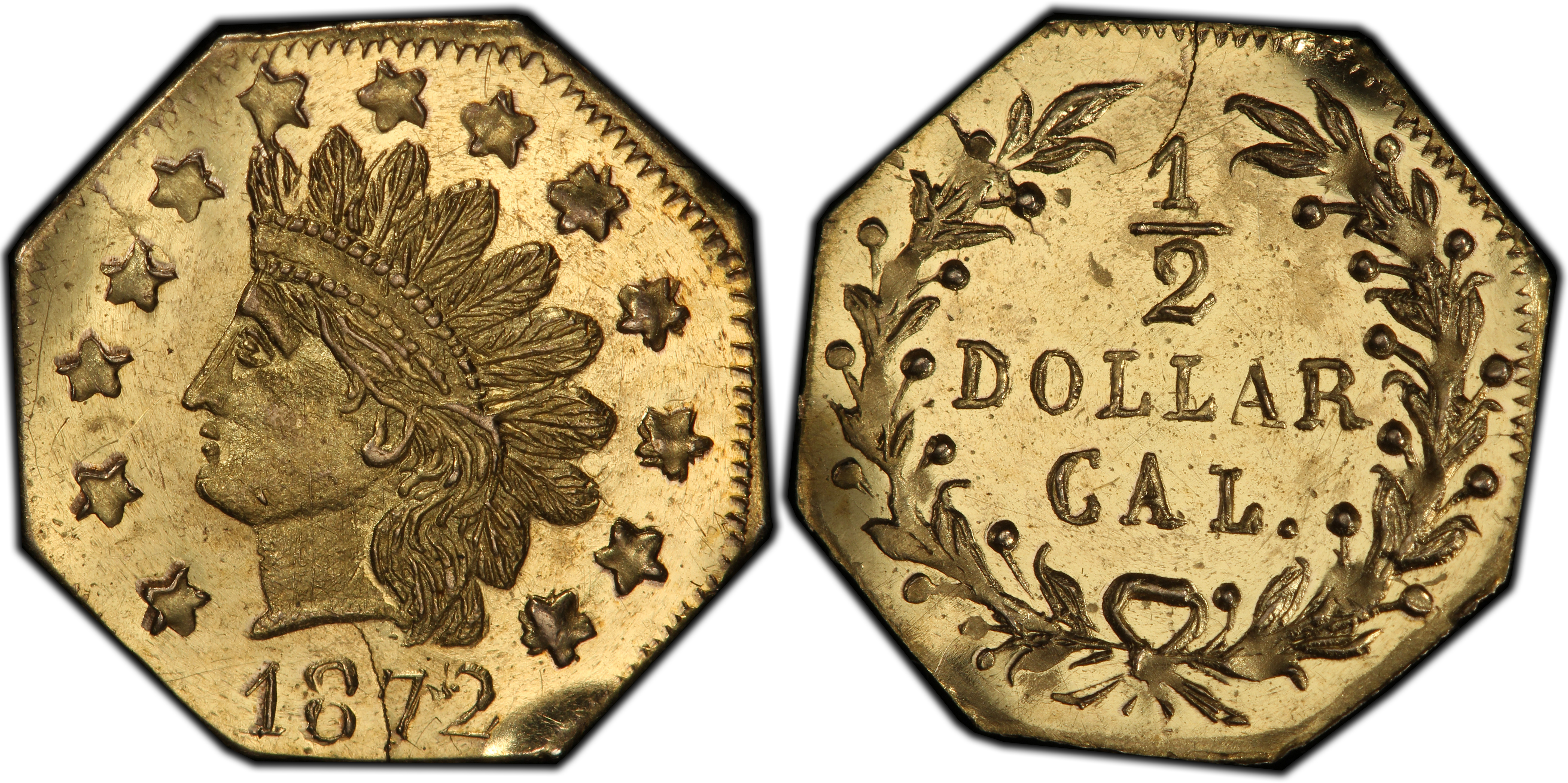
Obverse & Reverse
The 1872 50 Cents, cataloged as Breen-Gillio 939, is a quintessential example of a 'Period Two' California Fractional Gold piece. By the 1870s, the initial impetus for these tiny gold coins—a severe shortage of small-denomination federal coinage in Gold Rush California—had long since vanished. The establishment and high output of the San Francisco Mint in the mid-1850s saturated the region with official silver and gold coins, rendering the private issues obsolete for commerce. However, the romance of the Gold Rush had captured the nation's imagination, and California had become a significant tourist destination. Jewelers and private minters, recognizing a new market, pivoted from producing circulating currency to creating handsome souvenirs. These 'jeweler's issues,' as they are often called, were struck not to facilitate trade but to be sold as keepsakes, charms, and mementos of a visit to the Golden State. The BG-939 was struck during this era of robust souvenir production. Unlike the earlier Period One issues that more closely adhered to federal weight standards, Period Two pieces were notoriously underweight for their stated value, and their gold content could be inconsistent. Their legality was also dubious. The Private Coinage Act of 1864 had made such private issues illegal, but the law was not strictly enforced against these small, popular tokens until the U.S. Secret Service began a major crackdown. The producer of this variety, San Francisco jeweler Christopher Ferdinand Mohrig, fell victim to this enforcement. On August 10, 1876, he was arrested, and his inventory and coining equipment were confiscated and destroyed. This event makes his later-dated pieces, like those from 1872, particularly scarce, as his production was abruptly terminated. The BG-939, with its attractive Indian Head design, represents the peak of the souvenir era—a beautifully crafted memento whose existence was ultimately curtailed by federal law, cementing its status as a tangible link to a fascinating and legally gray chapter of American numismatic history.
Associated EventCalifornia Gold Rush Souvenir Trade
Reason For MintingTo serve the growing tourist and souvenir market in California, not for general circulation.
Minter HistoryChristopher Ferdinand Mohrig was a prominent German-born jeweler and private minter operating in San Francisco. He was a prolific producer of California Fractional Gold during the 'Period Two' (1858-1882) era, responsible for numerous varieties of quarter dollars, half dollars, and dollars, including many popular Indian Head designs. His pieces are generally regarded as being of high-quality workmanship for the type. Mohrig's coining activities came to an abrupt end on August 10, 1876, when he was arrested by the U.S. Secret Service for violating the Private Coinage Act of 1864. His dies and existing stock of fractional gold pieces were confiscated, which contributes significantly to the rarity of many of his issues. His arrest was a key event in the federal government's successful effort to suppress the private minting of coin-like tokens.
Historical SignificanceThe BG-939 is historically significant as a prime example of a 'Period Two' jeweler's issue, illustrating the transition of fractional gold from necessity coinage to souvenir items. Its creation and the ultimate fate of its minter highlight the legal conflict between private minters and the federal government, which culminated in the suppression of the series in the early 1880s.
BG-939
Denomination50 Cents
Minting Period1872
Assayer/MinterChristopher Ferdinand Mohrig
Geographic OriginSan Francisco, California
Obverse DescriptionAn Indian Head portrait facing left, adorned with a feathered headdress. The portrait is surrounded by 13 six-pointed stars, representing the original colonies. The date '1872' is positioned below the bust.
Obverse Inscription1872
Reverse DescriptionA wreath composed of two branches tied with a ribbon at the bottom. Inside the wreath, the denomination is expressed on two lines as '1/2' and 'DOLLAR'.
Reverse Inscription1/2 DOLLAR
CompositionGold
Stated Fineness Actual FinenessVariable, typically between 14 and 22 karats for Period Two issues.
Weight0.25 grams
Diameter11.10 mm
EdgePlain
Unknown
Survival EstimateLow R-5, indicating approximately 60 to 75 examples are believed to exist.
Rarity ScaleLow R-5
This variety is highly sought after due to its classic Indian Head design, its octagonal shape which evokes the larger pioneer 'slugs', and its connection to the arrested minter C. F. Mohrig. Its defined rarity as a Low R-5 issue makes it a challenge for specialists to acquire, especially in high grades.
Key VarietiesThe primary variety is the regular business strike. A known later die state exists which is identifiable by a distinct radial die crack extending from the portrait's chin down to the rim at approximately the 5 o'clock position. This die crack serves as a useful diagnostic marker. No proof strikings from the period of issue are known, as these were produced as souvenirs, not for collectors. No official later-date restrikes are known.
Authentication TipsGenuine BG-939 pieces must have the denomination '1/2 DOLLAR' on the reverse; modern replicas often lack a denomination or feature a bear, which is never present on genuine 19th-century issues. Authentic pieces are typically struck on very thin planchets. The strike can be uneven, with areas of weakness, particularly opposite the high points of the design; this is a common characteristic of genuine pieces, whereas modern fakes are often sharply and uniformly struck. Look for the specific die markers of the variety, such as the shape and position of the stars and numerals. A copy of Breen-Gillio's 'California Pioneer Fractional Gold' is the essential reference for die-specific attribution.
Shopping ConsiderationsA premium quality example for its grade will exhibit a sharp strike on the high points, particularly the feathers of the headdress and the details within the wreath. Luster is a key factor; look for coins with original, vibrant, prooflike or deep mirror prooflike surfaces, which command significant premiums. Eye appeal is paramount—coins with rich, reddish-gold or orange-peel toning are highly desirable. Avoid examples that have been cleaned, which will appear hazy or have hairline scratches, or those that show evidence of being used in jewelry (e.g., solder marks, ex-mount evidence). The presence of the late-state die crack does not necessarily detract from the value and can be a point of interest for variety collectors. Given the high number of fakes, purchasing a specimen certified by a major grading service (PCGS or NGC) is strongly recommended.
A coin's grade is its condition, rated on a 1-70 scale. For rare coins, this is the most critical factor in determining value, as a tiny difference in preservation can mean a huge difference in price.
Relevant Grade TypesOriginal period issues were business strikes produced as souvenirs, not intended for circulation, and are found in both Circulated (1-58) and, more commonly, Mint State (MS, 60-70) grades. No Proof (PR/PF) examples were struck during the original period of issue. The terms 'Prooflike' (PL) and 'Deep Mirror Prooflike' (DMPL or DPL) are surface designations applied to high-quality business strikes that have deeply reflective fields, a quality that is highly prized on this issue.
Mint State CharacteristicsUncirculated examples of BG-939 are characterized by their luster, which can range from satiny to intensely prooflike. The strike is often somewhat weak on the highest points due to the hardness of the gold and the minting process; the D in DOLLAR is often soft as it is opposite the high relief of the hair. Small, intrinsic planchet flaws are common and generally accepted. Contact marks, even on high-grade specimens, are to be expected due to the softness of the gold and the way these small pieces were handled in bulk.
Circulated Wear PatternsAlthough most examples are uncirculated, on those that did see handling, wear first appears on the highest points of the design. On the obverse, look for flattening on the cheek of the Indian and the tops of the feathers in the headdress. On the reverse, the highest points of the wreath's leaves and the bow will show the first signs of friction and loss of detail.
Key Factors For ValueThe primary drivers of value are grade and surface quality. A high-grade Mint State coin (MS-64 or better) with original, undisturbed luster will command a much higher price. The presence of a Prooflike or Deep Mirror Prooflike designation adds a significant premium. Strong strike and excellent eye appeal, defined by attractive toning and minimal distracting marks, are crucial. A CAC sticker, indicating premium quality for the grade, will also add a substantial premium for this desirable issue.
PCGS Price Guide
| Grade | Price | Population |
|---|---|---|
| 55 | $265.00 | 1 |
| 55+ | $270.00 | N/A |
| 58 | $280.00 | 1 |
| 58+ | $290.00 | N/A |
| 60 | $300.00 | N/A |
| 61 | $325.00 | 1 |
| 62 | $335.00 | 9 |
| 62+ | $350.00 | N/A |
| 63 | $475.00 | 13 |
| 63+ | $500.00 | N/A |
| 64 | $650.00 | 12 |
| 64+ | $775.00 | N/A |
| 65 | $1,500.00 | 4 |
| 65+ | $1,750.00 | N/A |
| 66 | $2,750.00 | 1 |
| 66+ | $3,500.00 | N/A |
| 67 | $4,750.00 | N/A |