1864 G50C BG-1015 (Regular Strike)
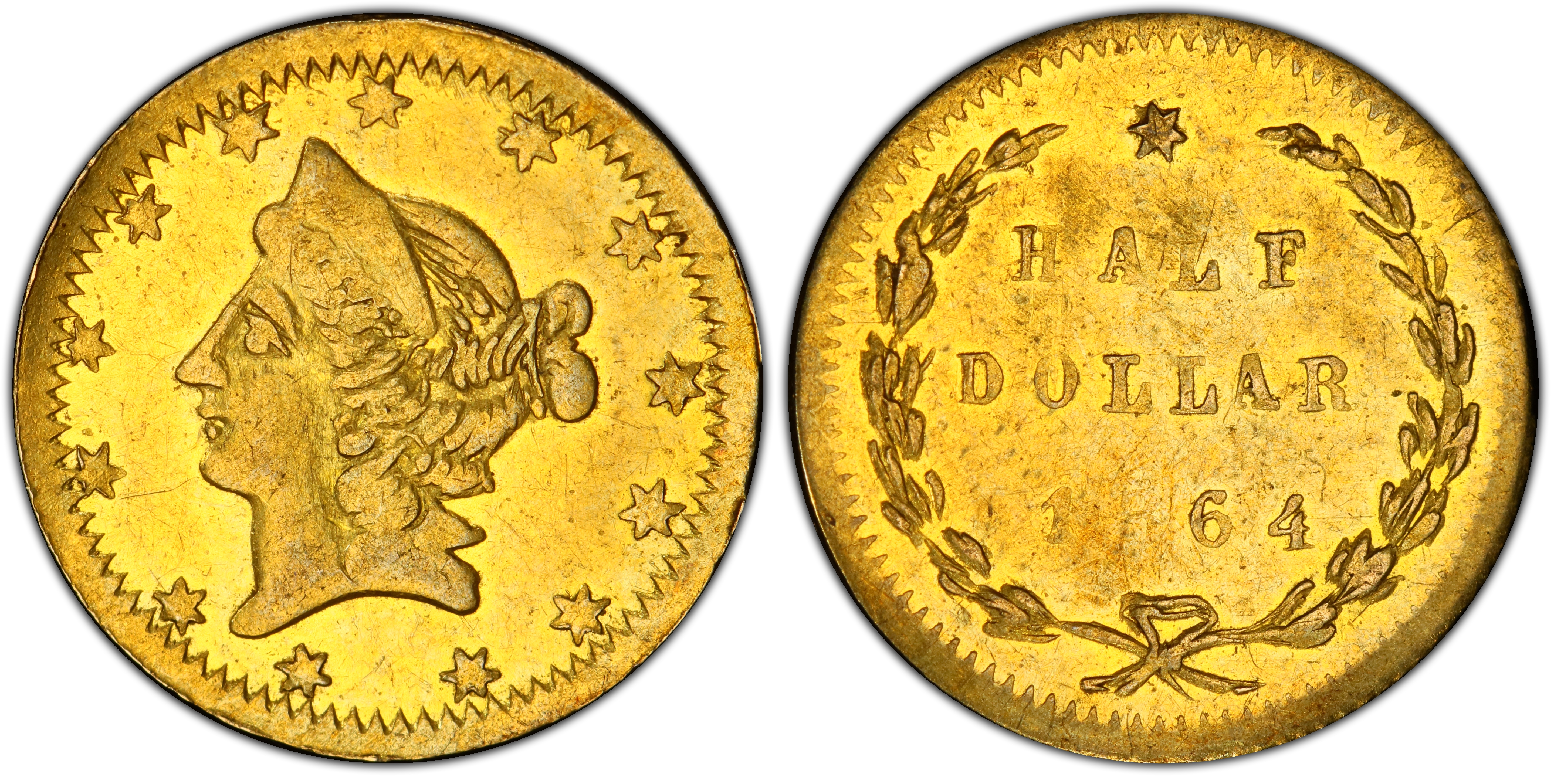
Obverse & Reverse
The 1864 G50C BG-1015 is a numismatic artifact from a pivotal moment in American monetary history, representing the twilight of legitimate private coinage. Struck in San Francisco by the jewelry firm of Robert B. Gray & Co., this minuscule gold piece belongs to what specialists Walter Breen and Ronald Gillio termed 'Period Two' (1859-1882) of California Fractional Gold. Unlike the earlier 'Period One' issues, which were struck with the genuine intent of alleviating the severe shortage of small change during the initial Gold Rush boom, Period Two issues served a dual purpose. While still useful in commerce, they were increasingly produced as souvenirs and keepsakes for a populace fascinated with the romanticism of the West. The year 1864 was profoundly significant; the Coinage Act of April 22, 1864, expressly forbade the private production of coinage, making issues like the BG-1015 technically illegal at the time of their creation. However, the federal government's enforcement of this law, particularly in the distant and still-developing state of California, was lax. The Secret Service did not begin to earnestly crack down on the practice until 1883. This legal ambiguity allowed jewelers like Robert B. Gray to continue striking their denominated 'coins' for nearly two more decades. These pieces were typically manufactured using the 'hammer method,' where a planchet was placed on an anvil die and struck with a hand-held sledgehammer bearing the obverse die. This crude but effective technique resulted in coins of varying strike quality, often with areas of weakness, a characteristic now considered a key sign of authenticity. The BG-1015, as a high-rarity variety, offers a direct link to the Civil War-era economy of San Francisco, a city flush with gold but still grappling with the integration of its regional economy into the broader, federally-controlled monetary system.
Associated EventCalifornia Gold Rush Aftermath
Reason For MintingTo provide small denomination currency for local commerce and to serve the growing market for Gold Rush souvenirs, despite a new federal law prohibiting private coinage.
Minter HistoryRobert B. Gray & Co. was a significant San Francisco-based jewelry and watchmaking firm that became a prolific producer of California Fractional Gold during 'Period Two.' In late 1858 or early 1859, Gray acquired the business of another prominent French jeweler and fractional minter, Antoine Louis Nouizillet. Gray continued to use some of Nouizillet's old dies before creating new ones, often distinguished by his hallmark 'G' placed on the obverse, typically near the date. Gray's firm operated until 1871, when he sold his interests to the California Jewelry Co. (Levison Bros.). Gray's issues are noted by numismatists for generally being of higher weight and intrinsic value compared to many other Period Two pieces.
Historical SignificanceThis coin is a prime example of the final phase of constitutionally permissible private coinage in the United States. Its 1864 date places it squarely at the transition point when federal law officially criminalized such issues, yet market demand and weak enforcement allowed them to persist. It represents an act of local economic defiance and entrepreneurship in a region still shaping its identity.
N/A
Denomination50 Cents
Minting Period1864
Assayer/MinterRobert B. Gray & Co.
Geographic OriginSan Francisco, California
Obverse DescriptionA head of Liberty facing left, her hair tied in a bun. She is surrounded by thirteen six-pointed stars arranged in an arc around the periphery. The date '1864' is below the bust.
Obverse Inscription1864
Reverse DescriptionThe denomination '1/2' is in the center, enclosed by a wreath of leaves and berries. The wreath is open at the top.
Reverse Inscription1/2
CompositionGold
Stated Fineness Actual FinenessVaries (typically 14-22 Karats for Period Two issues)
Weight0.48 grams
Diameter11.50 mm
EdgePlain
Unknown (Extremely Low)
Survival Estimate4 to 6 known
Rarity ScaleR-7 (High)
The BG-1015 is a highly coveted numismatic rarity, prized for its extreme scarcity (R-7), its link to the famous San Francisco minter Robert B. Gray & Co., and its significant date of issue, the same year private coinage was outlawed. Its appeal lies in the intersection of Gold Rush history, Civil War-era economics, and the story of private American mints.
Key VarietiesThe BG-1015 is a specific die variety itself and has no major sub-varieties from its original minting. The primary distinction for collectors is differentiating it from other 1864 50C varieties (such as BG-1016) through minute die characteristics. No special collector issues, patterns, or restrikes of the BG-1015 die marriage are known to exist.
Authentication TipsAuthenticity is paramount. Genuine Period Two fractionals like BG-1015 must have a denomination (e.g., '1/2', 'HALF DOL'). Replicas often have a bear on the reverse and no denomination. Genuine pieces are struck on extremely thin planchets, often the thickness of a business card. Counterfeits are typically thicker, heavier, and often have a better, more uniform strike. Look for characteristic weakness in the strike, especially on the stars or wreath, which results from the crude hammer-striking process. The surfaces of genuine pieces may show fine die polishing lines and a soft, satiny luster, unlike the glassy or tool-marked fields of many fakes.
Shopping ConsiderationsFor an R-7 variety, any opportunity to acquire an example is significant. A premium quality piece would be one that is well-centered and shows as much of the design detail as possible for the variety, which is known for being softly struck. Focus on originality of the surfaces; undisturbed, non-brittle 'skin' with original luster is far more desirable than a cleaned, bright-looking piece. Even high-grade examples can exhibit planchet roughness or minor adjustment marks, which are part of the coin's character and generally accepted. Due to the high rarity, any example, even those with minor impairments, will be highly sought after. Third-party certification by PCGS or NGC is essential for guaranteeing authenticity and providing a standardized grade.
A coin's grade is its condition, rated on a 1-70 scale. For rare coins, this is the most critical factor in determining value, as a tiny difference in preservation can mean a huge difference in price.
Relevant Grade TypesAll original 1864 G50C BG-1015 coins were struck as business strikes intended for circulation or use as souvenirs, and are thus graded on the Circulated (1-58) and Mint State (MS, 60-70) scales. No proofs were struck during the original period of issue, and there are no known later-date Proof restrikes for this specific die pair.
Mint State CharacteristicsAn uncirculated BG-1015 will be defined by its luster and strike. The luster is typically soft and satiny rather than deeply prooflike. Strike is a major issue; these were not struck with the force of a steam press. Expect some weakness, particularly on the highest points of Liberty's hair and the leaves of the wreath. The central denomination '1/2' is often better struck. Small, mint-made planchet flaws or adjustment marks are common and should not be heavily penalized unless they are distracting. Contact marks, even on high-grade pieces, are to be expected due to the softness of the gold and the casual handling these pieces received.
Circulated Wear PatternsWear first appears on the highest points of the design. On the obverse, look for flattening on Liberty's hair above her ear and on her cheekbone. The thirteen stars, especially those opposite the portrait, are also prone to early wear. On the reverse, the high points of the wreath's leaves and the bow at the bottom will show the first signs of friction. In lower grades (VF and below), the date and stars will begin to merge with the fields.
Key Factors For ValueFor an R-7 variety, survival itself is the primary value driver. Beyond that, value is determined by surface preservation and strike. An example with original, uncleaned surfaces commands a massive premium over a cleaned or polished coin. While a full strike is not expected, coins that show more detail in the stars and wreath than is typical for the variety are highly desirable. Eye appeal, which encompasses toning (often a reddish-gold hue), luster, and the absence of distracting marks, is critical. A CAC sticker for this issue would be a significant value-add, confirming premium quality for the assigned grade.
PCGS Price Guide
| Grade | Price | Population |
|---|---|---|
| 50 | $850.00 | 2 |
| 50+ | $925.00 | N/A |
| 53 | $1,100.00 | N/A |
| 53+ | $1,250.00 | N/A |
| 55 | $1,500.00 | 2 |
| 55+ | $1,650.00 | N/A |
| 58 | $1,750.00 | 1 |
| 58+ | $2,000.00 | N/A |
| 60 | $2,250.00 | N/A |
| 61 | $2,750.00 | 2 |
| 62 | $4,500.00 | 4 |