1881 G25C BG-887 (Regular Strike)
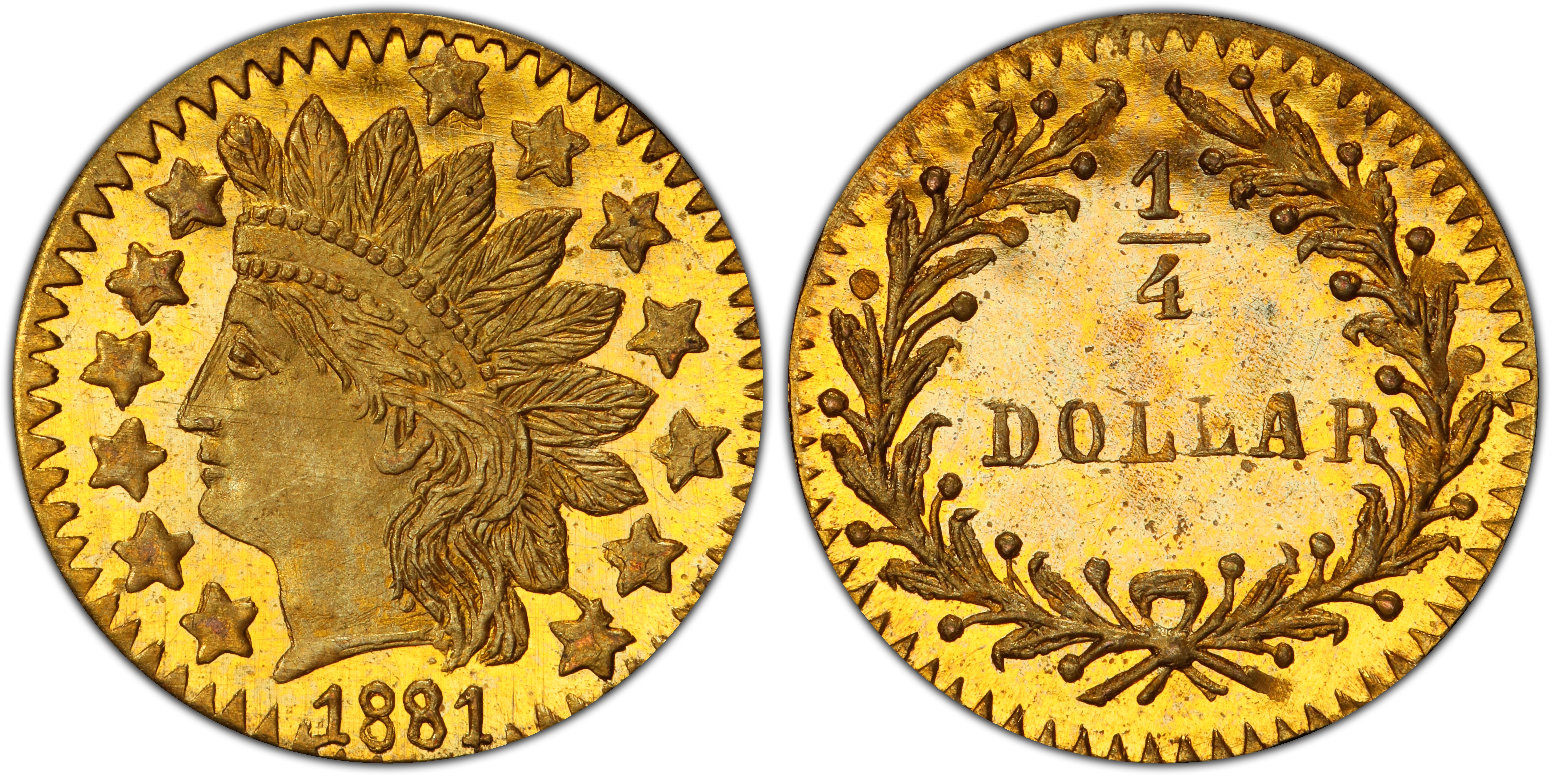
Obverse & Reverse
The 1881 BG-887 25 Cents is a product of the second phase, or 'Period Two' (1858-1882), of California Fractional Gold production. The initial impetus for these small-denomination gold coins arose from the acute shortage of circulating coinage in the aftermath of the 1848 California Gold Rush. With a massive influx of population and gold dust as the primary medium of exchange, even simple transactions were cumbersome. From 1852 to 1857 ('Period One'), private jewelers and minters in San Francisco began striking tiny gold coins in 25 cent, 50 cent, and dollar denominations to facilitate commerce. However, by the time the BG-887 was struck in 1881, the United States Mint in San Francisco had been in operation for over a quarter-century and the initial commercial need had long since vanished. The purpose of these Period Two pieces was entirely different; they were created and sold as souvenirs and curiosities for tourists and collectors, romantic mementos of the now-legendary Gold Rush era. The Coinage Act of 1864 had officially made private coinage illegal, but this law was not strictly enforced by the Secret Service until 1883. This legal gray area allowed numerous San Francisco jewelers to continue producing these denominated 'coins' throughout the 1870s and early 1880s. The BG-887, with its clear denomination, falls into this category of numismatic souvenirs produced just before the final crackdown, which forced subsequent issuers to remove any indication of monetary value, instead labeling them as 'charms' or 'tokens'. As such, the BG-887 represents one of the final expressions of this uniquely American private minting tradition, a tangible link to the fading memory of the Gold Rush.
Associated EventCalifornia Gold Rush (Souvenir Period)
Reason For MintingPrimarily struck as a souvenir or collectible item for the tourist trade, not for general circulation.
Minter HistoryThe specific minter or jeweler responsible for the BG-887 variety is unknown. This is common for many Period Two California Fractional Gold issues. They were often produced by anonymous craftsmen in San Francisco who catered to the robust market for Gold Rush memorabilia. Unlike some of the earlier Period One minters who occasionally identified their work, the makers of these later souvenir pieces rarely signed their dies.
Historical SignificanceThis coin is significant as an example of a 'Period Two' California Fractional Gold piece, representing the transition of these private issues from necessary instruments of commerce to nostalgic souvenirs. Struck just two years before federal enforcement ended the practice of private, denominated coinage, it marks the end of a fascinating and unregulated chapter in American monetary history.
BG-887
Denomination25 Cents
Minting Period1881
Assayer/MinterUnknown private minter
Geographic OriginSan Francisco, California
Obverse DescriptionA stylized head of a Native American chieftain facing left, wearing a feathered headdress. The portrait is surrounded by thirteen six-pointed stars, representing the original colonies.
Obverse Inscription(No inscription)
Reverse DescriptionThe denomination '1/4' is enclosed within a wreath of leaves and berries. The wreath is open at the top, and the date '1881' is positioned directly below the opening, above the fraction. The inscription 'CALIFORNIA GOLD' encircles the lower portion of the wreath.
Reverse InscriptionCALIFORNIA GOLD / 1/4 / 1881
CompositionGold
Stated Fineness Actual FinenessVariable, but generally lower than federal coinage of the era.
Weight0.25 grams
Diameter9.80 mm
EdgePlain
Unknown
Survival Estimate200-300
Rarity ScaleR-5
The BG-887 is highly popular with collectors due to its attractive 'Indian Head' design, its status as a late-dated and historically interesting souvenir issue, and its relative affordability compared to the earlier Period One circulating issues. It is one of the more common varieties, making it an accessible entry point into the complex series of California Fractional Gold.
Key VarietiesThe primary variety is the regular business strike. However, collectors should be aware of special surface designations awarded by grading services, such as 'Proof-Like' (PL) and 'Deep Mirror Proof-Like' (DMPL) or 'Deep Proof-Like' (DPL). These are not separate issues or restrikes but are business strikes from freshly polished dies that exhibit mirrored fields. These specimens are highly coveted and command significant premiums.
Authentication TipsAuthentic BG-887 specimens from 1881 will always bear a denomination ('1/4'). Pieces with similar designs but lacking a denomination are typically later, non-contemporary tokens or charms made after the 1883 government crackdown. Look for a reasonably sharp strike, though weakness in the stars or wreath details is common. Counterfeits may have a soapy or cast-like appearance, incorrect weight, or incorrect die characteristics. Comparison with certified examples is the best authentication method.
Shopping ConsiderationsA premium quality example for its grade will possess a sharp strike, especially on the high points of the Indian's headdress and the numerals of the date. Seek out coins with smooth, lustrous fields free of distracting marks, cleaning, or tooling. Eye appeal is paramount for this issue; pieces with original, unconserved surfaces and attractive rose-gold or green-gold toning are highly desirable. The existence of PL and DMPL/DPL examples makes surface quality a key value driver, so pay close attention to the reflectivity of the fields. Avoid examples that have been mounted in jewelry, as this often results in hidden solder marks, rim damage, or harsh cleaning.
A coin's grade is its condition, rated on a 1-70 scale. For rare coins, this is the most critical factor in determining value, as a tiny difference in preservation can mean a huge difference in price.
Relevant Grade TypesOriginal 1881 issues were all business strikes, technically intended for sale as souvenirs rather than circulation, so most survivors are found in Mint State (MS, 60-70). While they were not spent as money, they were handled, and so examples in high circulated grades (About Uncirculated, AU 50-58) are also encountered. No true Proofs were struck during the original period of issue. Later collector designations like Proof-Like (PL) and Deep Mirror Proof-Like (DMPL) refer to business strikes from polished dies and are not a separate striking method.
Mint State CharacteristicsIn uncirculated grades, the BG-887 often exhibits a decent but not always complete strike. Weakness can be present on the stars or the fine details of the wreath. Luster is typically satiny and can be quite vibrant. High-grade examples, especially those designated PL or DMPL, will have flashy, mirrored fields that contrast with frosted devices. Due to the small size and manufacturing process, it is common to see minor planchet flaws or striations, which should not be confused with post-strike damage.
Circulated Wear PatternsOn circulated examples, wear first appears on the highest points of the design. For the obverse, this includes the cheek and the feathers of the headdress. On the reverse, the highest points of the wreath leaves and the fraction '1/4' will show the first signs of friction and flattening. In lower grades, the legends and date will become soft and eventually merge with the fields.
Key Factors For ValueThe primary drivers of value are grade and surface quality. A high Mint State grade (MS-64 or better) is essential for a top-tier price. The presence of a PL or DMPL/DPL designation from a major grading service can multiply the coin's value. Beyond the technical grade, eye appeal is critical; a coin with rich, original color and brilliant luster will always be prized over a dull or cleaned specimen in the same grade. A CAC sticker, indicating premium quality for the grade, adds a significant premium for this popular issue.
PCGS Price Guide
| Grade | Price | Population |
|---|---|---|
| 55 | $195.00 | 1 |
| 55+ | $200.00 | N/A |
| 58 | $210.00 | 1 |
| 58+ | $220.00 | N/A |
| 60 | $250.00 | N/A |
| 61 | $270.00 | N/A |
| 62 | $300.00 | 11 |
| 62+ | $310.00 | N/A |
| 63 | $375.00 | 39 |
| 63+ | $425.00 | N/A |
| 64 | $525.00 | 61 |
| 64+ | $575.00 | 1 |
| 65 | $700.00 | 34 |
| 65+ | $975.00 | 1 |
| 66 | $1,300.00 | 8 |
| 66+ | $1,550.00 | N/A |
| 67 | $3,750.00 | 2 |