1875 G25C BG-878, PL (Regular Strike)
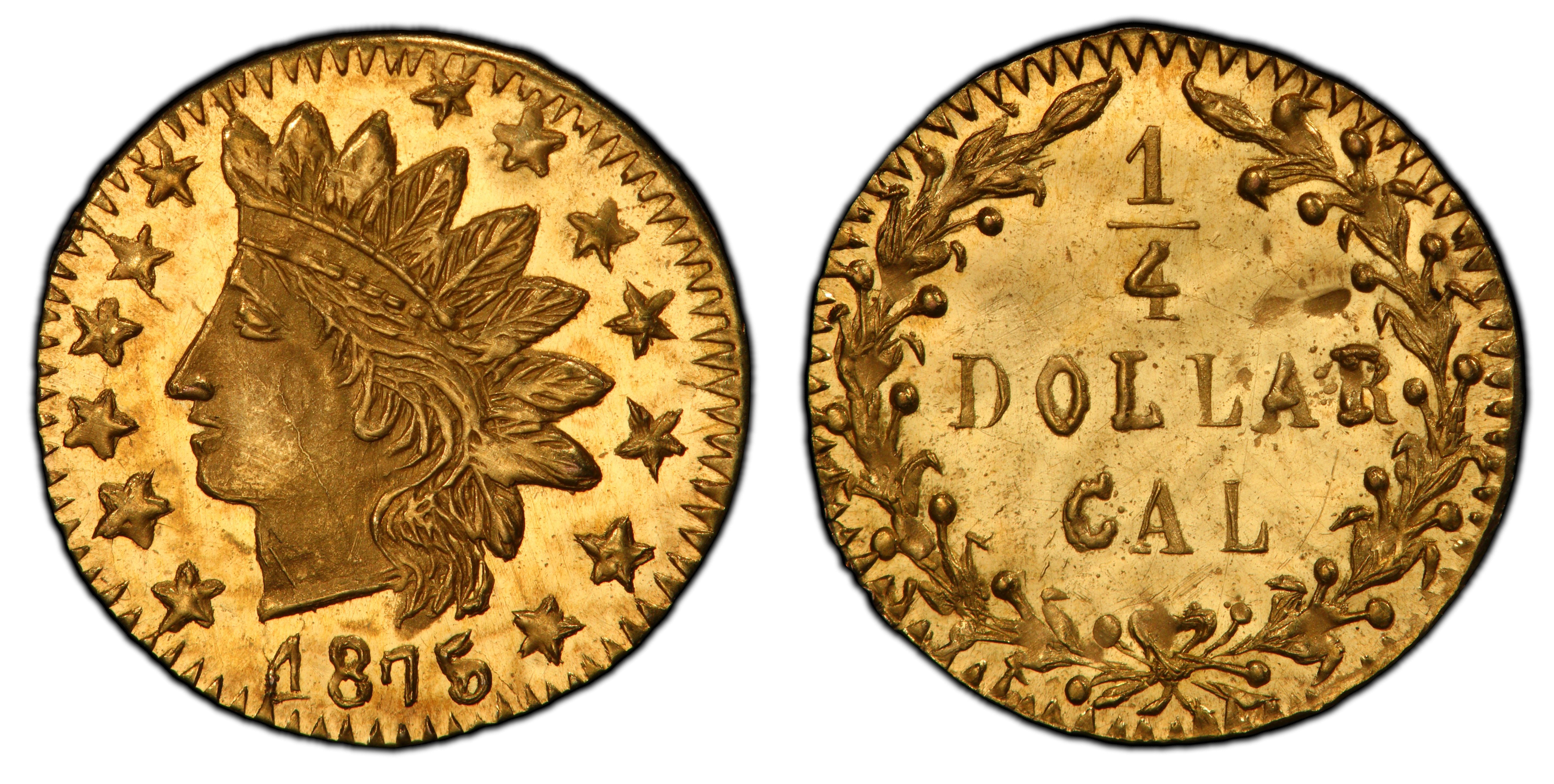
Obverse & Reverse
The 1875 25 Cents, cataloged as Breen-Gillio 878, is a quintessential example of a 'Period Two' California Fractional Gold piece. By the mid-1870s, the initial, urgent need for small denomination coinage that characterized the Gold Rush aftermath had largely subsided. The San Francisco Mint was in full operation, supplying the region with official federal currency. Consequently, the purpose of privately issued gold pieces shifted dramatically from utilitarian currency to charming souvenirs. San Francisco had blossomed from a chaotic boomtown into a major American city and a burgeoning tourist destination. Visitors, fascinated by the romantic legacy of the '49ers, were eager for keepsakes of their journey to the Golden State. Jewelers and private minters, many of whom had produced the earlier, circulating 'Period One' issues, astutely recognized and catered to this new market. These later pieces, often termed 'jeweler's issues,' were not intended to pass hand-to-hand in commerce. Their gold content was typically less than their face value would imply, and their designs, while often intricate and appealing, were created for novelty. The BG-878, with its classic Indian Head motif, was a popular design choice, evoking a romanticized vision of the American West. Production methods remained rudimentary, often involving a screw press or even a simple hammer-striking process, which led to significant variation in strike quality from one piece to another. While the Private Coinage Act of 1864 had officially made such private issues illegal, enforcement was lax, particularly for items clearly intended for the souvenir trade rather than direct competition with federal money. This legal gray area allowed for their continued production until a Secret Service crackdown in the early 1880s finally halted the practice. Today, the BG-878 is not valued for its role in circulation, but as a tangible link to a transformative period in California's history, representing the commercialization of the Gold Rush legend itself.
Associated EventPost-Gold Rush California Tourism
Reason For MintingPrimarily created to be sold as souvenirs and keepsakes to tourists and visitors in San Francisco.
Minter HistoryWhile the specific maker of BG-878 is not definitively known, it is widely attributed to the network of manufacturing jewelers active in San Francisco during this period. The leading candidates are firms descended from the operations of Robert B. Gray & Co. In 1871, Gray sold his coining interests to the prominent California Jewelry Co., also known as the Levison Brothers. These firms possessed the die-sinking and striking capabilities to produce such pieces. Unlike the earlier Period One minters who sometimes hallmarked their work, these later souvenir issues were almost always produced anonymously.
Historical SignificanceThis coin is historically significant not as a medium of exchange, but as a cultural artifact representing the transition of the California Gold Rush from a lived economic reality into a romanticized historical legend marketed to a wider public.
N/A
Denomination25 Cents
Minting Period1875
Assayer/MinterUnknown San Francisco Jeweler (Attributed to the circle of Robert B. Gray & Co. / Levison Brothers)
Geographic OriginSan Francisco, California
Obverse DescriptionA stylized head of Liberty facing left, wearing a Native American-style feathered headdress. The portrait is surrounded by thirteen stars, representing the original colonies.
Obverse Inscription[No Inscription - design elements only]
Reverse DescriptionThe denomination '1/4 DOLLAR' and the date '1875' are enclosed within a wreath composed of two branches tied together with a bow at the bottom.
Reverse Inscription1/4 DOLLAR 1875
CompositionGold
Stated Fineness Actual FinenessVariable, typically lower than monetary-issue gold, often in the 14-22 karat range.
Weight0.25 grams
Diameter9.80 mm
EdgePlain
Unknown
Survival Estimate201-300 (per Breen-Gillio)
Rarity ScaleR-3
Sought after for its classic Indian Head design, affordability relative to Period One issues, and its direct connection to the souvenir trade of historic San Francisco. It is a popular type coin for collectors building a set of California Fractional Gold varieties.
Key VarietiesThe primary variety is the regular business strike (BG-878). No proof strikings from the original period of issue are known to exist. Any specimen exhibiting deeply mirrored fields is designated 'Prooflike' (PL) or 'Deep Mirror Prooflike' (DMPL) by grading services, a feature resulting from polished dies, but these are not true Proofs. No official restrikes were made. Modern replicas are common and have no numismatic value.
Authentication TipsGenuine examples are characteristically thin and lightweight. The strike is often uneven, with some areas appearing soft. The surfaces may show die polish lines, and the luster can range from satiny to prooflike. Replicas are often thicker, have a soapy or cast-like appearance, incorrect weight, and may feature a bear on the reverse, a design element never used on genuine 19th-century issues. The lettering and date on genuine pieces, while sometimes crude, should match the die characteristics cataloged in the Breen-Gillio reference.
Shopping ConsiderationsA premium quality example for the grade will exhibit a sharp, well-centered strike, especially on the high points of the Indian's headdress and the details of the wreath. Original, lustrous surfaces are highly desirable. Many surviving pieces were used as jewelry, so look carefully for evidence of mounting, solder, or harsh cleaning, which will significantly lower the value. Specimens with a 'Prooflike' (PL) designation command a significant premium due to their enhanced eye appeal. Given the variability in strike, a coin that is fully struck up is considerably scarcer and more valuable than a weakly struck counterpart in the same numerical grade.
A coin's grade is its condition, rated on a 1-70 scale. For rare coins, this is the most critical factor in determining value, as a tiny difference in preservation can mean a huge difference in price.
Relevant Grade TypesOriginal period issues were business strikes intended for sale as souvenirs, not circulation, but are graded along the same scale. They are found in Circulated (1-58, typically from mishandling rather than commerce) and Mint State (MS, 60-70) grades. No true Proof (PR/PF) examples were struck during the original period. The 'PL' designation refers to Prooflike business strikes made from polished dies and is not a separate issue type.
Mint State CharacteristicsUncirculated examples of BG-878 are defined by their luster, which is typically bright and satiny, though some are highly reflective (Prooflike). Due to the manufacturing process, strike quality varies immensely; a weakly struck MS-64 is common, while a sharply struck MS-62 is highly desirable. Central softness on the Indian's cheek and the bow of the wreath is typical. Bag marks are less common than handling marks, as these pieces did not circulate in large quantities. The delicate nature of these tiny coins means even minor contact can be significant.
Circulated Wear PatternsAlthough not intended for circulation, mishandled or pocket-carried pieces show wear first on the highest points. On the obverse, this includes the feathers in the headdress, the eyebrow, and the cheekbone. On the reverse, the leaves and bow of the wreath will show the first signs of friction and flattening. In lower grades, the stars and lettering will begin to merge with the fields.
Key Factors For ValueFor the BG-878, value is primarily driven by three factors beyond the numerical grade: 1) Strike quality - a sharp, fully detailed strike can be worth double a weakly struck coin of the same grade. 2) Surface preservation - original, uncleaned surfaces with strong luster or prooflike reflectivity are paramount. 3) Eye appeal - coins with attractive, original golden toning and no distracting marks sell for significant premiums. A CAC sticker for this issue confirms quality and often results in a higher price.
PCGS Price Guide
| Grade | Price | Population |
|---|---|---|
| 63 | $450.00 | 1 |
| 63+ | $550.00 | N/A |
| 64 | $700.00 | 3 |
| 64+ | $825.00 | N/A |
| 65 | $1,000.00 | 3 |
| 66 | N/A | N/A |
| 67 | N/A | N/A |