1876 G50C BG-951, PL (Regular Strike)
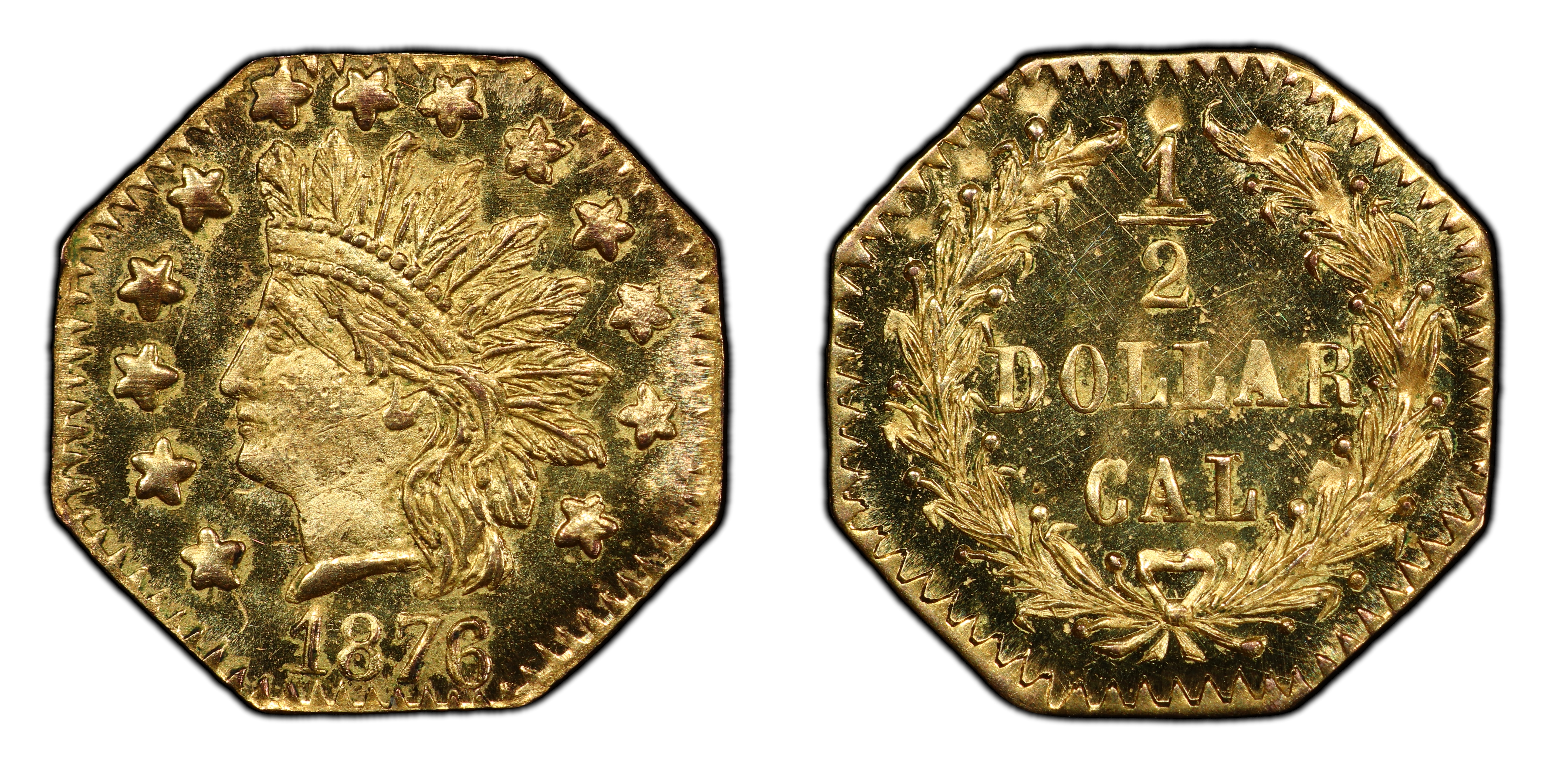
Obverse & Reverse
The 1876 BG-951 50 Cents is a product of the second phase of California Fractional Gold production, a fascinating and complex chapter in American numismatics. The initial period, from 1852 to roughly 1857, was born of dire necessity. The massive influx of population during the Gold Rush created a thriving economy but also a severe shortage of small-denomination coinage for daily transactions. Gold dust was imprecise and foreign silver coins were confusing and inconsistent. Private minters, mostly jewelers with the requisite skills, stepped in to fill this void, creating quarter, half, and one-dollar gold pieces that facilitated local commerce. However, by the time the BG-951 was struck in 1876, the landscape had changed dramatically. The San Francisco Mint, opened in 1854, was producing ample federal coinage, eliminating the original commercial need for fractional gold. The Coinage Act of 1864 had officially made private coinage illegal, but the law was not strictly enforced by the Secret Service until the early 1880s. In this interim period, from 1858 to 1882, the nature of fractional gold shifted from utilitarian currency to souvenir and novelty items. These 'Period Two' issues, often called 'jeweler's issues,' were struck for merchants, tourists, and collectors as mementos of the romanticized Gold Rush era. The year 1876 was particularly significant as it marked the nation's Centennial, fueling a market for historical keepsakes. The BG-951, with its Indian Head motif—popularized by the federal cent—was designed to appeal to this sentiment. These pieces were not intended to circulate widely but served as popular items for mounting into jewelry, such as stickpins, cufflinks, and watch fobs. Their production was a final, nostalgic echo of the private minting tradition that had been so vital to California's frontier economy a generation earlier.
Associated EventPost-Gold Rush Era / U.S. Centennial
Reason For MintingPrimarily struck as souvenirs and for use in jewelry during the U.S. Centennial year, long after the commercial need for such coinage had passed.
Minter HistoryThe specific minter of BG-951 is unknown, which is characteristic of most 'Period Two' California Fractional Gold issues. Production was often clandestine due to its questionable legal status. The work is attributed to the many skilled jewelers operating in San Francisco during the era, such as Robert B. Gray & Co. and others who had the equipment and expertise in working with gold. These craftsmen produced a wide variety of designs and die-pairings, often with little regard for consistent weight or fineness, as the pieces were sold as novelties rather than fiduciary currency.
Historical SignificanceThe BG-951 is historically significant not as a coin of commerce, but as a cultural artifact representing the commercialization of Gold Rush history. It marks the transition of fractional gold from a necessary form of currency to a popular souvenir, reflecting a burgeoning nostalgia for the '49er era. Its creation in the Centennial year of 1876 further cements its status as a historical memento, a tiny gold link to a defining period of American expansion and enterprise.
N/A
Denomination50 Cents
Minting Period1876
Assayer/MinterUnknown Private Minter (Jeweler)
Geographic OriginSan Francisco, California
Obverse DescriptionAn Indian Head motif facing left, stylistically similar to the contemporary federal coinage. The portrait is surrounded by thirteen stars, representing the original colonies.
Obverse Inscription[No Inscription]
Reverse DescriptionA wreath of two branches tied with a ribbon at the bottom encircles the denomination. The date '1876' is positioned below the wreath.
Reverse Inscription1/2
CompositionGold
Stated Fineness Actual FinenessVaries, often between .500 and .800 fine (12k to 19k gold).
Weight0.25 grams
Diameter10.00 mm
EdgePlain
Unknown, but very low.
Survival Estimate31-75 known specimens
Rarity ScaleR-5+
This variety is highly sought after for its octagonal shape, popular Indian Head design, and status as a Centennial-year issue. Its R-5+ rarity ensures strong demand, and the existence of Prooflike (PL) examples adds a further dimension for specialists seeking coins with exceptional surface quality.
Key VarietiesThe primary variety for collectors is the surface designation. While most are found with a standard business strike finish, a small number were produced with highly polished dies and planchets, resulting in a Prooflike (PL) or Deep Mirror Prooflike (DMPL) appearance. These PL examples are considered a separate collecting category and command significant premiums. No known official restrikes or patterns exist.
Authentication TipsGenuine pieces must have a denomination ('1/2') on the reverse; souvenir tokens without a denomination (e.g., those with a bear) are not official Period Two issues. The strike is often uneven, but the details should be fine and sharp, not crude or mushy like many modern replicas. The gold color should be consistent, not plated. Authentication by a major third-party grading service (PCGS or NGC) is highly recommended, as this is one of the most heavily counterfeited series in U.S. numismatics.
Shopping ConsiderationsFor a premium quality example, seek a coin with a sharp, well-centered strike, particularly on the stars and the details within the wreath. The 'PL' designation is key for top-tier value; look for brightly mirrored fields that contrast with frosted devices. Many surviving examples are ex-jewelry and may show signs of rim damage, solder, or harsh cleaning, which should be avoided. An ideal piece will possess original, untouched surfaces, perhaps with a hint of reddish-gold toning. A CAC sticker on a certified coin provides an additional layer of assurance regarding quality for the assigned grade.
A coin's grade is its condition, rated on a 1-70 scale. For rare coins, this is the most critical factor in determining value, as a tiny difference in preservation can mean a huge difference in price.
Relevant Grade TypesOriginal examples were produced as business strikes, although their souvenir nature means many were well-preserved. They are found in both Circulated (1-58) and Mint State (MS, 60-70) grades. No true Proofs were struck. However, the 'Prooflike' (PL) designation is extremely important for this issue. A PL coin is a business strike made with fresh, highly polished dies, resulting in mirrored surfaces that resemble a Proof. These are not a separate issue, but rather a desirable quality of the strike, and they are graded on the standard MS 60-70 scale with the PL modifier.
Mint State CharacteristicsUncirculated examples of BG-951 are defined by their luster. A typical Mint State piece has a soft, satiny glow. A premium 'PL' specimen, however, will exhibit brightly mirrored fields. Strike quality varies; many show some weakness on the high points of the Indian's hair and the knot of the ribbon on the reverse. Small planchet flaws or unstruck areas are common due to the crude minting process and are generally accepted. Contact marks, while present on most, are judged harshly on such a small coin.
Circulated Wear PatternsWear first appears on the highest points of the design. On the obverse, check the cheek and the details in the feathered headdress. On the reverse, the highest points of the wreath's leaves and the bow's ribbon will show friction first. As wear progresses, the stars will begin to lose their definition and the date will become weak.
Key Factors For ValueFor the BG-951, the single most important factor is the surface quality, specifically the presence of a Prooflike designation. A certified MS-64 PL will trade for significantly more than a standard MS-64. Beyond that, strike sharpness is critical; a fully struck-up coin with bold details is rare and prized. Eye appeal, encompassing attractive original toning and mark-free surfaces, is paramount on these tiny gold pieces. Finally, due to the prevalence of counterfeits and altered surfaces, certification by PCGS or NGC is virtually required for any significant transaction, with a CAC sticker adding a further premium for exceptional quality.
PCGS Price Guide
| Grade | Price | Population |
|---|---|---|
| 65 | $2,000.00 | 1 |
| 66 | N/A | N/A |
| 67 | N/A | N/A |