1873 G25C BG-871 (Regular Strike)
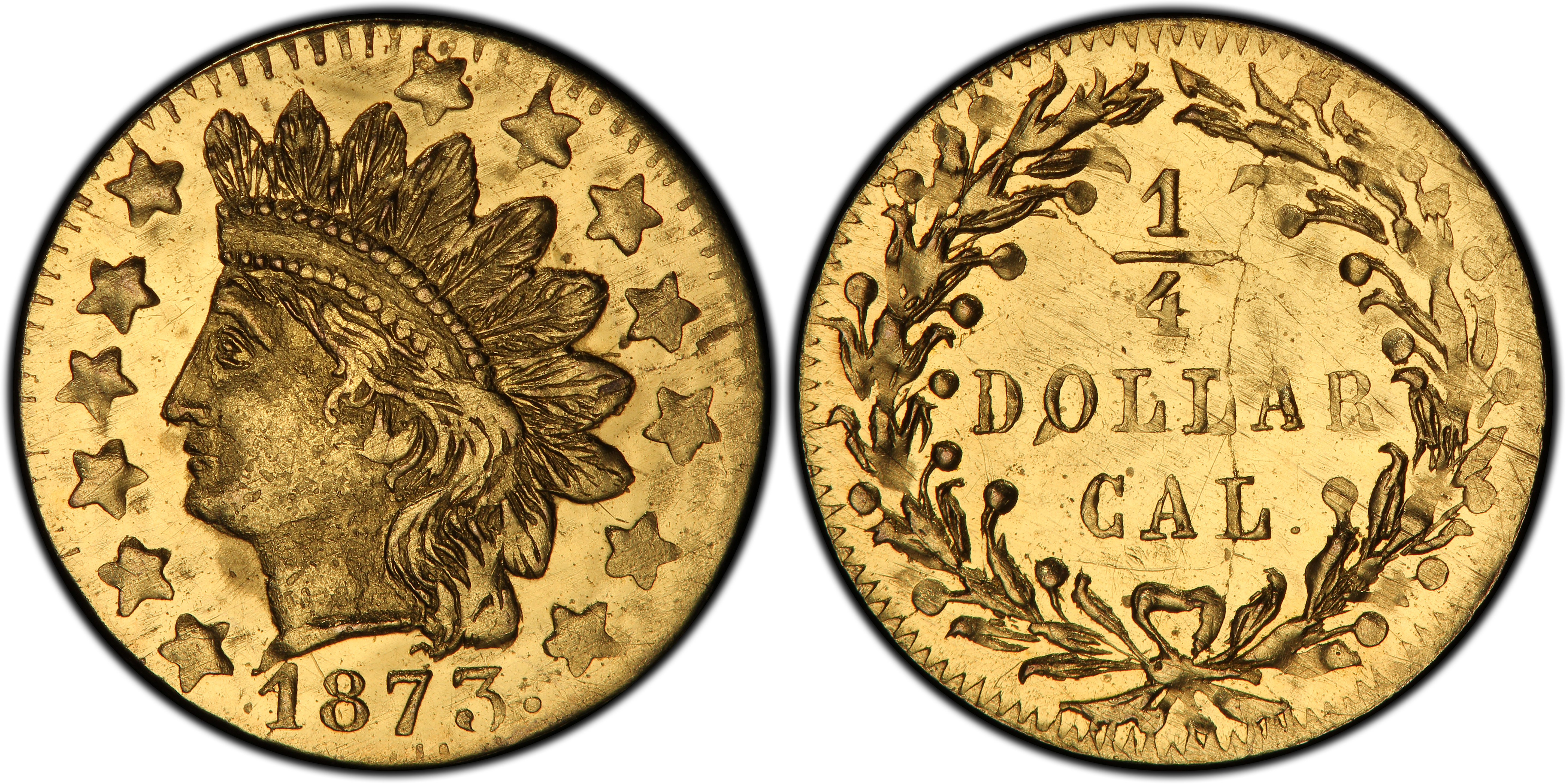
Obverse & Reverse
The 1873 BG-871 25 Cents represents a fascinating and complex era of American numismatics, born from the unique economic conditions of post-Gold Rush California. This piece is classified as a 'Period Two' or 'Jeweler's Issue' (1858-1882) by the authoritative Breen-Gillio reference. Unlike the earlier 'Period One' issues (1852-1857), which were minted out of genuine necessity to alleviate a severe shortage of small change in the booming gold fields, these later pieces served a different purpose. By 1873, the San Francisco Mint was in full operation, producing ample federal coinage for commerce. The Private Coinage Act of 1864 had officially outlawed the production of private currency, rendering new issues like this one technically illegal for circulation. However, the law was not aggressively enforced against these tiny gold pieces until the early 1880s. San Francisco jewelers, recognizing a burgeoning market, continued to produce them, not for Main Street, but for a growing tourist trade and a national audience fascinated by the romance of the 'Wild West.' These pieces were souvenirs, keepsakes of the golden land that had captured the nation's imagination. The minters of these 'jeweler's issues' were often anonymous artisans who backdated their coins or used ambiguous designs to avoid the attention of Treasury agents. The BG-871 is a product of this environment. Its creation was not driven by a lack of circulating media, but by commercial nostalgia. The quality of these pieces varied wildly, from crudely made to sharply detailed, reflecting the skill of the individual jeweler. The gold content was also unregulated and often significantly below face value, reinforcing their status as tokens rather than true coinage. Today, the BG-871 is not significant for its role in commerce, but for what it represents: the commercialization of the Gold Rush myth and the enduring cottage industry that grew up around it, creating a collectible legacy long after the placer gold was gone.
Associated EventPost-Gold Rush California Commerce
Reason For MintingPrimarily created as a souvenir or collectible for the tourist trade rather than to fulfill a need for circulating currency.
Minter HistoryThe specific minter of the BG-871 variety is unknown, a common characteristic of many 'Period Two' California Fractional Gold pieces. Following the Private Coinage Act of 1864, many San Francisco jewelers who produced these souvenir tokens operated anonymously to avoid legal repercussions from the U.S. Secret Service, which began to crack down on private issues in the 1880s. These artisans, working in small shops, would create their own dies and strike pieces by hand, resulting in a wide array of styles and qualities but leaving little in the way of official records.
Historical SignificanceThe BG-871 is significant not as a circulating coin, but as a tangible artifact of the post-Gold Rush souvenir trade. It illustrates how private enterprise adapted to federal laws by shifting production from functional currency to nostalgic tokens, capitalizing on the national fascination with California's goldfields. Its extreme rarity today highlights the ephemeral nature of these privately-made pieces, most of which were lost or melted over time.
BG-871
Denomination25 Cents
Minting Period1873
Assayer/MinterUnknown Private Minter
Geographic OriginSan Francisco, California
Obverse DescriptionThe obverse features a small, stylized head of an Indian princess facing left, adorned with a feathered headdress. The portrait is encircled by thirteen six-pointed stars, often weakly struck or unevenly spaced, which are themselves contained within a denticled border.
Obverse Inscription[None]
Reverse DescriptionThe reverse design is dominated by a wreath composed of two branches tied together with a bow at the bottom. Inside the wreath, the denomination '25' is prominently displayed at the center, with the word 'CENTS' below it. The date '1873' is inscribed below 'CENTS'. A key diagnostic feature for this variety can be the presence of die cracks.
Reverse Inscription25 CENTS 1873
CompositionGold
Stated Fineness Actual FinenessVariable, often low-karat gold (typically 14-20 karats), as was common for Period Two issues.
Weight0.25 grams
Diameter9.50 mm
EdgePlain
Unknown; extremely small.
Survival EstimateFewer than 15 known examples.
Rarity ScaleR-6+ (High R-6)
BG-871 is highly sought after due to its extreme rarity and the popularity of the Indian Head motif. As a 'Period Two' issue, it is part of the complex and challenging series of California Fractional Gold, appealing to specialists who appreciate the nuances of these privately minted tokens. Its tiny size and historical connection to the California Gold Rush legend add to its allure.
Key VarietiesThe primary variety is the regular business strike. No proof or special collector issues from the period of minting are known. However, advanced die states are a key diagnostic for this variety. Heritage Auctions has noted an example with 'advanced state of die cracks on the reverse,' which serves as an important identifying feature and helps to plate the coin. Collectors should be aware of the vast number of modern, gold-plated replicas that imitate California Fractional Gold; only pieces conforming to the Breen-Gillio specifications are considered authentic period issues.
Authentication TipsAuthentic BG-871s are struck in real, albeit sometimes low-karat, gold. They should not be magnetic. The strike is often somewhat crude and uneven, a hallmark of hand-striking. Details on the stars or wreath may be soft. Conversely, modern replicas often have a very uniform, 'too perfect' appearance or are obviously gold-plated with base metal showing on the edges. Genuine pieces must be denominated; fakes often say 'CALIFORNIA GOLD' without a 'CENTS' or 'DOLLAR' value. Compare the specific die characteristics—the style of the portrait, the font of the numerals, and the wreath details—to high-resolution images of certified examples. The known reverse die cracks are a powerful authentication tool.
Shopping ConsiderationsFor a 'premium quality' BG-871, a buyer should prioritize a sharp strike on the central devices—the Indian's portrait and the denomination '25 CENTS' on the reverse. Given the hand-minting process, perfectly struck examples are virtually nonexistent, so a relatively well-centered and bold strike commands a significant premium. Look for clean, original surfaces that have not been harshly cleaned or polished, as this is a common issue with these tiny coins which were often kept as jewelry. Original, slightly reddish-gold toning is highly desirable. Due to the high rarity, any example, even one with minor planchet flaws or a slightly weak strike, is considered a major prize. Certification by PCGS or NGC is essential for market acceptance and to guarantee authenticity.
A coin's grade is its condition, rated on a 1-70 scale. For rare coins, this is the most critical factor in determining value, as a tiny difference in preservation can mean a huge difference in price.
Relevant Grade TypesOriginal 1873 BG-871 issues were business strikes, technically produced as souvenirs but made with the same methods as circulating coins. They are found in both Circulated (1-58) and, more commonly for this souvenir issue, Mint State (MS, 60-70) grades. No proofs were struck during the original period of issue, and there are no known authorized later-date restrikes. Any piece described as a 'Proof' is likely a modern replica or a misattribution of a prooflike business strike.
Mint State CharacteristicsUncirculated examples of BG-871 are defined by their luster, which is typically satiny rather than deeply frosty. The strike is a critical factor; many exhibit softness on the peripheral stars and the finer details of the feathers and wreath. A coin that is sharply struck for the issue is a major condition rarity. Due to the softness of the gold and the production methods, it is common to see minor planchet flaws or light adjustment marks made before striking. Small, scattered contact marks are typical and must be evaluated to determine the specific grade from MS-60 to higher levels. Mirrored or prooflike surfaces are sometimes encountered and command a premium.
Circulated Wear PatternsOn circulated examples, wear first appears on the highest points of the design. On the obverse, this includes the cheek and the feathers of the headdress. On the reverse, the highest points of the wreath's leaves and the numerals '25' will show the first signs of friction, appearing flattened and losing their detail. In lower grades (VF and below), the stars will begin to merge with the fields, and the legends will become soft.
Key Factors For ValueFor the BG-871, value is driven by three main factors: 1) Grade and Surface Quality: An example with minimal marks and original, uncleaned surfaces is paramount. 2) Strike Sharpness: A coin with a bold, well-centered strike is far more desirable than a weakly struck counterpart, even in the same numerical grade. 3) Eye Appeal: Coins with attractive, original toning and clean fields command significant premiums. The presence of a CAC sticker, indicating premium quality for the grade, adds another layer of value and is particularly meaningful for this series where quality can vary dramatically.
PCGS Price Guide
| Grade | Price | Population |
|---|---|---|
| 60 | $750.00 | 1 |
| 61 | $830.00 | 2 |
| 62 | $900.00 | 2 |
| 62+ | $950.00 | N/A |
| 63 | $1,050.00 | 9 |
| 63+ | $1,125.00 | N/A |
| 64 | $1,300.00 | 4 |
| 64+ | $1,500.00 | N/A |
| 65 | $1,825.00 | 2 |
| 65+ | $2,100.00 | N/A |
| 66 | $2,500.00 | N/A |