1872 G25C BG-815 (Regular Strike)
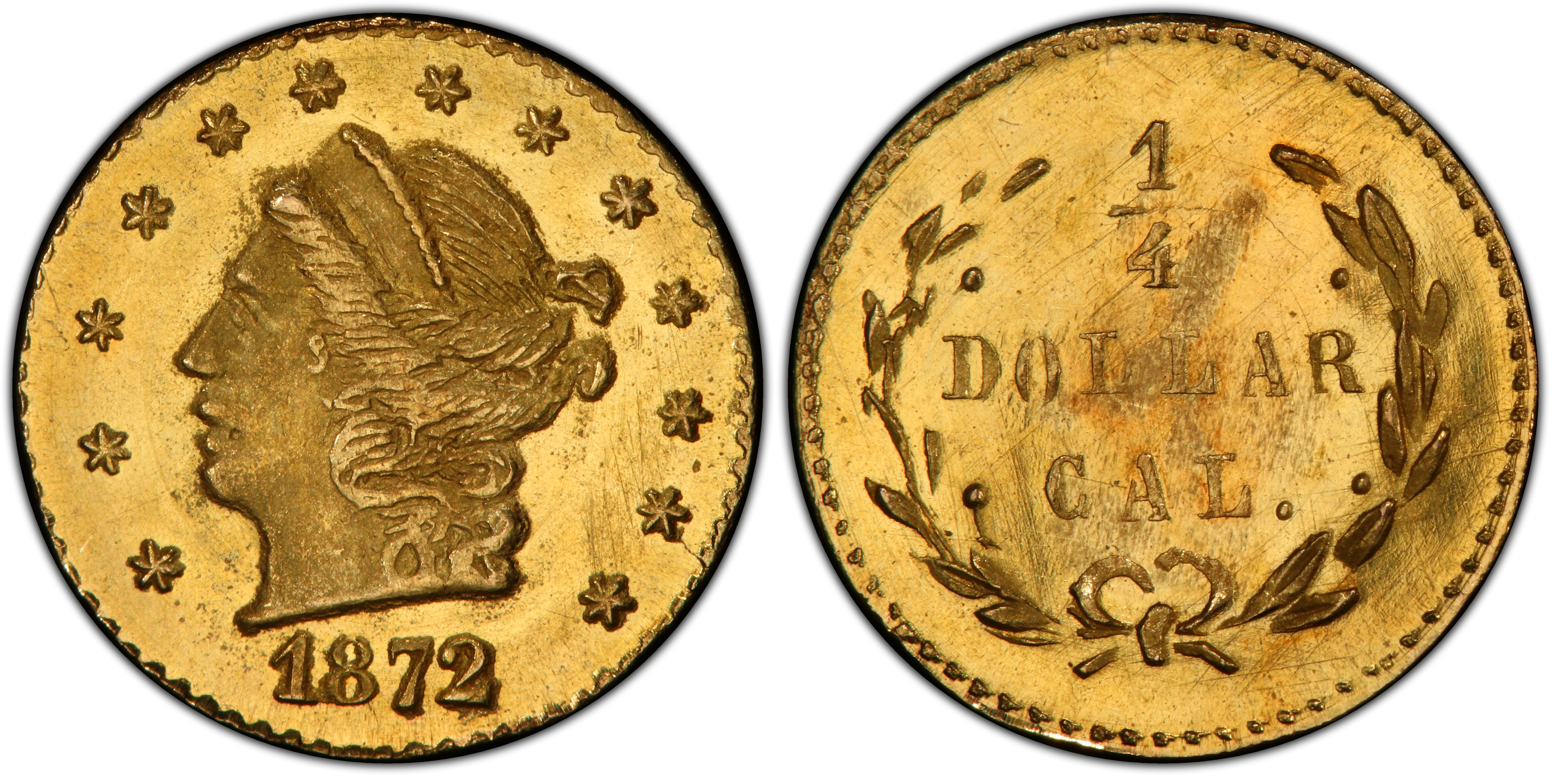
Obverse & Reverse
The 1872 G25C BG-815 is a product of the fascinating 'Period Two' (1858-1882) of California Fractional Gold production. By the 1870s, the initial frenzy of the Gold Rush had subsided, but California's economy remained robust, albeit plagued by a chronic shortage of small change. The smallest denomination federal coin in regular circulation on the West Coast was the silver quarter dollar, which was often inconvenient for minor transactions. Gold dust, the de facto currency of the early rush, had become impractical for everyday commerce. This persistent need created a niche for private minters, primarily jewelers and metallurgists in San Francisco, to produce their own small-denomination gold coins. These pieces, often called 'charms' or 'tokens' to circumvent federal laws against private coinage, were widely accepted and fulfilled a vital economic role. The Act of 1864 had explicitly forbidden the private issuance of gold coins, pushing production into a legally gray area. Manufacturers ingeniously omitted the word 'DOLLAR' from their designs, using abbreviations like 'DOL.' or simply 'D' or, in many cases, just the denomination like '1/4' or '25 CENTS' to argue their products were not official currency. The BG-815 variety, with its classic Indian Head motif, was a popular design choice of the era, evoking the imagery of official U.S. gold coinage and thereby enhancing public trust. These pieces were struck with meticulous care, though often in small quantities, and circulated freely in the small-scale commerce of San Francisco and surrounding regions. Their existence is a testament to the lingering economic independence and unique monetary conditions of post-Gold Rush California, a period when the state's commercial needs outpaced the capacity of the distant federal government.
Associated EventPost-California Gold Rush Economic Expansion
Reason For MintingA severe shortage of small-denomination circulating coinage for minor daily transactions in California prompted private production.
Minter HistoryThe specific minter of BG-815 is not definitively known, which is common for Period Two fractionals. Production is attributed to the network of San Francisco jewelers who created these pieces. Prominent firms of the era, such as Robert B. Gray & Co. (who often used the mark 'G' on their products, though not present here) and Herman J. Brand, are considered the most likely candidates. These artisan-minters operated in a competitive environment, creating a wide variety of designs to appeal to the public and facilitate commerce. They were skilled metallurgists and engravers who filled a crucial gap in the region's money supply.
Historical SignificanceThe BG-815, like other California Fractional Gold pieces, represents a tangible link to the unique economic conditions of 19th-century California. It highlights a period of semi-autonomous regional commerce and demonstrates the ingenuity of private enterprise in response to government shortcomings. These coins are important artifacts of American monetary history, illustrating the final chapter of private gold coinage in the United States before the federal government fully asserted its monopoly.
N/A
Denomination25 Cents
Minting Period1872
Assayer/MinterUnknown, likely produced by one of the San Francisco jewelry manufacturers such as Robert B. Gray & Co. or Herman J. Brand.
Geographic OriginSan Francisco, California
Obverse DescriptionA beaded border encircles a Liberty Head design, facing left. She wears a Native American-style feathered headdress with the band inscribed 'LIBERTY'. The field is adorned with 13 stars, representing the original colonies, arranged with seven to the left and six to the right of the portrait.
Obverse InscriptionLIBERTY
Reverse DescriptionA beaded border surrounds the denomination '1/4' and the date '1872', which are centrally located within a wreath of leaves and berries. The wreath is open at the top.
Reverse Inscription1/4 1872
CompositionGold
Stated Fineness Actual FinenessApproximately .500 to .600 fine, often lower than the gold rush issues.
Weight0.25 grams
Diameter9.70 mm
EdgePlain
Unknown
Survival Estimate250-350
Rarity ScaleR-4
This variety is highly popular due to its classic 'Indian Princess' design, which mimics the official U.S. gold dollar, making it one of the most aesthetically pleasing and recognizable types of fractional gold. Its defined date and clear denomination add to its appeal as a representative piece of the series. The R-4 rarity rating indicates it is scarce but obtainable, making it a desirable target for both type collectors and specialists.
Key VarietiesThis is a 'Regular Strike' business issue. There are no known major varieties, patterns, or official restrikes for the BG-815 designation itself, as it is a specific die marriage. However, the broader 1872 Quarter Dollar series includes other die pairings (e.g., BG-816) with subtle differences in die state, date placement, or design details. No special collector issues like Proofs were made during the original minting period for this variety.
Authentication TipsAuthentic examples exhibit sharp, well-defined details, especially in the feathers and the word 'LIBERTY' on the headband, though some softness of strike is common. The planchets are typically thin and uniform. Counterfeits often have a mushy or soapy appearance, incorrect weight, or a brassy color. They may also display tooling marks or casting bubbles. The numerals in the date should match the specific punch style known for the BG-815 die marriage. Pay close attention to the shape of the wreath's leaves and the font of the '1/4'.
Shopping ConsiderationsA premium quality example for its grade will possess a sharp strike with full details on Liberty's headdress and the wreath. Seek out coins with minimal, non-distracting contact marks and lustrous, original surfaces, often exhibiting a rich, reddish-gold or orange-peel texture. Common problems include harsh cleanings, which strip the original skin and impart hairline scratches, and jewelry mounting or removal damage. Given their small size, even minor imperfections are magnified, so eye appeal is paramount. Look for coins with even, attractive color and avoid those with spots, stains, or evidence of being bent.
A coin's grade is its condition, rated on a 1-70 scale. For rare coins, this is the most critical factor in determining value, as a tiny difference in preservation can mean a huge difference in price.
Relevant Grade TypesOriginal period issues of BG-815 were business strikes intended for circulation. They are found in Circulated grades (AG-3 to AU-58) and Mint State grades (MS-60 to MS-70). No Proof (PR/PF) examples were struck during the original period of issue, and there are no known later-date Proof restrikes for this specific die variety. Any coin described as a 'Proof' would be highly suspect and require expert examination.
Mint State CharacteristicsUncirculated examples of BG-815 are characterized by a soft, satiny luster. The strike can be variable; a sharply struck specimen will show clear definition in all 13 stars and the individual feathers of the headdress, which is a key indicator of quality. Weakness is often seen in the center of the design on both sides. Due to the softness of the low-karat gold alloy, even high-grade Mint State examples will typically show small, scattered contact marks from brief handling or storage with other pieces.
Circulated Wear PatternsWear first appears on the high points of the design. On the obverse, this includes Liberty's cheek, the eyebrow, and the upper feathers of the headdress. On the reverse, the highest points of the wreath and the fraction '1/4' will show the first signs of friction. In lower grades (VF and below), the word 'LIBERTY' on the headband will become indistinct and the finer details of the wreath will merge.
Key Factors For ValueFor the BG-815, value is driven by several key factors. Firstly, surface preservation is critical; an example with original, uncleaned 'skin' and luster will command a significant premium over a cleaned or polished coin of the same numerical grade. Secondly, strike quality is paramount; collectors pay more for well-struck coins where details of the hair, headdress, and wreath are sharp. Thirdly, eye appeal, which encompasses toning (attractive, original reddish-gold hues are desirable) and the absence of distracting marks, plays a major role. Finally, certification by a top-tier grading service (PCGS or NGC) is standard, and a CAC sticker, indicating premium quality for the grade, will add a substantial premium.
PCGS Price Guide
| Grade | Price | Population |
|---|---|---|
| 60 | $2,500.00 | 1 |
| 61 | $2,750.00 | 1 |
| 62 | $4,000.00 | 3 |
| 62+ | $5,000.00 | N/A |
| 63 | $7,500.00 | 3 |
| 63+ | $8,500.00 | N/A |
| 64 | $9,500.00 | 2 |
| 64+ | $11,000.00 | N/A |
| 65 | $15,000.00 | 1 |