1856 G25C BG-818A (Regular Strike)
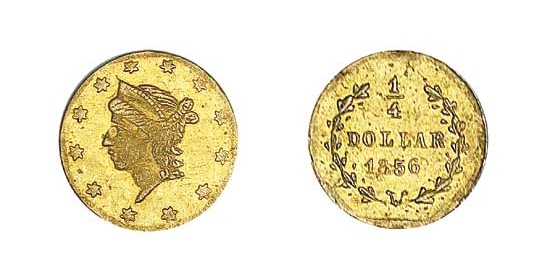
Obverse & Reverse
The 1856 G25C BG-818A is not a product of the initial California Gold Rush coinage era, but rather a fascinating and exceedingly rare artifact from the subsequent 'Period Two' (1858-1882) of fractional gold production. These later issues, often termed 'Jeweler's Issues,' represent a shift in purpose from circulating currency to souvenir and novelty items. The original dies used for this piece were for the BG-111, an octagonal 25-cent coin dated 1856, likely engraved and first used by Antoine Louis Nouizillet, a prominent French jeweler in San Francisco. Nouizillet was a key figure during 'Period One' (1852-1857), when a severe shortage of small denomination federal coinage compelled private minters to produce fractional gold to facilitate commerce. These early pieces, while often underweight, served a genuine economic need. However, by 1856-1857, the new San Francisco Mint was in full operation, alleviating the coin shortage and rendering private issues obsolete for circulation. Around 1859-1860, another jeweler, Robert B. Gray, purchased Nouizillet's business, acquiring his tools of the trade, including hubs, punches, and old dies. Gray continued the production of fractional gold, but his market was different. The Gold Rush had transformed from a mad scramble for wealth into a legendary chapter of American history, and tourists and citizens alike desired mementos of this era. Gray capitalized on this by using older, dated dies to create restrikes. The BG-818A is a prime example of this practice: a 'mule' created by pairing the original 1856-dated dies of the octagonal BG-111 but striking it on a round planchet, circa 1860. This deliberate change in shape distinguished it from the original issue and catered to the collector and jewelry trade. Its status as a restrike explains the anachronistic date. The production quality of these Period Two pieces often varied, and they were typically struck with a lower intrinsic gold value compared to their stated denomination, as their value was primarily sentimental and curatorial. The BG-818A is the pinnacle of rarity within this specialized field; census reports from major grading services indicate it is a unique, one-of-a-kind piece, making it a spectacular prize for the advanced specialist in California fractional gold.
Associated EventCalifornia Gold Rush (Jeweler's Issue Period)
Reason For MintingStruck as a souvenir or curio for the burgeoning jewelry and tourist trade, utilizing older, retired dies from the circulation period.
Minter HistoryThe original dies were created by Antoine Louis Nouizillet, a French jeweler active in San Francisco during the 1850s. The restrikes were produced circa 1860 by Robert B. Gray & Co., who had purchased Nouizillet's business and equipment, including his old dies. Gray was a significant producer of 'Period Two' fractional gold, often using his own hallmark 'G' on later pieces, but is known to have made trial strikes and restrikes from Nouizillet's dies after the acquisition.
Historical SignificanceThe BG-818A is a quintessential example of a 'Period Two' California fractional gold restrike, illustrating the transition of these pieces from utilitarian coinage substitutes to historical souvenirs. Its existence as a unique muling of original dies on a different planchet shape provides a tangible link between the original Gold Rush minters and the later jewelers who commercialized its legacy. Its extreme rarity makes it a landmark piece for numismatic study.
BG-818A
Denomination25 Cents
Minting Periodcirca 1860
Assayer/MinterRobert B. Gray & Co. (using dies from Antoine Louis Nouizillet)
Geographic OriginSan Francisco, California
Obverse DescriptionA small Liberty Head facing left, crudely rendered in a style imitative of the official U.S. gold dollars of the era. The portrait is surrounded by thirteen stars of varying quality. The date '1856' appears below the bust.
Obverse Inscription1856
Reverse DescriptionThe denomination '1/4' is enclosed within a wreath of two olive branches tied with a bow at the bottom. The legend 'CALIFORNIA GOLD' encircles the wreath along the upper periphery.
Reverse InscriptionCALIFORNIA GOLD 1/4
CompositionGold
Stated Fineness Actual FinenessTypically of lower fineness than Period One issues, often 14-21 karats, but the specific fineness for this unique piece is not published.
EdgePlain
Extremely low, likely a trial or test piece.
Survival Estimate1 known.
Rarity ScaleR-9 (Unique)
This coin's appeal is immense for the advanced specialist. It is a unique (R-9) restrike that connects two major periods of fractional gold production and two significant minters, Nouizillet and Gray. It represents the ultimate rarity in a popular and historically rich collecting field.
Key VarietiesBG-818A is a unique variety in itself, defined as a restrike of the 1856 BG-111 (octagonal) dies on a round planchet. The original BG-111 is the parent coin, and it exists in several die states, with later states showing significant die degradation (broken nose on Liberty, fragmented bow on reverse). There are also later, cruder souvenir copies known as Kroll restrikes (e.g., BG-1301) which are distinct from this Period Two issue.
Authentication TipsAuthentication hinges on comparing the die characteristics precisely to known examples of the BG-111 dies. Look for specific die markers, such as the shape of the letters and numbers, and any known die cracks or breaks. As a Period Two piece, the strike may be weaker than Period One originals. The planchet's fabric and gold composition should be consistent with known jeweler's issues from the circa 1860 period. Beware of modern replicas, which often have a soapy, cast-like appearance, incorrect weight, and often feature a bear on the reverse, which is absent from all genuine 19th-century issues.
Shopping ConsiderationsAs this is a unique coin, the opportunity to purchase it would be an extraordinary event, likely at a major, named auction. Any potential buyer would need to rely heavily on the pedigree and certification by a top-tier grading service (the single known example is certified by NGC). A premium quality example would be defined by the clarity of its strike, minimal surface impairments, and the overall eye appeal. For a restrike, evidence of die fatigue from the original BG-111 dies would be expected and part of its character, not necessarily a flaw. The key consideration is simply its existence and availability on the market.
A coin's grade is its condition, rated on a 1-70 scale. For rare coins, this is the most critical factor in determining value, as a tiny difference in preservation can mean a huge difference in price.
Relevant Grade TypesOriginal period issues (Period One) were business strikes intended for circulation, found in Circulated (1-58) and Mint State (MS, 60-70) grades. This specific coin, BG-818A, is a 'Period Two' restrike, created as a special collector's piece or souvenir. As such, it was never intended to circulate and would be expected to grade in the Mint State (MS) range. There were no Proofs struck during the original period, nor are any later-date Proof restrikes of this variety known.
Mint State CharacteristicsAs a unique piece, characteristics are defined by the sole known specimen. Generally for this type, a high-grade example would be judged on the sharpness of the strike, particularly on Liberty's hair details and the fine elements of the reverse wreath. Period Two issues are sometimes weakly struck due to the use of worn dies or less care in production. Luster on these jeweler's issues can be subdued and satiny rather than frosty. Contact marks, common on softer gold, would be a primary determinant of the specific grade within the MS scale.
Circulated Wear PatternsWhile this piece was not made for circulation, if it were to show wear, it would first appear on the highest points: Liberty's cheek, hair above the eye, and the ear. On the reverse, the leaves and the bow of the wreath would be the first areas to exhibit flatness. On lower grade fractional gold, the fine legends and the date are often the first elements to become indistinct.
Key Factors For ValueFor this unique coin, value is almost entirely dictated by its status as a one-of-a-kind numismatic treasure. Its specific grade is a secondary, though still important, factor. Eye appeal, encompassing attractive original coloration and a lack of distracting marks or imperfections, would be paramount. The coin's unimpeachable pedigree and certification by a trusted grading service are absolute requirements. A CAC sticker would provide further confirmation of its quality for the grade.
PCGS Price Guide
| Grade | Price | Population |
|---|---|---|
| 63 | $11,000.00 | 1 |