1881 G50C BG-956 (Regular Strike)
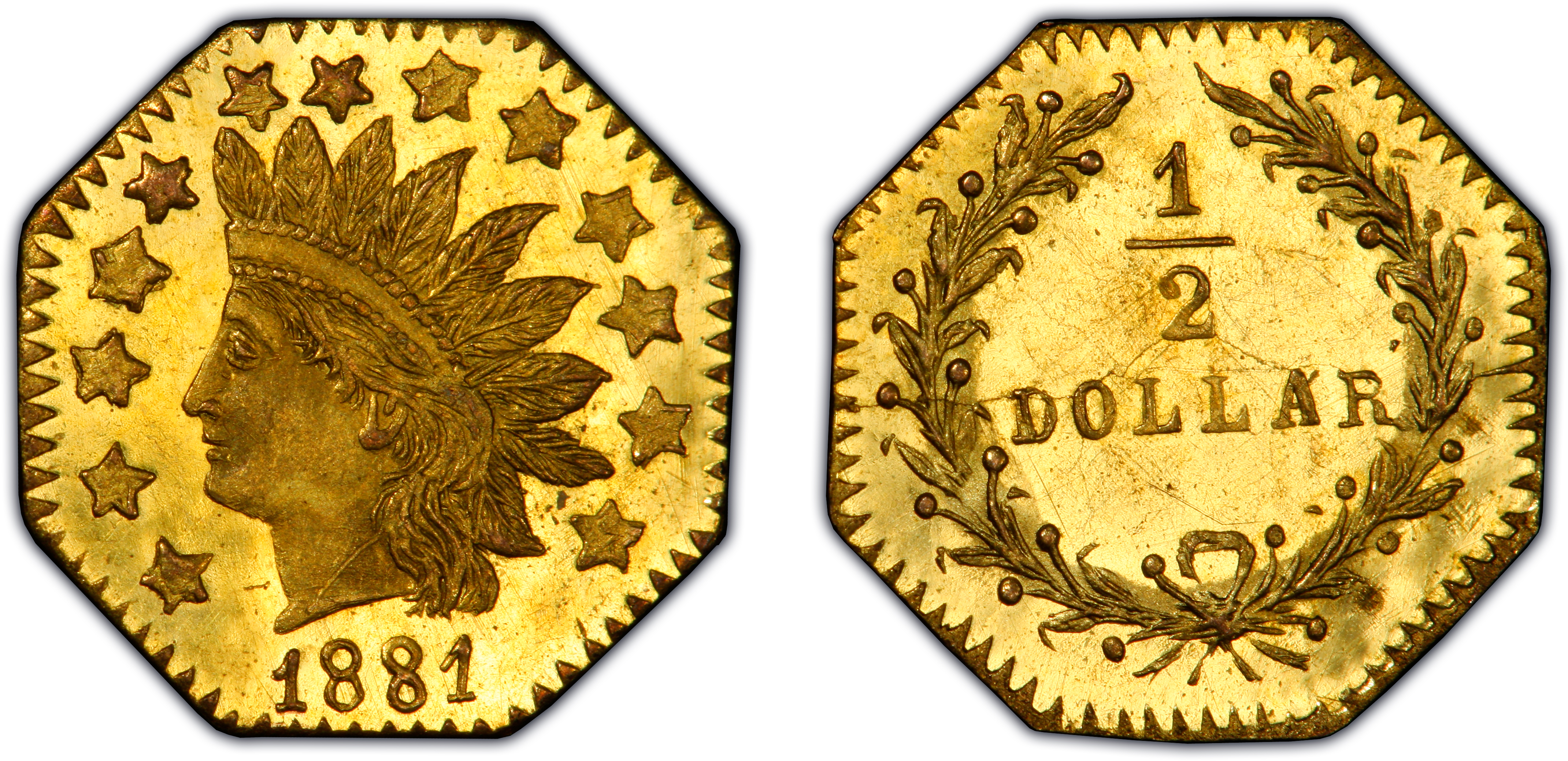
Obverse & Reverse
The 1881 G50C BG-956 is a product of the second great period of California fractional gold production, long after the initial chaos of the Gold Rush had subsided. The first period, from 1852 to roughly 1857, saw these small gold coins struck out of genuine commercial necessity to alleviate a severe shortage of small change. However, by the time the San Francisco Mint was operating at full capacity, this need vanished. The fractional gold coins produced from 1858 to 1882, classified as 'Period Two' issues, served a different purpose. They were primarily created as souvenirs, keepsakes, and jewelry items for a burgeoning tourist trade and for locals nostalgic for the heady days of '49. Although the Coinage Act of 1864 explicitly outlawed private coinage, enforcement was lax in the far West. Jewelers and private minters continued to produce these denominated tokens, often undeterred, until the Secret Service finally cracked down in 1883. The BG-956 is a quintessential example of this later period. Struck in 1881, it was made in a California far more settled than that of the Gold Rush pioneers. San Francisco was a major American city, and the romanticism of its recent past was a marketable commodity. These tiny gold pieces, often underweight and of varying fineness, were not intended for widespread circulation in the same way a federal dime or quarter was. Instead, they were mementos of the 'Golden State.' The dies for many of these late-date fractionals were produced by local engravers and manufacturers, with Robert B. Gray & Co. being a prominent name associated with many Period Two issues. The quality and artistry could vary, but the Indian Head motif, as seen on BG-956, was a popular and recurring theme, echoing contemporary federal coinage designs and invoking a uniquely American identity.
Associated EventCalifornia Gold Rush Souvenir Period
Reason For MintingPrimarily struck as souvenirs and jewelry items for the tourist trade, not for general circulation, during a period of lax enforcement of private coinage laws.
Minter HistoryRobert B. Gray & Co. was a San Francisco-based manufacturing jeweler and engraver active in the latter half of the 19th century. While not a 'private mint' in the territorial sense of assayers like Moffat & Co., Gray's firm was a significant producer of dies and planchets for, and likely a striker of, many Period Two California fractional gold pieces. Their work is characterized by the 'jeweler's issue' style—often featuring designs inspired by federal coinage but adapted for the souvenir market. The precise history is somewhat obscure, as these operations were technically illegal and not well-documented.
Historical SignificanceThe BG-956 represents the final phase of private gold coinage in California, a tradition born of necessity that evolved into a commercial enterprise catering to tourism and nostalgia. It is a tangible link to the romanticized memory of the Gold Rush, produced just before federal authorities permanently ended the practice. These Period Two issues are a distinct and fascinating chapter in American numismatics, illustrating a transition from functional pioneer money to collectible memorabilia.
N/A
Denomination50 Cents
Minting Period1881
Assayer/MinterRobert B. Gray & Co. (Attributed)
Geographic OriginSan Francisco, California
Obverse DescriptionAn Indian Head portrait facing left, with a feathered headdress. The portrait is surrounded by 13 six-pointed stars.
Obverse Inscription[None]
Reverse DescriptionThe denomination '1/2' is centered within a wreath of leaves and berries. The date '1881' is positioned below the wreath, and the inscription 'CALIFORNIA GOLD' encircles the upper portion of the wreath.
Reverse InscriptionCALIFORNIA GOLD 1/2 1881
CompositionGold
Stated Fineness Actual FinenessVaries, typical for Period Two issues to be of lower fineness than stated or implied value.
Weight0.24 grams
Diameter10.00 mm
EdgePlain
Unknown
Survival Estimate76-150 (Estimated)
Rarity ScaleR-4+
This coin is popular due to its classic Indian Head design, octagonal shape, and status as a late-date, denominated fractional gold piece. It offers collectors a relatively accessible entry point into the fascinating world of California 'souvenir' gold struck just before the federal crackdown.
Key VarietiesThe primary variety is the regular business strike. Breen-Gillio also lists a Prooflike (PL) striking for this variety, designated as BG-956 PL, which is considerably scarcer and sought after for its reflective surfaces. No known contemporary restrikes or patterns exist, though the entire Period Two series is distinct from the earlier, circulating Period One issues.
Authentication TipsGenuine pieces will have a denomination ('1/2') and the words 'CALIFORNIA GOLD.' Fakes and modern replicas are extremely common. Many forgeries feature a bear on the reverse, a design element never used on genuine 19th-century issues. Authentic pieces, especially from this period, may exhibit a slightly crude, shallow strike or have unstruck areas due to the thinness of the planchets. Replicas are often perfectly struck and have a soapy, unnatural luster. All suspected pieces should be authenticated by a major third-party grading service.
Shopping ConsiderationsA premium quality example for this issue will exhibit a sharp strike, particularly on the details of the headdress feathers and the numbers in the date. Look for original, undisturbed surfaces with a gentle, mellow luster. Many of these tiny coins were cleaned, bent, or used in jewelry, so evidence of tooling, harsh cleaning (hairlines), or solder marks should be avoided. Prooflike (PL) designated examples carry a significant premium and should display clear reflectivity in the fields. Given the high frequency of counterfeits, purchasing certified examples from reputable dealers is strongly advised.
A coin's grade is its condition, rated on a 1-70 scale. For rare coins, this is the most critical factor in determining value, as a tiny difference in preservation can mean a huge difference in price.
Relevant Grade TypesOriginal issues were business strikes produced for souvenir and jewelry purposes, not active circulation. They are found in both Circulated (1-58, though uncommon as they saw little use) and Mint State (MS, 60-70) grades. No true Proofs were struck during the original period of issue. However, some pieces were struck with polished dies on polished planchets, resulting in a Prooflike (PL) surface, which is a separate designation from a true Proof (PR/PF) striking and is noted on the grading label.
Mint State CharacteristicsUncirculated examples of BG-956 are characterized by a soft, satiny luster. The strike is often somewhat weak in the center, particularly on the high points of the Indian's hair and the wreath on the reverse. Bag marks are common, but due to their small size, they are often minuscule. A truly choice Mint State piece will have minimal marks, a strong strike for the issue, and pleasing original color.
Circulated Wear PatternsAlthough not intended for heavy circulation, wear on circulated examples first appears on the high points of the Indian's cheek and the feathers of the headdress. On the reverse, the bow of the wreath and the fraction '1/2' will show the first signs of flattening. In lower grades, the stars and legends will become soft and merge towards the rim.
Key Factors For ValueSurface preservation is paramount; an example with original, uncleaned surfaces and attractive luster will command a strong premium. Strike quality is a key differentiator, with sharply struck pieces being highly desirable. Eye appeal, including attractive original gold toning, significantly impacts value. Prooflike (PL) examples are rare and trade for multiples of their non-PL counterparts. A CAC sticker, indicating premium quality for the grade, is highly valued by collectors and adds a substantial premium for this issue.
PCGS Price Guide
| Grade | Price | Population |
|---|---|---|
| 55 | $250.00 | 1 |
| 55+ | $275.00 | N/A |
| 58 | $300.00 | 1 |
| 58+ | $325.00 | N/A |
| 60 | $350.00 | 2 |
| 61 | $375.00 | N/A |
| 62 | $400.00 | 8 |
| 62+ | $440.00 | N/A |
| 63 | $520.00 | 13 |
| 63+ | $565.00 | N/A |
| 64 | $650.00 | 30 |
| 64+ | $725.00 | N/A |
| 65 | $875.00 | 6 |
| 65+ | $1,100.00 | N/A |
| 66 | $1,500.00 | 1 |
| 67 | N/A | N/A |