1871 G25C BG-857 (Regular Strike)
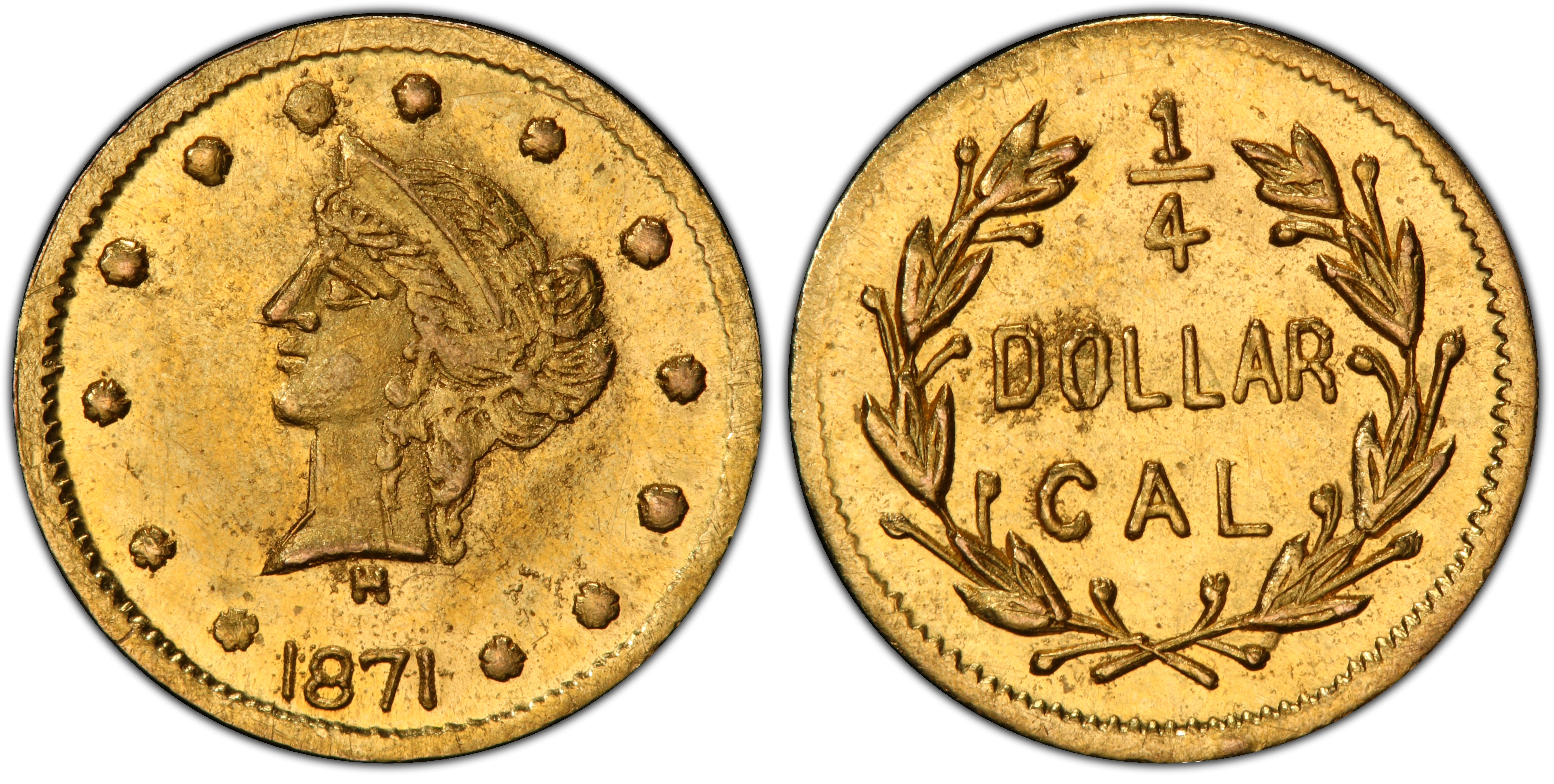
Obverse & Reverse
The 1871 BG-857 25-cent piece represents a fascinating and legally fraught chapter in the history of U.S. private coinage. By the 1870s, the initial chaos of the California Gold Rush had subsided, but the need for small-denomination coinage persisted, particularly in the West. The Coinage Act of 1864 had explicitly forbidden the private issuance of any coins, a direct response to the flood of lightweight and debased private tokens that emerged during the Civil War. Despite this federal prohibition, various jewelers and entrepreneurs continued to strike minuscule gold 'charms' or 'tokens,' often resembling official coinage, to satisfy a commercial and souvenir demand. Reuben N. Hershfield and Noah Mitchell, jewelers operating far from the gold fields in Leavenworth, Kansas, entered this market in 1871. Their plan was to produce fractional gold pieces for distribution in the coinage-starved markets of California. Their operation was distinguished by the small 'H' initial for Hershfield placed discreetly below the bust of Liberty. However, their enterprise was short-lived. In August 1871, U.S. Secret Service agents, tasked with enforcing the 1864 Act, raided their facility, seizing their production and arresting the partners. This abrupt end to their minting activities makes the BG-857 a one-year type issue and infuses it with a dramatic backstory of defiance against federal law. The coins are technically not 'territorials' in the traditional sense, as they were not a product of a pre-statehood region lacking federal mint services, but rather a clandestine issue produced in direct violation of established law, making them numismatically significant as among the last of the classic privately issued gold coin series.
Associated EventPost-Civil War Economic Expansion and Enforcement of Federal Coinage Laws
Reason For MintingTo profit from the continuing shortage of small change in California by creating privately-issued gold coins, despite federal prohibition.
Minter HistoryReuben N. Hershfield and Noah Mitchell were jewelers based in Leavenworth, Kansas. They embarked on the enterprise of striking California Fractional Gold pieces in 1871, likely seeing a commercial opportunity to supply the West Coast. Their coins are identifiable by the 'H' initial on the obverse. Their operation came to a dramatic halt in August 1871 when it was shut down by the U.S. Secret Service for violating the Private Coinage Law of 1864, making their numismatic output scarce and historically notable.
Historical SignificanceThe BG-857 is significant as a product of one of the few private minting operations shut down by the Secret Service for violating the Coinage Act of 1864. Its story highlights the federal government's increasing efforts to centralize and control the nation's currency in the late 19th century and represents one of the final gasps of the private minting tradition that began during the earlier gold rushes.
N/A
Denomination25 Cents (Quarter Dollar)
Minting Period1871
Assayer/MinterReuben N. Hershfield and Noah Mitchell
Geographic OriginLeavenworth, Kansas
Obverse DescriptionA beaded border encircles a left-facing portrait of a female head, intended to be Liberty, with hair tied in a bun. Thirteen stars surround the portrait. The initial 'H' for Hershfield is located below the truncation of the neck, and the date 1871 is below that.
Obverse Inscription1871
Reverse DescriptionA beaded border contains the denomination '1/4' and 'DOLLAR' within a wreath of two olive branches tied with a ribbon at the bottom. The mintmark, if any, is not present; instead, the inscription 'CALIFORNIA GOLD' appears above the wreath.
Reverse InscriptionCALIFORNIA GOLD 1/4 DOLLAR
CompositionGold
Stated Fineness Actual FinenessVaries, but generally around .500 fine or slightly higher.
Weight0.25 grams
Diameter9.70 mm
EdgePlain
Unknown
Survival Estimate76-100
Rarity ScaleHigh R-4
The BG-857 is highly prized for its unique story involving the Secret Service raid, its status as a one-year type, and the identifiable 'H' initial of its illicit minter. This backstory adds a layer of intrigue beyond its connection to California's gold history.
Key VarietiesThere are no major varieties of the BG-857 regular strike from 1871. However, collectors should be aware of a single known Proof striking (designated BG-857P) which is exceptionally rare. This piece was likely a presentation piece or a die trial and is considered a great numismatic prize. No other special collector issues like later-date restrikes are known to exist.
Authentication TipsGenuine examples exhibit a sharp, well-defined strike for the type. The 'H' initial below the bust should be clear and properly formed. Check for filled or tooling marks around the initial, as this is a key diagnostic. Counterfeits are common; they often have a soapy, indistinct appearance, incorrect weight, or a brassy color. The beading around the rim on genuine pieces is typically uniform and crisp, while fakes may show irregular or weak beads.
Shopping ConsiderationsA premium quality BG-857 will exhibit sharp details on Liberty's hair and the leaves of the reverse wreath. Seek out examples with minimal contact marks and original, undisturbed luster. The color should be a consistent, rich gold; pieces that appear to have been cleaned or polished will have a 'washed-out' or unnaturally bright look and should be valued lower. Weakness in the strike is common, especially on the stars and the word 'DOLLAR', so a well-struck example commands a significant premium. Pay close attention to the fields for signs of scratches, tooling, or repairs.
A coin's grade is its condition, rated on a 1-70 scale. For rare coins, this is the most critical factor in determining value, as a tiny difference in preservation can mean a huge difference in price.
Relevant Grade TypesOriginal period issues of BG-857 were business strikes intended for circulation, although their illicit nature meant their time in commerce was brief. They are found in Circulated (1-58) and Mint State (MS, 60-70) grades. No Proofs were struck for circulation during the original period. A single special Proof striking is known to exist and is a separate, unique numismatic item, not to be confused with the business strikes.
Mint State CharacteristicsAn uncirculated BG-857 typically displays a vibrant, satiny luster. The strike can be variable, but high-quality examples will show strong definition in the strands of Liberty's hair and the wreath leaves. Due to the small size and minting process, even Mint State examples may show minor planchet imperfections or a slight softness in peripheral details. Contact marks are common but should not be overly distracting.
Circulated Wear PatternsWear first appears on the highest points of the design: the hair above Liberty's eye and ear, and her cheekbone. On the reverse, the bow of the wreath and the letters in 'DOLLAR' will show the first signs of friction. In lower grades (VF and below), the date and the 'H' initial will begin to lose their sharpness and may merge with the fields.
Key Factors For ValueThe primary value drivers for an 1871 BG-857 are grade and surface quality. An example with original, uncleaned surfaces and strong luster will always be more valuable than a cleaned one of the same grade. Strike quality is crucial; a sharply struck coin showing full details is highly desirable. Eye appeal, encompassing attractive natural toning and a lack of distracting marks, plays a major role. A certification from a top-tier grading service (PCGS or NGC) is standard, and a CAC sticker for this issue indicates premium quality for the grade and will add a significant price premium.
PCGS Price Guide
| Grade | Price | Population |
|---|---|---|
| 50 | $250.00 | 1 |
| 50+ | $252.00 | N/A |
| 53 | $255.00 | N/A |
| 53+ | $260.00 | N/A |
| 55 | $265.00 | 1 |
| 55+ | $270.00 | N/A |
| 58 | $275.00 | 2 |
| 58+ | $300.00 | N/A |
| 60 | $325.00 | 2 |
| 61 | $380.00 | 7 |
| 62 | $425.00 | 12 |
| 62+ | $475.00 | N/A |
| 63 | $550.00 | 27 |
| 63+ | $625.00 | N/A |
| 64 | $1,000.00 | 10 |
| 64+ | $1,200.00 | N/A |
| 65 | $1,650.00 | N/A |