1876 G25C BG-880, PL (Regular Strike)
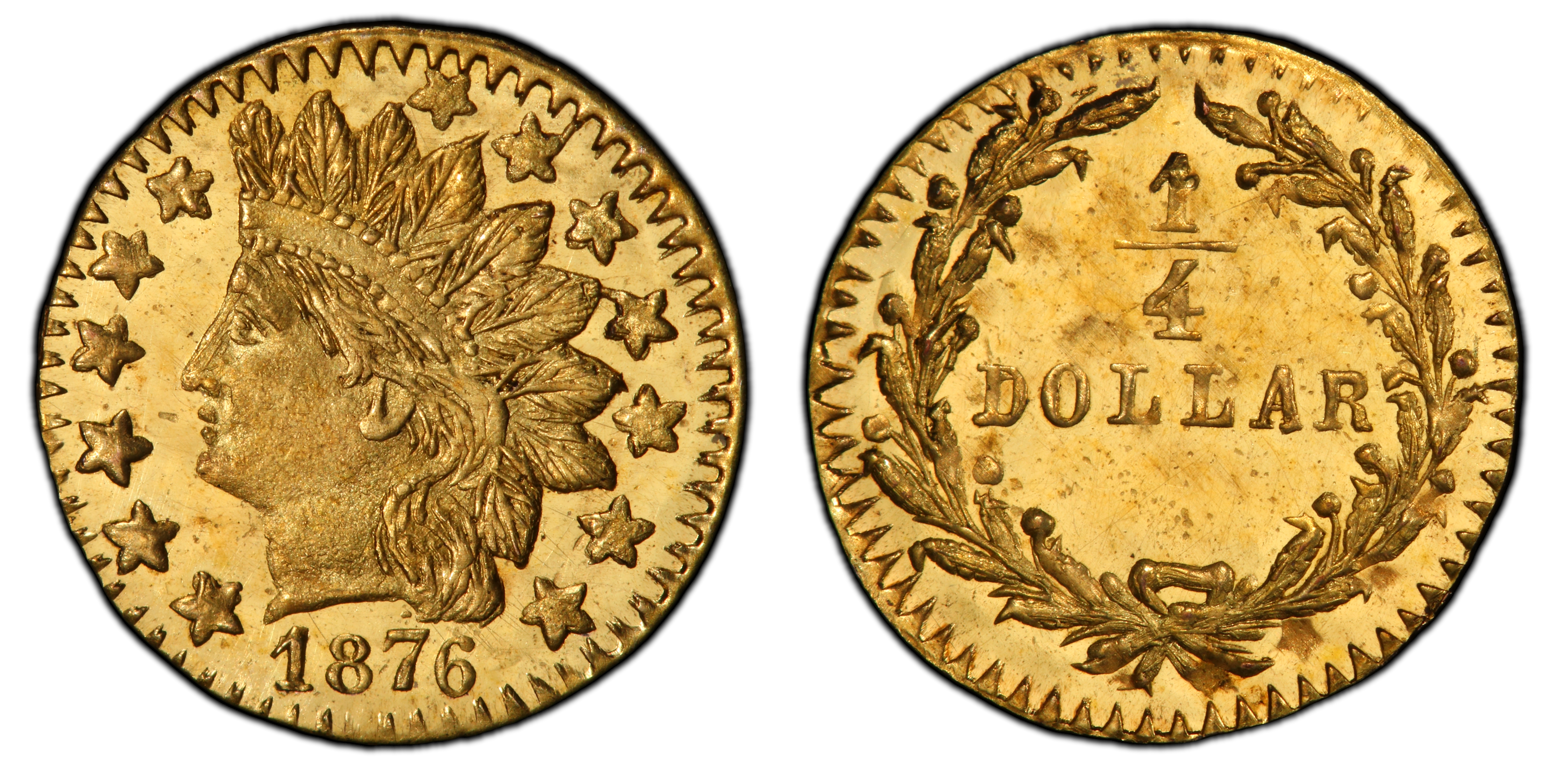
Obverse & Reverse
The 1876 BG-880 25 Cents represents a fascinating and complex chapter in American numismatics, born from the lingering economic realities of the California Gold Rush. By the mid-1870s, the initial frenzy had subsided, but California's economy remained distinct. Gold dust was no longer the primary medium of exchange, yet a severe, chronic shortage of small-denomination federal coinage persisted on the West Coast. This scarcity made everyday transactions incredibly difficult. The smallest circulating U.S. coin was often the silver dime, which was a significant sum for minor purchases. This void created a market for privately manufactured small-denomination coins, which had been produced since the early 1850s. However, the legal landscape had shifted dramatically. The Coinage Act of April 22, 1864, explicitly forbade the private issuance of any coin intended to pass as money. To circumvent this, manufacturers began producing what are now known as 'Period Three' California Fractional Gold pieces (1872-1882). These pieces were technically tokens or charms, ingeniously designed to satisfy the demand for small change without explicitly violating federal law. They often omitted the word 'DOLLAR' or 'CENTS' (using 'C' or 'CTS' instead) and sometimes bore designs, like the Indian Head on BG-880, that were popular but distinct from federal issues. The BG-880 was struck in 1876, the year of the nation's Centennial, a time of great patriotic fervor, which may have influenced the classic American design choices. These pieces were sold as souvenirs and keepsakes but were undoubtedly used as de facto currency in local commerce, accepted by merchants and the public out of sheer necessity. Their tiny size made them easy to lose, contributing to their present-day rarity. Their production represents a clever adaptation to economic need in the face of legal restriction, a final echo of the private minting spirit that defined the Gold Rush era.
Associated EventPost-Gold Rush Economic Period & U.S. Coinage Shortage
Reason For MintingTo serve as a substitute for scarce small-denomination federal coinage in daily commerce, while technically being produced as a souvenir or charm to bypass federal laws against private coinage.
Minter HistoryThe specific minter of BG-880 is unconfirmed, as was common for Period Three manufacturers seeking to avoid legal trouble. However, numismatic research, primarily by Robert D. Leonard, Jr., points towards jewelers and manufacturers like Herman J. Brand of San Francisco. These producers were not large-scale assayers like their Gold Rush-era predecessors but rather skilled craftsmen who saw a commercial opportunity in the public's demand for small change. They operated in a legal gray area, producing these pieces for sale to merchants and the public, who would then press them into service for transactions.
Historical SignificanceThe BG-880 is significant as an artifact of the persistent economic uniqueness of the American West long after the initial Gold Rush. It represents the final phase of private gold 'coinage' in the United States, showcasing the ingenuity of manufacturers in creating a product that filled a crucial monetary gap while navigating a restrictive legal environment. It is a tangible link to the everyday commercial life of 1870s California.
N/A
Denomination25 Cents (Quarter Dollar)
Minting Period1876
Assayer/MinterUnknown Private Minter, possibly Herman J. Brand
Geographic OriginSan Francisco, California
Obverse DescriptionA stylized head of Liberty facing left, adorned with a feathered headdress. Thirteen stars encircle the portrait along the rim.
Obverse Inscription(No inscriptions, only stars and portrait)
Reverse DescriptionThe denomination '1/4' is centered within an ornate wreath of leaves and berries. The date '1876' is positioned below the wreath, and the inscription 'CALIFORNIA GOLD' appears above it along the upper rim.
Reverse InscriptionCALIFORNIA GOLD 1/4 1876
CompositionGold
Stated Fineness Actual FinenessGenerally ranges from .500 to .900 fine, often inconsistent.
Weight0.25 grams
Diameter9.70 mm
EdgePlain
5,000 - 10,000
Survival Estimate200-300
Rarity ScaleR-5
BG-880 is highly popular with collectors due to its classic Indian Head design, association with the U.S. Centennial year, and its status as a relatively common and accessible entry point into the complex series of California Fractional Gold. Its historical narrative as a 'coin of necessity' adds to its allure.
Key VarietiesThe primary designation for this coin is BG-880 (Breen-Gillio 880). Within this catalog number, numismatists look for minor die state variations. No major varieties, patterns, or official restrikes are known to exist for this specific issue. All known examples are considered 'regular strikes' produced for commercial purposes during the period. The 'PL' designation refers to 'Prooflike' surfaces, which are not a separate striking but rather a characteristic of early strikes from fresh, polished dies, and they command a premium.
Authentication TipsGenuine BG-880 pieces exhibit a sharp, if sometimes uneven, strike from high-pressure steam presses. The details of the feathers and the wreath should be clear. Counterfeits are common and often fall into two categories: contemporary fakes made of brass, and modern copies. Look for a 'mushy' or soft appearance in the details, incorrect weight, and a brassy or unnatural color. Diagnostics for the BG-880 die pair include the specific positioning of the date relative to the wreath and the stars relative to the portrait. Genuine pieces often have a slightly irregular, non-circular shape due to the striking process.
Shopping ConsiderationsA premium quality example for its grade will possess sharp details, especially on the high points of the headdress feathers and the bow of the wreath. Seek out coins with bright, original luster and minimal distracting marks. Prooflike (PL) examples, with mirrored fields and frosted devices, are especially desirable and command a significant premium. Avoid coins that have been harshly cleaned, which strips the original surface and imparts a dull, lifeless appearance. Also, be wary of pieces that have been used as jewelry, looking for evidence of soldering, rim damage, or polishing. A CAC sticker on a certified coin provides an additional layer of confidence regarding its quality for the grade.
A coin's grade is its condition, rated on a 1-70 scale. For rare coins, this is the most critical factor in determining value, as a tiny difference in preservation can mean a huge difference in price.
Relevant Grade TypesAll original 1876 BG-880 pieces were business strikes intended for circulation, though many were saved as souvenirs. They are found in Circulated grades (AG-3 to AU-58) and Mint State grades (MS-60 to MS-70). No true Proofs were struck during the original period of issue. The 'PL' (Prooflike) designation is applied to exceptional business strikes from polished dies that mimic the appearance of a Proof, but they are not a separate issue and are graded on the standard MS scale.
Mint State CharacteristicsAn uncirculated BG-880 will exhibit full, unbroken mint luster, often with a vibrant, satiny texture. The strike can be inconsistent; many examples show some softness on the highest points of the feathers or the center of the wreath. A superior MS coin will have a strong, even strike. Due to their small size and handling in bulk, even uncirculated examples typically show tiny contact marks or 'chatter'. Coins with exceptionally clean surfaces and strong luster are rare and highly valued. Prooflike examples will have reflective, mirror-like fields.
Circulated Wear PatternsWear first appears on the highest points of the design. On the obverse, check the cheek of the Indian and the tips of the feathers in the headdress. On the reverse, the bow of the wreath and the highest leaves are the first areas to show flatness and loss of detail. On lower grade examples (VF and below), the individual feathers will begin to merge, and the fine details of the wreath will become indistinct.
Key Factors For ValueThe primary drivers of value are grade and surface quality. An uncirculated coin is worth many times more than a circulated one. Beyond the numerical grade, 'eye appeal' is paramount. Coins with original, lustrous surfaces and a pleasing reddish-gold toning are prized over dull or cleaned examples. Strike sharpness is critical; a well-struck coin with full details will always command a premium over a weakly struck coin of the same grade. The presence of a CAC sticker indicates a premium quality coin for the assigned grade and can add significantly to its value.
PCGS Price Guide
| Grade | Price | Population |
|---|---|---|
| 64 | $1,250.00 | 1 |
| 64+ | $1,500.00 | N/A |
| 65 | $3,250.00 | 1 |