1870 G25C BG-833 (Regular Strike)
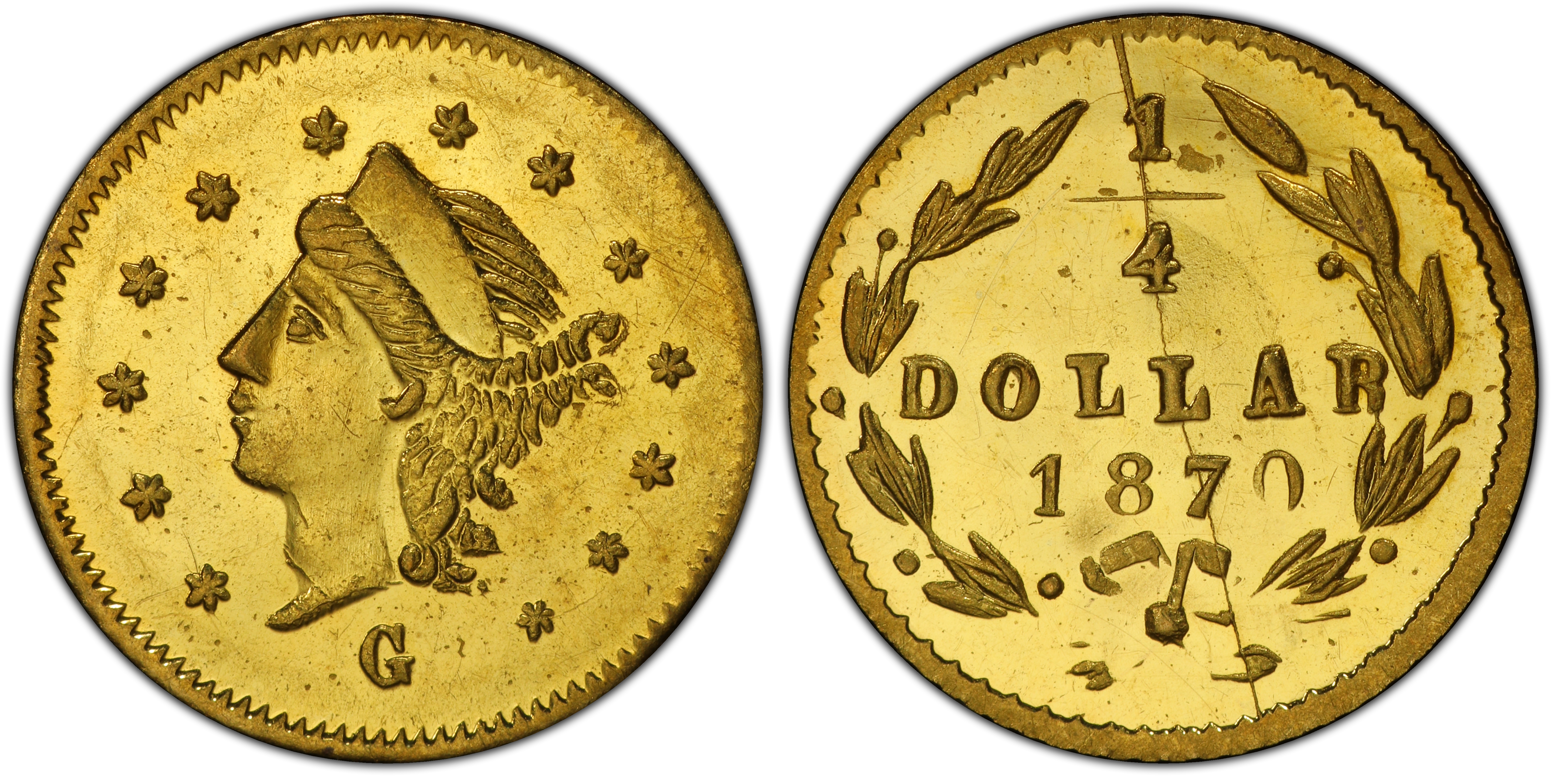
Obverse & Reverse
The 1870 G25C BG-833 is a product of the second period of California Fractional Gold production (1858-1882). Following the initial Gold Rush boom, the acute shortage of small change had somewhat lessened, and the purpose of these diminutive gold pieces began to shift. While the earliest issues of 1852-1856 were struck to genuinely facilitate commerce in a region starved for federal coinage, later pieces increasingly served as souvenirs and keepsakes. The Coinage Act of 1864 explicitly outlawed private coinage, rendering the continued production of denominated fractional gold illegal. However, enforcement in distant California was lax, and production continued unabated for nearly two more decades. Many minters, possibly to feign legitimacy or avoid scrutiny, began backdating their issues to pre-1864 years. The 1870 date on the BG-833 places it firmly within this legally ambiguous but numismatically prolific era. These pieces were not intended to contain their full face value in gold; they were essentially tokens whose acceptance relied on convenience and local custom. The 'G' mintmark below Liberty's bust remains unattributed, a common mystery in a series characterized by secretive and competitive private minters. Struck in San Francisco, the commercial heart of the West, these tiny coins would have been sold by jewelers and merchants to locals and tourists alike, a tangible, affordable piece of the romanticized Gold Rush legend. Their small size and low intrinsic value meant many were lost or spent, contributing to their high rarity today.
Associated EventPost-Gold Rush California Commerce
Reason For MintingPrimarily served as popular, easily transportable souvenirs and gift items during an era of weak enforcement of private coinage laws.
Minter HistoryThe identity of the minter who used the initial 'G' on the obverse is unknown. This is a common characteristic of the California Fractional Gold series, where many small-scale jewelers and metalworkers struck coins without leaving detailed records of their operations. The style of the lettering and design elements are the primary clues used by numismatists to attribute pieces to potential, but often unconfirmed, makers.
Historical SignificanceThe BG-833 is significant as a representative of 'Period Two' California Fractional Gold, an era defined by the transition from utilitarian necessity to souvenir production in defiance of federal law. It encapsulates the persistent entrepreneurial spirit of California and the lasting allure of gold, even in token form, long after the initial rush had subsided. Its rarity and the mystery of its minter make it a fascinating artifact of a unique chapter in American monetary history.
BG-833
Denomination25 Cents
Minting Period1870
Assayer/MinterUnknown Minter 'G'
Geographic OriginSan Francisco, California
Obverse DescriptionA left-facing bust of Liberty, her hair tied in a bun. She is encircled by 13 six-pointed stars, with a prominent initial 'G' below the truncation of the neck.
Obverse InscriptionG
Reverse DescriptionA simple wreath composed of two branches tied with a bow at the bottom. Within the wreath, the denomination '1/4' is at the top, 'DOLLAR' is in the center, and the date '1870' is below.
Reverse Inscription1/4 DOLLAR 1870
CompositionGold
Stated Fineness Actual FinenessVariable, typically 14-22 carats but substantially less than face value.
Weight0.38 grams
Diameter9.70 mm
EdgePlain
Unknown
Survival Estimate25-30
Rarity ScaleR-6-
This variety is highly sought after due to its high rarity (R-6-), classic Liberty Head design, and the mystery of its unattributed 'G' mintmark. As a dated 'Period Two' issue, it represents a key part of the California Fractional Gold story, appealing to specialists in the series and collectors of U.S. territorial coinage.
Key VarietiesThe primary variety is the regular business strike. However, collectors should pay close attention to die states. A prominent late die state, known as Die State III, is distinguished by a heavy, bisecting die crack across the obverse. Examples showing this dramatic die crack are highly prized and often command a premium. No proof or special collector strikings from the period of issue are known to exist.
Authentication TipsAuthenticity should be verified by comparing the coin's details to high-resolution images of certified examples. Pay special attention to the font and positioning of the 'G' on the obverse and the numerals in the date. The stars should be sharp and well-formed, though overall strike weakness is common. Counterfeits often have incorrect details, a soapy or cast appearance, and may be made of brass or have incorrect weight and dimensions.
Shopping ConsiderationsA premium quality example for its grade will exhibit a sharp strike, particularly on Liberty's hair and the details of the wreath. Look for coins with clean, lustrous surfaces and minimal distracting marks. Original, undisturbed 'skin' with a hint of reddish-gold toning is highly desirable. Avoid coins that have been harshly cleaned, show evidence of being used in jewelry (solder marks, excessive rim damage), or have been tooled to hide imperfections. Due to their small size, even minor flaws can be magnified, so careful inspection is critical. The presence of the late-state bisecting die crack can be seen as a desirable feature rather than a flaw.
A coin's grade is its condition, rated on a 1-70 scale. For rare coins, this is the most critical factor in determining value, as a tiny difference in preservation can mean a huge difference in price.
Relevant Grade TypesOriginal period issues of BG-833 were business strikes intended for commerce or sale as souvenirs, and are found in Circulated (1-58) and Mint State (MS, 60-70) grades. No Proofs (PR/PF) were struck during the original period of issue, and there are no known later-date collector restrikes for this specific variety.
Mint State CharacteristicsUncirculated examples of BG-833 often show a soft, satiny luster with a distinct lemon-gold or slightly reddish-gold hue. The strike can be uneven; it is common to see weakness on some of the stars or parts of the wreath opposite the high points of the obverse. Due to the primitive, often sledgehammer-striking process, perfectly centered and sharply struck specimens are rare and command significant premiums. Planchet quality can be irregular, and small, as-made flaws are sometimes present.
Circulated Wear PatternsWear first appears on the highest points of the design. On the obverse, this includes Liberty's cheek, the hair above her ear, and her eyebrow. On the reverse, the high points of the wreath's leaves and the bow at the bottom will show the first signs of friction. In lower grades (VF and below), the finer details of the hair and wreath will become indistinct, and the legends will begin to soften.
Key Factors For ValueFor the BG-833, value is driven by several key factors. Rarity is paramount, as few exist in any grade. The certified grade is the next most important factor. Within a specific grade, surface quality is critical; an example with original, uncleaned surfaces will always be worth more than a cleaned or polished one. Strike sharpness is a major determinant of eye appeal and value. Finally, coins with attractive original toning and a CAC sticker, indicating premium quality for the grade, will realize the highest prices.
PCGS Price Guide
| Grade | Price | Population |
|---|---|---|
| 50 | $275.00 | 2 |
| 50+ | $275.00 | N/A |
| 53 | $285.00 | 2 |
| 53+ | $285.00 | N/A |
| 55 | $300.00 | 5 |
| 55+ | $315.00 | N/A |
| 58 | $350.00 | 6 |
| 58+ | $375.00 | N/A |
| 60 | $450.00 | N/A |
| 61 | $600.00 | 4 |
| 62 | $800.00 | 3 |
| 62+ | $1,000.00 | N/A |
| 63 | $1,850.00 | 5 |
| 63+ | $2,100.00 | N/A |
| 64 | $2,500.00 | 1 |