1853 G25C BG-219 (Regular Strike)
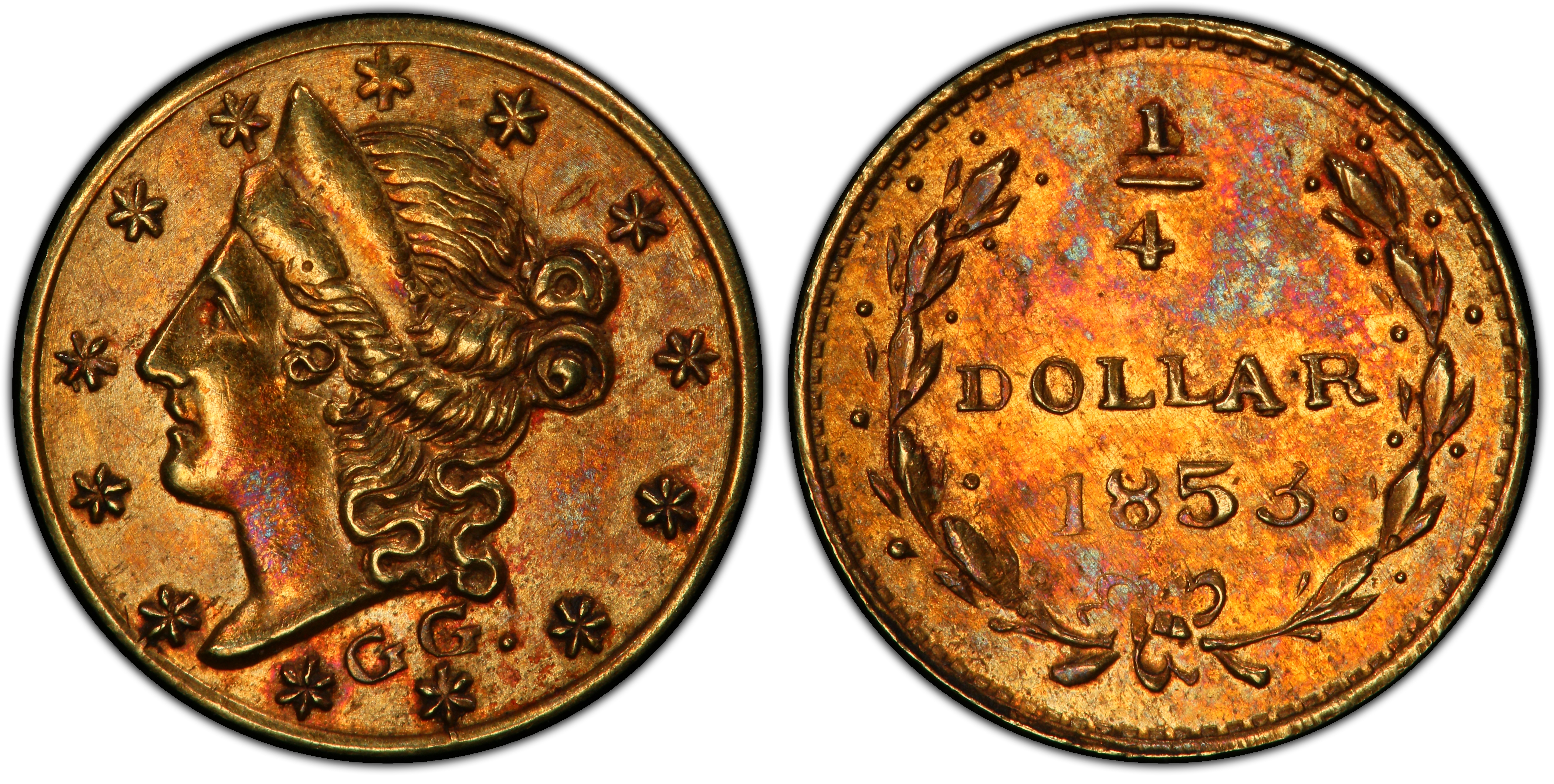
Obverse & Reverse
The 1853 BG-219 25 Cents is a quintessential artifact of the California Gold Rush, a period of dramatic economic upheaval and monetary scarcity. Following the discovery of gold at Sutter's Mill in 1848, a massive influx of prospectors and merchants flooded into California, creating a vibrant but chaotic economy. While vast quantities of gold dust and nuggets circulated, there was a crippling shortage of small-denomination coinage for daily transactions. A shave, a drink, or a loaf of bread was difficult to purchase when the smallest circulating coins were often worn Spanish silver or the recently introduced, but still scarce, federal silver coins. Gold dust, the primary medium of exchange, was imprecise, subject to spillage and fraud, and inconvenient for minor purchases. The U.S. government was slow to respond; the San Francisco Mint would not open until 1854, and initially, it was only authorized to produce larger denominations. This monetary vacuum created a fertile ground for private enterprise. Jewelers, assayers, and metallurgists in San Francisco began striking their own small-denomination coins in 1852 to meet the overwhelming public demand. These 'California Fractional Gold' pieces were not legal tender but were widely accepted in trade due to their convenience and the intrinsic value of their gold content. The BG-219 is classified as a 'Period One' (1852-1857) issue, a time when minters generally attempted to produce coins with a gold value reasonably close to their face value to ensure public trust and circulation. These early issues, often simple in design and crudely struck on primitive presses, are considered the most historically significant as they genuinely served as circulating currency in the Gold Rush boomtowns. The anonymous minter of BG-219, like many of his contemporaries, likely operated a small, back-room operation, producing these tiny coins until the establishment of the federal mint and the increasing supply of official coinage rendered them obsolete. The fact that many Period One specimens are found in worn, circulated condition provides tangible proof of their vital role in the commerce of Gold Rush California.
Associated EventCalifornia Gold Rush
Reason For MintingTo alleviate a severe shortage of small-denomination coinage for everyday commercial transactions in Gold Rush-era California.
Minter HistoryThe specific minter or jeweler who produced the BG-219 variety has been lost to history. During 'Period One' of California Fractional Gold production (1852-1857), many pieces were struck anonymously to avoid potential legal repercussions and to focus on utility rather than brand recognition. Research by experts like Walter Breen and Ronald Gillio has identified some makers of other varieties, but many, including the producer of BG-219, remain unattributed, their identities likely recorded only in forgotten ledgers or directories of mid-19th century San Francisco.
Historical SignificanceThe BG-219 is a tangible link to the chaotic, commerce-starved economy of the California Gold Rush. It represents a grassroots, private-sector solution to a government failure in supplying adequate currency for a rapidly growing population. As a 'Period One' issue, it is considered a genuine circulating coin of the era, not a souvenir, making it a historically important and highly sought-after numismatic artifact.
N/A
Denomination25 Cents (Quarter Dollar)
Minting Period1853
Assayer/MinterUnknown Private Minter
Geographic OriginSan Francisco, California
Obverse DescriptionA simple, somewhat crudely rendered head of Liberty facing left, modeled after the contemporary federal gold dollar designed by James B. Longacre. She wears a coronet, and her hair is tied in a bun. The portrait is surrounded by thirteen six-pointed stars, representing the original colonies.
Obverse Inscription Reverse DescriptionThe denomination '1/4 DOLLAR' is arranged in two lines within a simple wreath of two branches tied by a bow at the bottom. The date '1853' is positioned just below the bow.
Reverse Inscription1/4 DOLLAR 1853
CompositionGold
Stated Fineness Actual FinenessTypically around .800 to .900 fine, often containing a natural alloy of silver which imparts a lighter color.
Weight0.25 grams
Diameter10.00 mm
EdgePlain
Unknown
Survival Estimate50-75
Rarity ScaleR-5 (Very Scarce)
This coin is highly prized for its direct connection to the California Gold Rush, its status as a circulating 'Period One' issue, and its classic Liberty Head design. Its tiny size and historical importance make it a fascinating and desirable collectible.
Key VarietiesThe primary variety is the regular business strike BG-219. A key related variety is BG-219A, which is from the same obverse die but a different reverse die, identified by a larger date. No known patterns, trial pieces, or later-date restrikes exist for this specific variety.
Authentication TipsAuthentic BG-219 specimens often show a slightly crude, soft strike, characteristic of the primitive presses used. Look for die markers specific to the variety, such as the exact positioning of the stars and the shape of the numerals in the date. The surfaces should have the look of naturally alloyed Gold Rush gold, often with a slightly pale or greenish-gold hue due to silver content. Counterfeits are common; many are cast and will have a porous or soapy appearance with weak details. Others are modern strikes from fantasy dies that do not match the Breen-Gillio plates. Third-party certification from PCGS or NGC is highly recommended.
Shopping ConsiderationsA premium quality example for its grade will exhibit a sharp strike for the issue, particularly on Liberty's coronet and the wreath details. Original, uncleaned surfaces are paramount; many of these tiny coins have been harshly cleaned or used as jewelry, and such damage severely impacts value. Look for examples with minimal distracting contact marks and evidence of original mint luster in the protected areas. Eye appeal is critical; a coin with a pleasing, honest circulated appearance is far more desirable than a harshly cleaned, higher-grade piece. Avoid specimens that have been tooled, have rim damage, or show evidence of being previously mounted in jewelry.
A coin's grade is its condition, rated on a 1-70 scale. For rare coins, this is the most critical factor in determining value, as a tiny difference in preservation can mean a huge difference in price.
Relevant Grade TypesOriginal 1853 BG-219 issues were exclusively business strikes intended for circulation. Therefore, they are found in Circulated grades (AG-3 to AU-58) and, very rarely, in Mint State grades (MS-60 to MS-70). No Proof examples were struck during the original period of issue, and no later-date Proof restrikes of this variety are known to exist. Any piece described as a 'Proof' should be regarded with extreme skepticism and is likely a modern fantasy piece.
Mint State CharacteristicsUncirculated examples of BG-219 are exceptionally rare. A true Mint State specimen would exhibit full mint luster, which is typically soft and satiny rather than frosty. The strike is often somewhat weak in the centers, so a well-struck coin with full detail on Liberty's hair and the wreath is highly desirable. Due to the softness of the gold and primitive handling at the time of minting, even MS examples can be expected to have some light contact marks or planchet imperfections.
Circulated Wear PatternsWear first appears on the highest points of the design: Liberty's cheek, the hair above her eye, and the coronet. On the reverse, the high points of the wreath leaves and the bow will show the first signs of friction. On moderately circulated examples (VF-XF), the individual hair strands will be merged, and the finer details of the wreath will be smoothed. In lower grades, the stars, date, and lettering become progressively weaker and can merge with the fields.
Key Factors For ValueFor the BG-219, the primary value drivers are grade and surface preservation. An example with original, uncleaned 'skin' is worth a significant premium over a cleaned coin of the same grade. Strike quality is also critical; a sharply struck coin will command more than a weakly struck one. Eye appeal, encompassing toning (which can range from light yellow to deep reddish-gold), luster, and the absence of distracting marks, plays a major role. A sticker from CAC (Certified Acceptance Corporation) indicating a premium quality coin for the grade will add a substantial premium for this issue.
PCGS Price Guide
| Grade | Price | Population |
|---|---|---|
| 50 | $1,600.00 | 1 |
| 50+ | $1,850.00 | N/A |
| 53 | $3,000.00 | N/A |
| 53+ | $3,100.00 | N/A |
| 55 | $3,250.00 | 2 |
| 55+ | $3,350.00 | N/A |
| 58 | $3,500.00 | 2 |
| 58+ | $3,750.00 | N/A |
| 60 | $4,000.00 | N/A |
| 61 | $4,500.00 | 1 |
| 62 | $5,000.00 | 2 |