1872/1 G25C BG-790, PL (Regular Strike)
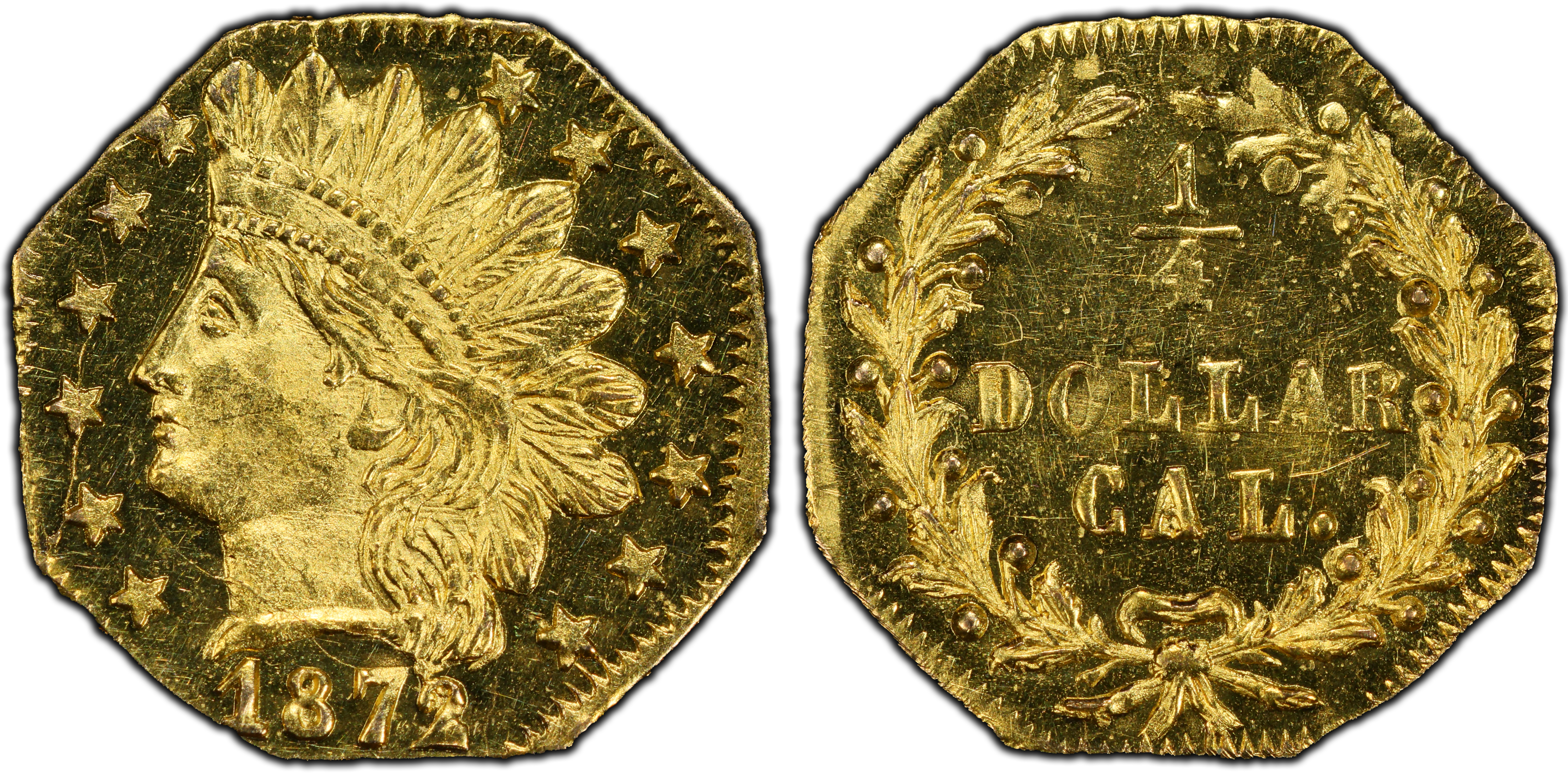
Obverse & Reverse
The 1872/1 G25C BG-790 is a quintessential example of a 'Period Two' California Fractional Gold piece. This era, spanning from 1859 to 1882, represents a significant shift from the initial, necessity-driven 'Period One' issues. By the 1870s, the acute shortage of small change that plagued California during the Gold Rush had largely been resolved by the output of the official San Francisco Mint. Consequently, the private production of fractional gold transitioned from a functional monetary necessity to a commercial enterprise catering to tourists, jewelry makers, and collectors. These later pieces, often termed 'jeweler's issues,' were struck by various manufacturers, with Christopher Ferdinand Mohrig being the prolific producer of the BG-790 and related varieties. Mohrig, a San Francisco jeweler, operated during a legally ambiguous period. The Private Coinage Act of 1864 had prohibited the issuance of private money, but federal enforcement was inconsistent and often lax, particularly on the distant West Coast. This allowed jewelers like Mohrig to continue production, often backdating coins to pre-1864 years to feign legality. The 1872/1 overdate is a fascinating byproduct of this practice, where an 1871 die was re-punched for use in 1872, a common cost-saving measure for these private ventures. These small, octagonal pieces were not intended to meet their stated face value in gold content and were known to be significantly underweight, a fact that precluded their widespread use in commerce but made them affordable and popular as souvenirs of the romanticized Gold Rush. Mohrig's enterprise came to an abrupt end on August 10, 1876, when he was arrested by the U.S. Secret Service for illegal coining. His dies and stock of coins were confiscated and destroyed, an event that ironically contributes to the rarity and numismatic appeal of his surviving issues today.
Associated EventCalifornia Gold Rush (Later Souvenir Period)
Reason For MintingPrimarily struck for sale as souvenirs, jewelry, and keepsakes for tourists and collectors, rather than for general circulation.
Minter HistoryChristopher Ferdinand Mohrig was a San Francisco-based jeweler and a significant producer of 'Period Two' California Fractional Gold. He struck a variety of denominations and designs during the 1870s. His operation was ultimately shut down by the U.S. Secret Service in 1876 for violating the Private Coinage Act of 1864, which led to the confiscation and destruction of his minting equipment and inventory, making his extant pieces historically significant.
Historical SignificanceThe BG-790 represents the commercialization of the Gold Rush legacy, shifting from private coinage for necessity to private minting for the souvenir trade. Its existence highlights the lax enforcement of federal coining laws in 19th-century California and its maker's eventual suppression by the Secret Service marks a key chapter in the final days of private U.S. coinage.
BG-790
Denomination25 Cents
Minting Period1872
Assayer/MinterChristopher Ferdinand Mohrig
Geographic OriginSan Francisco, California
Obverse DescriptionA stylized Indian Head facing left, adorned with a feathered headdress. The portrait is encircled by thirteen stars, representing the original colonies. The date, 1872, is positioned below the bust, with a clear '2' punched over a '1'.
Obverse Inscription1872/1
Reverse DescriptionThe reverse features the denomination '1/4' at the center, enclosed within a decorative wreath of leaves and berries. The wreath is open at the top.
Reverse Inscription1/4
CompositionGold
Stated Fineness Actual FinenessVaries, but typically of lower fineness than official U.S. coinage of the era.
EdgePlain
Unknown
Survival EstimateFewer than 200
Rarity ScaleR-3
The BG-790 is highly popular due to its classic Indian Head design, octagonal shape, and the clear 1872/1 overdate. As a product of the later 'jeweler's period' and a known minter (Mohrig), it offers strong historical context. The existence of high-grade, reflective examples adds to its appeal for quality-conscious collectors.
Key VarietiesThe primary variety is the 1872/1 overdate itself. Of critical importance to collectors are special surface designations. While all are business strikes, some were produced using highly polished dies, resulting in coins with reflective fields. These are designated as 'Proof-Like' (PL) or, for exceptional examples, 'Deep Mirror Proof-Like' (DMPL or DPL). These PL/DMPL coins are not true Proofs but are highly prized business strikes that command significant premiums. No original Proofs or later restrikes are known for this variety.
Authentication TipsGenuine pieces will exhibit a sharp, if sometimes uneven, strike from manually operated presses. Look for the distinct characteristics of the overdate. The fields, especially on high-grade examples, may show fine die polishing lines. Fakes are common in this series; be wary of pieces with a soft, cast-like appearance, incorrect weight, or design details that do not match known genuine examples. Modern replicas often feature a bear on the reverse, a design element not found on genuine 19th-century fractional gold. Authenticate any potential purchase through a reputable third-party grading service.
Shopping ConsiderationsA premium quality example for its grade will possess a sharp strike, particularly on the feathers of the headdress and the details of the wreath. Luster is paramount; seek examples with original, undisturbed surfaces. Many of these tiny coins were cleaned, bent, or used in jewelry, so careful inspection for damage, tooling, or evidence of mounting is crucial. For Mint State examples, the presence of Proof-Like (PL) or Deep Mirror Proof-Like (DMPL) surfaces dramatically increases the coin's desirability and value. Look for coins with attractive, reddish-gold or yellow-gold toning and minimal distracting contact marks.
A coin's grade is its condition, rated on a 1-70 scale. For rare coins, this is the most critical factor in determining value, as a tiny difference in preservation can mean a huge difference in price.
Relevant Grade TypesAll original 1872/1 G25C BG-790 coins are business strikes, produced for commercial sale as souvenirs, not for circulation. They are found in Circulated (1-58) and, more commonly, Mint State (MS, 60-70) grades. No true Proof (PR/PF) examples were struck during the original period of issue, and no later-date restrikes are known. However, special attention should be paid to business strikes with superior surfaces struck from polished dies; these receive 'Proof-Like' (PL) and 'Deep Mirror Proof-Like' (DMPL) designations from grading services and are considered a separate and more valuable collecting category than standard Mint State examples.
Mint State CharacteristicsUncirculated examples are defined by their luster. A typical strike can be slightly weak in the centers due to the hand-hammered or rudimentary press techniques used. High-quality examples (MS-63 and above) will show strong luster, often with a satiny or, in the case of PL/DMPL coins, a highly reflective finish. Due to the softness of the gold and the way these pieces were handled, even high-grade specimens may show minor planchet flaws or small, scattered contact marks. The overall eye appeal, combining luster, strike, and surface preservation, is key.
Circulated Wear PatternsFor circulated examples, wear first appears on the highest points of the design. On the obverse, check for flatness on the cheek and the upper feathers of the headdress. On the reverse, the highest points of the wreath's leaves and bow will show initial friction and loss of detail. In lower grades (VF and below), the stars and the date will begin to merge with the fields.
Key Factors For ValueThe single greatest value driver is the surface designation; a DMPL coin is worth many multiples of a standard MS coin of the same grade. Beyond that, a sharp, well-centered strike is highly desirable. Surface quality is critical; coins with clean, original 'skin' free of harsh cleanings, scratches, or jewelry mounts are prized. Eye appeal, including attractive original toning and minimal distracting marks, contributes significantly to value. A CAC sticker for this issue confirms premium quality for the grade and often results in a substantial price premium.
PCGS Price Guide
| Grade | Price | Population |
|---|---|---|
| 64 | $700.00 | 2 |
| 65 | N/A | N/A |
| 67 | N/A | N/A |