1874 G50C BG-958A (Regular Strike)
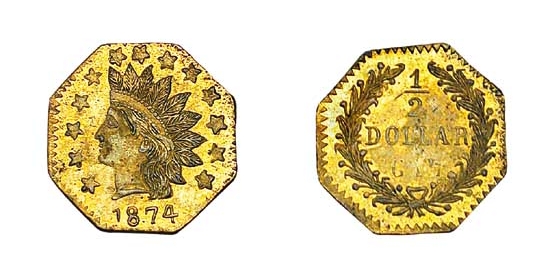
Obverse & Reverse
The 1874 BG-958A Gold Half Dollar is a product of the second period of California Fractional Gold production (1859-1882), a fascinating era that sought to address a chronic shortage of small-denomination coinage decades after the initial Gold Rush. The first period (1852-1857) saw hastily produced, often underweight coins that were eventually driven from circulation by public distrust and federal legislation in 1864 that outlawed private currency. However, the commercial needs of the West, particularly in California, remained unmet. The smallest circulating U.S. coin was the silver three-cent piece, and barter with gold dust was impractical for everyday transactions. This persistent demand led to a resurgence of private minting, but with a crucial distinction: to circumvent federal law, these new issues were not explicitly denominated as 'dollars' or 'cents'. Instead, they were often marked '1/2 DOL' or simply '1/2' and were intended to be sold as jewelry or souvenirs, though they inevitably found their way into local commerce as a convenient medium of exchange. The BG-958A, with its 'CALIFORNIA GOLD' inscription and depiction of an Indian princess, was a typical example of this period. Struck with more sophistication than their Period One counterparts, these pieces were machine-made with relatively standardized designs, often featuring either a Liberty head or an Indian head. The anonymous minters, likely jewelers and metallurgists in San Francisco, produced these tiny gold coins to meet a niche but very real economic need. Their existence is a testament to the lingering economic independence of California and the practical challenges of a bimetallic standard in a gold-rich region. The era of fractional gold finally concluded in the early 1880s as the supply of federal small change became sufficient to meet the demands of the West.
Associated EventPost-Gold Rush Economic Development in California
Reason For MintingTo provide a circulating medium for small transactions in California, bypassing federal laws against private coinage by being marketed as tokens or souvenirs.
Minter HistoryThe specific minter of BG-958A is unknown, a common characteristic for Period Two California Fractional Gold. Production during this time was dominated by several San Francisco-based jewelers and private manufacturers who often did not place their own identifying marks on the coins. Firms like Frontier, Deviercy & Co., and others are known to have produced similar items, and it is likely that one of these entities, or a direct successor, was responsible for this piece. They operated in a legal gray area, producing items that functioned as currency but were technically manufactured as charms or keepsakes to avoid federal prosecution.
Historical SignificanceThe BG-958A represents the mature phase of private currency in the American West, showcasing the persistent need for small change and the ingenuity of local businesses in meeting that demand. It is a tangible link to the daily economic life of post-Gold Rush California, reflecting a period of transition as the state's economy integrated more fully with the rest of the nation. Numismatically, it is a key representative of the popular Indian Head series of Period Two fractionals.
BG-958A
DenominationG50C (Gold 50 Cents)
Minting Period1874
Assayer/MinterUnknown Private Minter (Possibly Frontier, Deviercy & Co. or successors)
Geographic OriginSan Francisco, California
Obverse DescriptionA head of an Indian princess facing left, wearing a feathered headdress. The headdress is adorned with nine feathers, with the band inscribed LIBERTY, although the inscription is often illegible or weakly struck. The portrait is surrounded by 13 six-pointed stars.
Obverse InscriptionLIBERTY (on headdress band)
Reverse DescriptionThe denomination '1/2' is centrally located within an open wreath composed of two branches tied together at the bottom with a ribbon. The legend 'CALIFORNIA GOLD' appears above the wreath along the upper rim. The date '1874' is situated below the wreath, just above the lower rim.
Reverse InscriptionCALIFORNIA GOLD / 1/2 / 1874
CompositionGold
Stated Fineness Actual FinenessVaries, typically between .500 and .800 fine (12k to 19k gold).
Weight0.24 grams
Diameter9.70 mm
EdgePlain
Unknown
Survival Estimate500-750
Rarity ScaleR-4
BG-958A is highly popular due to its classic Indian Head design, affordability relative to rarer fractional issues, and its status as a tangible piece of Gold Rush-era history. It is a cornerstone piece for collectors building a representative set of Period Two California Fractional Gold.
Key VarietiesThe primary variety is the regular business strike (BG-958A). There are no known major die varieties from the original minting period. Crucially, collectors must be aware of the existence of restrikes. In the mid-20th century, numismatist Robert H. Bashlow acquired many of the original California Fractional Gold dies and produced a large number of restrikes, often in different metals. While interesting, these Bashlow Restrikes are not contemporary issues and hold significantly less value than original 1874 strikings. Additionally, countless modern replicas and counterfeit pieces exist. There are no known original Proofs or patterns for this issue.
Authentication TipsAuthentic BG-958A pieces have a characteristic 'look' from the original dies. Pay close attention to the shape of the numerals in the date and the style of the wreath. The stars on the obverse should be well-formed six-pointed stars, not crude blobs. The surfaces of genuine pieces, even when worn, should not exhibit the casting bubbles or soapy, indistinct details common on modern fakes. Many fakes are also the wrong weight or have a brassy, unnatural color. Comparing a prospective purchase to high-resolution images of certified examples is the most effective authentication method.
Shopping ConsiderationsA premium quality example for its grade will possess a sharp, well-centered strike. Weakness is common, particularly on the word 'LIBERTY' on the headdress and on the details of the wreath. Look for pieces with smooth, lustrous surfaces free of distracting marks, cleaning, or tooling. Original, uncleaned 'skin' with a nice reddish-gold or orange-peel texture is highly desirable and commands a significant premium. Avoid examples that have been used as jewelry, which often show evidence of soldering, harsh polishing, or rim damage. A smooth, problem-free surface with strong underlying luster is the goal.
A coin's grade is its condition, rated on a 1-70 scale. For rare coins, this is the most critical factor in determining value, as a tiny difference in preservation can mean a huge difference in price.
Relevant Grade TypesOriginal 1874 issues of BG-958A were business strikes intended for commerce or sale as souvenirs, and are found in Circulated (AU-58 and below) and Mint State (MS-60 to MS-70) grades. The vast majority of surviving examples are circulated. No Proof (PR/PF) examples were struck during the original period of issue. Later-date restrikes, such as those made by Robert Bashlow in the 1960s, are distinct numismatic items and should not be confused with original 1874 strikes.
Mint State CharacteristicsAn uncirculated BG-958A will display full, unbroken mint luster, which is typically frosty or satiny in appearance. Strike quality varies; many are softly struck in the centers, so a coin with a sharp 'LIBERTY' on the band and crisp wreath details is highly desirable. Due to their small size and handling in groups, even high-grade Mint State examples often show small, scattered contact marks. A 'gem' MS-65 or finer example would be exceptionally rare, exhibiting a nearly perfect strike and pristine, mark-free surfaces.
Circulated Wear PatternsWear first appears on the highest points of the design. On the obverse, this is the cheek of the Indian princess and the feathers of the headdress. On the reverse, the high points of the wreath's leaves and the ribbon bow will show initial friction and smoothing. In lower grades (VF and below), the word 'LIBERTY' becomes completely obliterated, the feathers merge, and the wreath details become flat and indistinct.
Key Factors For ValueThe primary drivers of value are grade and surface quality. An example with original, uncleaned surfaces will always be worth substantially more than a cleaned, polished, or damaged coin of the same technical grade. Sharpness of strike is a major consideration; a well-struck coin with full details is prized. Eye appeal is paramount—a coin with attractive, original toning and vibrant luster will command a significant premium over a dull or hazy specimen. For this issue, third-party certification by PCGS or NGC is virtually required for any significant transaction, and a CAC sticker indicating premium quality for the grade adds another level of desirability and value.
PCGS Price Guide
| Grade | Price | Population |
|---|---|---|
| 64 | $8,250.00 | 3 |
| 66 | N/A | N/A |